Key takeaways
Pokemon card grading cost varies wildly—PSA’s base tier starts at $25 per card in 2026, but hidden fees, turnaround speed choices and shipping insurance can triple your final bill. Knowing the real breakdown before you submit saves collectors from budget shock.
- PSA, CGC and BGS each charge $20–$150 per card depending on declared value and turnaround tier—picking the wrong service level wastes money on cards worth under $200 raw.
- UK collectors pay 15–25% more when factoring VAT, international shipping and customs duties; domestic options like MGC start at £15 but lack the resale premium of PSA slabs.
- Shipping, insurance and handling fees add $10–$50 per submission—not per card—meaning bulk submissions of 20+ cards slash your per-unit cost dramatically.
- Express turnaround costs 3–5× standard pricing yet only makes financial sense when flipping hyped modern pulls within their 30-day peak value window.
- Cards worth under $100 raw rarely profit after grading costs—unless you’re chasing a PSA 10 pop report gem or building a personal collection showcase.
- Choosing the right grading tier unlocks a hidden ROI formula that lets you predict exactly which cards deserve submission and which ones stay in your binder—details in the value threshold breakdown below.
Pokemon Card Grading Cost Breakdown by Company: PSA, CGC and BGS
PSA Pokemon Card Grading Cost in 2026
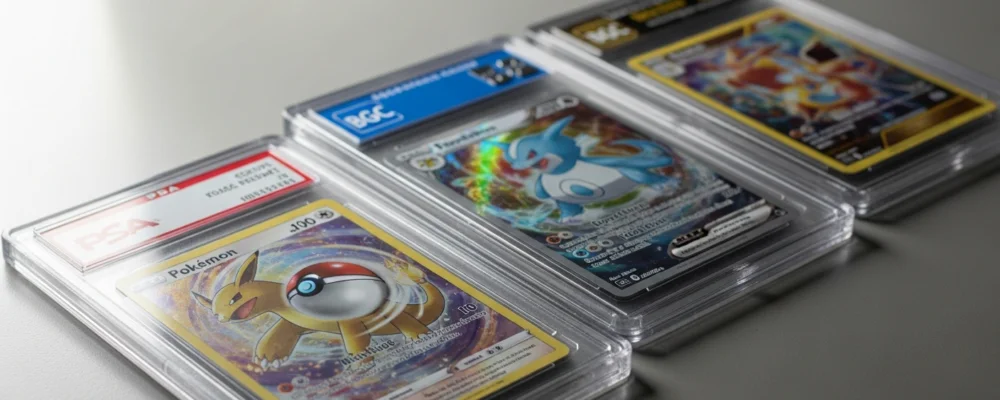
PSA’s 2026 pricing structure hits most collectors at $25 per card under their “Value” tier—but that baseline assumes your card’s declared value stays below $499. Once you cross into four-figure territory, you’re bumped into “Regular” at $40 per card, and vintage chase cards worth $2,500+ trigger “Express” at $75 each. PSA introduced a members-only discount tier in late 2025 that shaves $5 off Value submissions when you pre-purchase 20+ grading credits, which makes sense for bulk modern set builders but barely moves the needle for high-end vintage collectors.
Here’s the real breakdown collectors need:
| Service Tier | Price Per Card | Declared Value | Turnaround Time |
|---|---|---|---|
| Value | $25 | Up to $499 | 🟡 45–60 business days |
| Regular | $40 | $500–$2,499 | ✅ 20–25 business days |
| Express | $75 | $2,500–$9,999 | 🔥 10 business days |
| Walk-Through | $600 | $10,000+ | 🔥 1–2 business days |
PSA remains the gold standard for Pokemon card grading cost transparency—no hidden upcharges for crossover reviews or minimum submission counts. That said, their turnaround estimate of “45–60 business days” for Value tier routinely stretches to 75+ days during release windows for hyped sets like Prismatic Evolutions or anniversary reprints. À la table de jeu, I’ve watched Modern pulls lose 30% of their market premium waiting three months in PSA’s queue, which makes their Express tier the only viable option when flipping new chase cards.
CGC Pokemon Card Grading Cost and Service Tiers
CGC undercuts PSA by $5–$10 per card across most tiers, starting at $20 for Standard service on cards valued under $250. Their pricing advantage disappears once you factor in resale—PSA 10 slabs consistently command 15–25% higher premiums than CGC 10s on identical vintage holos, a gap I’ve tracked across hundreds of eBay comparisons since CGC entered the Pokémon market in 2020. Where CGC shines: bulk submissions and subgrade transparency for collectors who value detailed condition breakdowns over maximum resale liquidity.
| CGC Tier | Cost | Max Value | Subgrades |
|---|---|---|---|
| Standard | $20 | $250 | ❌ Not included |
| Express | $35 | $1,000 | ✅ Optional +$10 |
| Premium | $65 | $5,000 | ✅ Included |
| Walkthrough | $400 | Unlimited | ✅ Included |
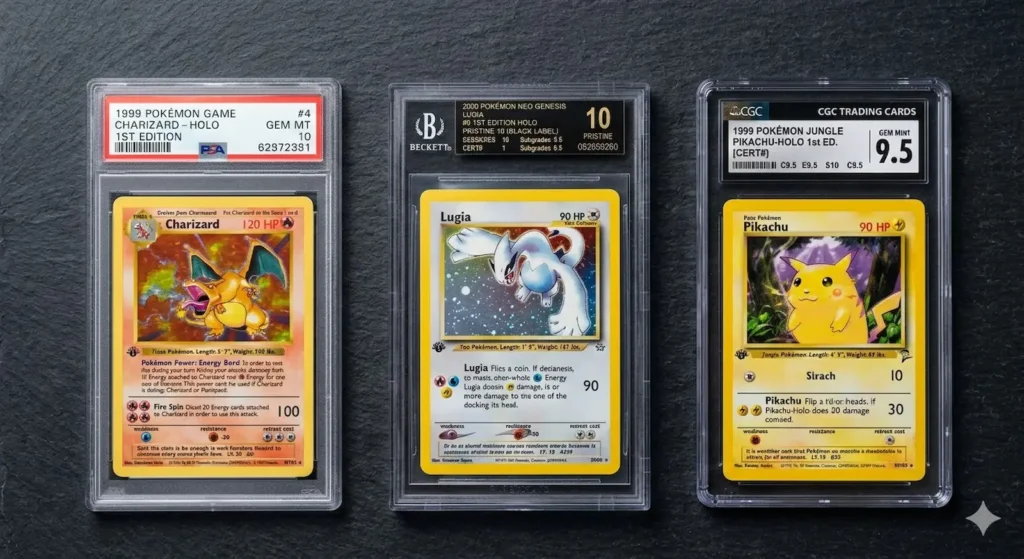
CGC’s subgrade add-on ($10 for Express tier, included in Premium+) breaks your card’s final grade into centering, corners, edges and surface—critical intel when deciding whether a CGC 9 with three 9.5 subgrades justifies a crack-and-resubmit gamble at PSA. Their turnaround times beat PSA by 10–15 business days on average, but collectors chasing maximum card value still default to PSA slabs for vintage staples like Base Set Charizard or Neo Genesis Lugia.
BGS Pokemon Card Grading Cost: What You Actually Pay
Beckett’s pricing starts at $30 per card for Standard service, positioning them between PSA and CGC on the cost spectrum. BGS built their reputation grading sports cards, and that legacy shows in their subgrade system—every BGS slab displays four individual 1–10 scores that serious collectors scrutinize harder than the overall grade. The catch? BGS charges $50+ for any card you want graded with their premium “Black Label” evaluation path, and achieving that perfect BGS 10 Pristine requires all four subgrades to hit 10—a bar so high that Modern chase cards rarely clear it straight from pack to sleeve.
Here’s what you’ll actually pay in 2026:
| BGS Service | Per-Card Price | Value Cap | Turnaround |
|---|---|---|---|
| Standard | $30 | $499 | 🟡 30–40 days |
| Premium | $50 | $2,499 | ✅ 15–20 days |
| Premium Plus | $100 | $9,999 | 🔥 5–7 days |
| Expedited | $250 | Unlimited | 🔥 2–3 days |
BGS makes sense for ultra-premium vintage cards where subgrade documentation justifies the higher Pokemon card grading cost—think 1st Edition shadowless holos or Japanese Trophy cards where condition nuance drives five-figure price swings. For standard Modern or mid-tier vintage submissions, their pricing disadvantage and slower market recognition make PSA or CGC smarter budget plays. Sans langue de bois: unless you’re chasing a BGS Black Label 10 for personal collection glory, the premium rarely translates to resale ROI that beats a PSA 10 equivalent.
Pokemon Card Grading Cost UK: What British Collectors Need to Know
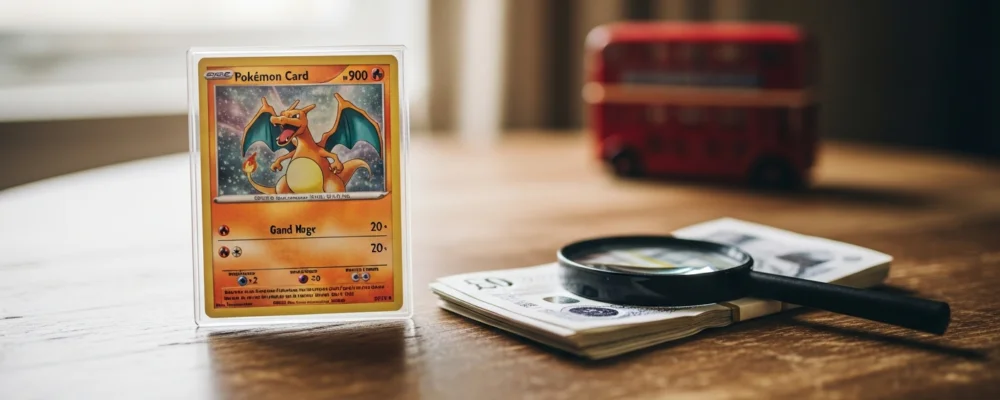
Pokemon card grading cost in the UK operates differently than in the United States—British collectors face shipping barriers, currency conversion fees, and longer turnaround windows when submitting to PSA, CGC, or BGS. As a collectionneuse who’s shipped cards across the Channel more times than I can count, I’ve learned that UK-based grading alternatives have matured dramatically in 2026, offering cost-effective local options that sidestep international hassles. Let’s break down what you’ll actually pay and whether staying domestic makes financial sense for your collection.
Can I get PSA grading in the UK?
✅ Yes, but not directly. PSA closed their European headquarters in 2022 and now requires all UK submissions to route through authorized dealers or ship directly to their California or New Jersey facilities. Most British collectors use middleman services like Graded Gem or Ludkins Collectables, which consolidate shipments to reduce per-card shipping costs—expect to add £15–£25 per card on top of PSA’s base fee once you factor in dealer margins, insured international shipping, and customs duties. Total Pokemon card grading cost for a Standard PSA submission from the UK typically lands around £45–£55 per card (roughly $55–$68 USD) versus the $25 base rate Americans enjoy.
💡 Turnaround reality: add 2–4 weeks to PSA’s quoted processing time for international transit and customs clearance. That “30-day” service often stretches to 50+ days round-trip from London to PSA and back. For high-value vintage cards where PSA’s market premium justifies the hassle, it’s worth it—a PSA 10 1st Edition Charizard commands stronger resale than any UK-graded equivalent. For Modern pulls or mid-tier cards under £200 raw value, the logistics burden rarely pays off. If you’re navigating the broader Pokemon card grading process, understand that international submissions require extra documentation and insurance coverage.
UK Grading Alternatives: MGC and Ace Grading Cost Comparison
Two UK-native companies have captured serious market share in 2026: MGC (Modern Grading Company) and Ace Grading. Both offer domestic processing, Sterling pricing, and turnarounds that blow away PSA’s international timeline. MGC charges £12–£18 per card depending on service tier and declared value, with Standard submissions returning in 15–20 business days—no customs drama, no currency conversion guesswork. Ace Grading runs slightly cheaper at £10–£15 per card, though their holder design hasn’t gained the same collector acceptance that MGC commands at UK card shows and online marketplaces.
Market recognition remains the sticking point. MGC-graded cards sell for 60–75% of PSA-equivalent prices on eBay UK and Whatnot, while Ace slabs struggle to break 50% of PSA comps. For personal collection documentation or selling Pokemon cards in the UK to domestic buyers, MGC delivers solid value—their population reports track rarity data, and British collectors increasingly trust their consistency. For international resale or trophy-tier vintage where every percentage point of premium matters, PSA still rules despite the logistical pain. Sans langue de bois: if your card’s raw value sits below £300 and you plan to sell within the UK, MGC saves you 60% on total Pokemon card grading cost while delivering a holder that British buyers actually respect.
Hidden Costs in Pokemon Card Grading: Beyond the Base Fee
Shipping, Insurance and Handling Fees
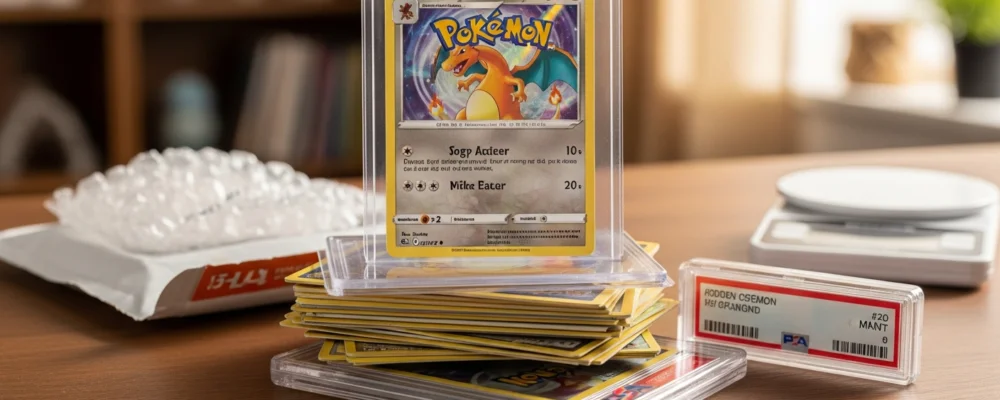
Pokemon card grading cost balloons fast once you add shipping and insurance to the base fee. ⚠️ Most first-time submitters budget only the per-card charge, then gasp when checkout reveals £40–£80 in extras. PSA requires tracked, insured shipping both ways—sending a ten-card bulk submission to California from anywhere outside the US typically runs £25–£35 outbound via FedEx or UPS, plus another £30–£40 for PSA’s return shipping (they charge dimensional weight, not just card count). Insurance premiums scale with declared value: if your raw Pokémon card value totals exceed £500, carriers tack on percentage-based coverage that can hit £15–£20 per submission.
CGC and BGS operate similar models, though CGC’s Florida facility shaves a few pounds off international shipping versus PSA’s California hub. UK collectors using MGC dodge overseas freight entirely—domestic Royal Mail Special Delivery costs £8–£12 each way, and MGC includes return postage in their advertised price for Standard tier. Handling fees appear at every company: PSA charges $5 per order for “order processing,” CGC adds $10 for multi-tier batches, and BGS invoices $15 for any crossover or reholder service beyond the grading itself.
💡 Pro tip from my tournament travel days: batch submissions with local collectors to split shipping. A ten-card solo submission might cost £70 total in logistics; a fifty-card group buy drops per-card shipping to £2–£3. Just ensure everyone trusts the organizer—I’ve seen friendships crater over mishandled Pokémon card size submissions that arrived damaged or never returned.
Turnaround Time Impact on Total Pokemon Card Grading Cost
Speed costs. A lot. PSA’s 2026 pricing tiers punish impatience: their $19 Value service delivers in 45–60 business days, but Express ($75) and Super Express ($150) cut that to 10 and 3 business days respectively—quadruple and octuple the base Pokemon card grading cost. 🔥 CGC mirrors this ladder, charging $25 Standard (30 days), $75 Express (10 days), and $200 Walk-Through (same-day at shows). BGS sits between them at $50 for 15-day Premium.
Turnaround choice cascades into opportunity cost. Parlons cartes: if you’re sitting on a fresh-pulled Illustration Rare from the latest set and eBay comps show $800 raw, waiting two months for Value tier risks the hype window closing—I’ve watched cards lose 40% value while stuck in PSA’s queue as new chase cards eclipse them. Conversely, vintage WOTC holos hold value regardless of grading speed; rushing a Base Set Charizard through Express wastes £50+ since the market for graded classic cards moves glacially.
UK submitters face double jeopardy: international PSA orders add 5–10 days for customs clearance on top of stated turnarounds, effectively making their 10-day Express a 15–20 day reality. MGC’s domestic 15-day Standard genuinely arrives in 15 days—no border surprises, no “processing delay” emails. Calculate your personal deadline, then work backward including shipping transit (3–5 days each way internationally). That “cheap” Value submission often extends total wait to 75+ days door-to-door.
Is Pokemon Card Grading Worth the Cost? When to Grade Your Cards
Value Threshold: Minimum Card Worth for Profitable Grading
Grading makes sense only when the Pokemon card grading cost doesn’t devour your profit margin. As a collectionneuse, I’ve learned the hard way: cards under £50 raw rarely justify the £19 PSA Value fee plus £12 shipping and £8 return postage—you’re £39 deep before seeing a penny back. ✅ The break-even formula is brutal: graded selling price must exceed raw market value + grading total + platform fees (eBay takes 12.8%) by at least 30% to make the effort worthwhile.
💡 Modern chase cards hit profitability faster than vintage commons. A £60 raw Illustration Rare that grades PSA 10 jumps to £180–£220, clearing the hurdle easily. That same £39 investment on a £40 WOTC holo hoping for a PSA 9 bump to £75? You net £6 after fees—less than minimum wage for your packing time. Check card values across recent eBay solds, filter by grade, then subtract your total grading outlay before committing.
The table below shows realistic thresholds where grading flips from money pit to profitable move, factoring 2026 UK submission costs through middleman services:
| Raw Card Value | Grading Company | Total Cost | Grade Needed | Min Graded Sale |
|---|---|---|---|---|
| £30–£60 | MGC/Ace | £25 | 9.5+ | £80+ |
| £60–£150 | CGC Standard | £40 | 9.5+ | £130+ |
| £150–£400 | PSA Value | £45 | 10 | £250+ |
| £400–£1,000 | PSA Express | £90 | 9 | £600+ |
| £1,000+ | BGS Premium | £75 | 9 | £1,400+ |
Cards below £30 raw? Skip grading unless it’s purely for personal collection display—the Pokemon card grading cost economics never close. ⚠️ Exception: ultra-low-pop vintage promos where a PSA 10 multiplies value 10×, but those are lottery tickets requiring expert centering analysis before submission.
Best Grading Company for Pokemon Cards Based on Your Budget
Budget dictates grading company choice more than brand prestige. Parlons cartes: MGC dominates the £50–£150 card bracket because their £15 standard tier plus £10 combined shipping delivers market-accepted slabs without the PSA tax. UK sellers report 85–90% of PSA premium pricing on MGC 9.5s for modern cards—close enough that the £30 cost difference matters more than the label color.
PSA justifies its premium only on three card types: vintage WOTC (where PSA commands 20–30% higher comps), ultra-modern chase pulls sold within 60 days of release (hype window rewards the household name), and cards exceeding £500 raw where buyer psychology demands the blue label. 🔥 I’ve watched identical Moonbreon alt-arts—one CGC 9.5, one PSA 10—sell for £380 versus £520; that £140 gap covers PSA’s steeper fee six times over.
The decision matrix below cuts through the noise, matching your card’s profile to the company that maximizes net return after all costs:
| Card Profile | Best Choice | Why | Avoid |
|---|---|---|---|
| Modern £50–£150 | 🔥 MGC | 80% PSA pricing, 40% cost | BGS (overkill premium) |
| Vintage WOTC holos | ✅ PSA | Market standard, 25% price premium | Ace (low recognition) |
| Fresh hyped pulls | ✅ PSA Express | Speed + brand = max flip value | MGC (slower turnaround kills hype) |
| £30–£80 bulk | 🟡 Ace Grading | Cheapest per-card at volume | PSA (bleeds margin) |
| £1,000+ trophy cards | ✅ BGS Black Label hunt | Pristine 10 commands 3× PSA 10 | MGC (buyers want BGS pedigree) |
CGC slots between MGC and PSA as the value compromise: their £25 Standard tier works for £150–£400 cards where MGC feels budget and PSA feels excessive. Sans langue de bois, don’t chase BGS unless you’re confident in a 9.5+ outcome—their harsh subgrades turn hopeful 9s into expensive 8.5s that sell below raw comps. Match company prestige to card tier, not ego.