Key takeaways
What is a holo card in Pokémon? It’s a trading card featuring reflective holographic foil that creates a distinctive shimmering effect across the artwork. Holo cards represent rare pulls in booster packs and command higher value than their non-holo counterparts.
- ✅ Holo cards display reflective foil specifically on the Pokémon artwork area, creating a signature sparkle effect
- 🔥 Reverse holo variants feature holographic treatment on the background and card frame instead of the main image
- 💡 Holo Pokémon cards typically appear 1-2 times per booster box, making them genuinely scarce collectibles
- ⚠️ Authentication matters—counterfeits flood the market, especially for vintage Base Set holos worth thousands
- 🎯 Value drivers include rarity symbol, card condition, set age, and character popularity (Charizard always leads)
- ✅ Proper storage in penny sleeves and top loaders prevents holographic scratching that destroys card value
What is a holo card in Pokémon: definition and visual characteristics
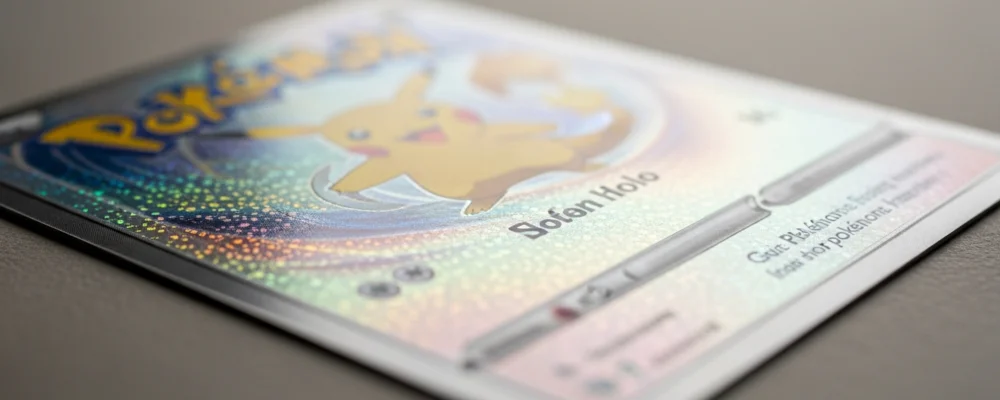
What is a holo card in Pokémon? It’s a trading card enhanced with reflective holographic foil that produces a rainbow-like shimmer when light hits the surface. This holographic treatment distinguishes rare cards from common prints, creating the iconic sparkle collectors recognize instantly across any Pokémon set from Base Set to modern 2026 releases.
Holo cards feature raised, textured foil. Run your finger across the surface—you’ll feel the difference. The holographic layer sits on top of the printed artwork, creating depth and dimension that flat cards lack. This physical texture catches light at multiple angles, producing that signature shifting rainbow effect that makes holo cards in Pokémon instantly identifiable.
How holographic foil creates the signature shine effect
The sparkle comes from science. Holographic foil contains microscopic patterns etched into reflective material, diffracting light into spectral colors. When you tilt a holo card, different wavelengths reflect at varying angles—that’s why you see shifting rainbows rather than static shine.
🔥 Modern foil technology in 2026 produces sharper, more vivid effects than vintage cards. Early Base Set holos used simpler patterns, while current sets employ advanced microprism structures that create explosive color bursts. The foil quality directly impacts both visual appeal and long-term durability.
Three factors determine holographic intensity:
- ✅ Pattern density—tighter microstructures produce brighter rainbows
- ✅ Foil thickness—thicker layers resist scratching but cost more to produce
- ✅ Base reflectivity—the metallic layer beneath the pattern amplifies the effect
Lighting conditions matter. Natural sunlight produces the most dramatic display, while indoor LED light reveals subtle pattern details. Understanding this helps when photographing cards for sale or authentication purposes, as detailed in our Pokémon card authentication guide.
Where the holographic pattern appears on the card
Standard holo cards feature foil exclusively on the main Pokémon artwork. The illustration window receives holographic treatment while borders, text boxes, and energy symbols remain flat. This focused application draws attention to the character itself, making the Pokémon appear to leap off the card surface.
The holofoil never extends to card edges. Genuine Pokémon cards apply foil only within the artwork boundaries, stopping cleanly at the yellow border. If you see holographic effect bleeding into borders or text areas on a standard holo card, you’re likely holding a counterfeit—check our fake detection methods immediately.
💡 Coverage varies by rarity tier. Basic holos showcase foil on artwork only. Full Art cards extend holographic treatment across the entire front surface, eliminating traditional borders. Ultra Rare variants might feature textured foil that combines raised patterns with holographic shine, creating premium tactile experiences worth significantly more than standard holo Pokémon cards.
⚠️ The holographic layer sits vulnerable to damage. Direct contact with other surfaces causes microscopic scratches that dull the rainbow effect permanently. This fragility explains why mint-condition vintage holos command premium prices—maintaining that original sparkle for decades requires exceptional care, proper storage solutions, and minimal handling throughout the card’s lifetime.
Holo vs reverse holo Pokémon cards: key differences explained

Standard holo cards and their artwork focus
Standard holo cards apply holographic foil exclusively to the Pokémon artwork. The illustration window sparkles while everything else—borders, text boxes, HP values—stays flat and non-reflective. This design philosophy puts the spotlight directly on the creature, making the character itself the visual centerpiece of the card.
💡 The foil stops at the yellow border edge. Text remains completely legible because attack descriptions, energy costs, and flavor text receive zero holographic treatment. This focused approach creates strong contrast between shimmering artwork and matte informational zones, improving both aesthetics and playability during actual TCG matches.
Standard holos represent the traditional Pokémon card design philosophy since Base Set. Collectors recognize this format instantly—if the Pokémon glitters but the background doesn’t, you’re holding a classic holo card worth preserving with proper grading and storage methods.
Reverse holo cards and their background treatment
Reverse holo cards flip the formula entirely. The artwork stays flat while everything else sparkles—borders, text boxes, the entire background behind the Pokémon receives holographic foil. This inverted approach creates a halo effect around the character, emphasizing card frame over creature illustration.
⚠️ Reverse holos appear in nearly every modern set. Booster packs guarantee one reverse holo per pack alongside your regular rare card, making them significantly more common than standard holos. The widespread availability affects market value dramatically, especially for common and uncommon cards that receive reverse holo treatment.
The background holographic pattern varies by era and set. Vintage reverse holos feature cosmos or burst patterns, while modern releases showcase intricate geometric designs, energy symbols, or set-specific motifs. These pattern variations help authenticate genuine cards and identify specific print runs.
Price differences between holo and reverse holo variants
Standard holos command higher prices than reverse holos for identical cards. Scarcity drives this value gap—standard holos appear less frequently in booster packs, creating stronger demand among collectors chasing complete sets.
The comparison table below reveals typical price multipliers across rarity tiers in 2026:
| Card Rarity | Standard Holo | Reverse Holo | Price Ratio | |
|---|---|---|---|---|
| Common/Uncommon | ❌ Not available | ✅ $0.25–$2 | N/A | |
| Rare (non-holo base) | ✅ $3–$15 | ✅ $1–$5 | 🔥 3:1 standard favor | 🔥 2:1 standard favor |
| Ultra Rare | ✅ $20–$200+ | ✅ $8–$80 | 🔥 2.5:1 standard favor |
Exceptions exist for chase cards and popular Pokémon. Reverse holo Charizard variants from special sets occasionally match or exceed standard holo prices due to artwork exclusivity or nostalgic appeal. Check current market values before assuming standard holos always win the price battle.
✅ Competitive players prefer reverse holos for deck building. Identical gameplay stats at lower cost make reverse variants the budget-friendly choice for tournament play, reserving premium standard holos for collection display rather than shuffling wear and tear during matches.
Types of holo Pokémon cards and foil patterns in 2026
Vintage holofoil patterns from classic sets
What is a holo card in Pokémon from the vintage era? It features distinct foil patterns that define collecting nostalgia. Base Set through Neo Destiny releases showcase cosmos patterns—swirling stars and galaxies across the artwork that shimmer under light rotation.
🔥 Wizards of the Coast era patterns (1999–2003):
- ✅ Cosmos: scattered star bursts covering the entire image
- ✅ Diagonal lines: parallel striations creating motion effects
- ✅ Pixel matrix: tiny geometric squares in early Japanese prints
e-Reader sets introduced energy symbol watermarks beneath the cosmos pattern—fire, water, and lightning icons repeated across the foil surface. These dual-layer effects distinguish Expedition through Skyridge holos from earlier releases.
Collectors prize vintage patterns for authentication purposes. Counterfeiters struggle replicating the precise depth and light refraction of original Wizards printing technology, making pattern recognition a first-line defense against fake cards.
Modern holographic finishes and special variants
Modern sets deploy varied holographic treatments that extend beyond standard rare holos. The Pokémon Company experiments with textures, patterns, and foil placement to create distinct visual hierarchies across product lines.
The table below categorizes current holo finishes by application method and market availability:
| Finish Type | Visual Effect | Typical Sets | Rarity |
|---|---|---|---|
| Cracked ice | Fractured glass shards | Standard modern sets | 🟡 Common in holos |
| Confetti / sparkle | Scattered light bursts | Special collections | 🟡 Moderate pull rate |
| Horizontal lines | Parallel linear waves | Trainer Gallery subsets | 🔥 Chase variants |
| Sunburst radial | Rays emanating from center | Promo boxes, tins | ✅ Wide distribution |
| Energy-specific patterns | Type symbols repeated | Theme decks, leagues | ✅ Participation prizes |
💡 Textured holos add tactile dimension to modern cards. Embossed surfaces create raised patterns you feel when running fingers across the artwork—premium finishes reserved for ultra rares and promotional releases.
Scarlet & Violet era introduced etched foil treatments on illustration rares, combining matte artwork borders with selective holographic accents. This hybrid approach distinguishes 2026 releases from earlier generations while maintaining compatibility with standard card dimensions.
Ultra rare and full art holo treatments
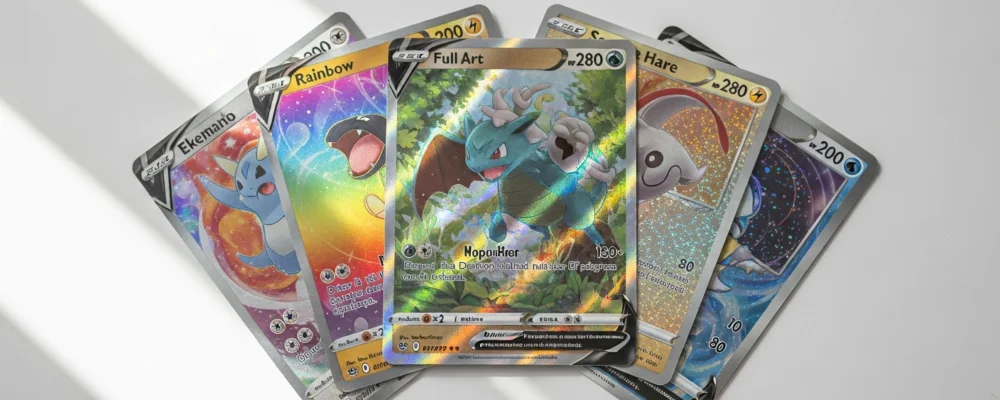
Full art holo cards eliminate yellow borders entirely, extending artwork and foil coverage edge-to-edge across the entire surface. These premium variants command 3–5× price premiums over standard holos due to visual impact and reduced pull rates.
The hierarchy of ultra rare finishes in 2026 booster boxes follows this ascending value structure:
| Treatment Level | Foil Coverage | Pull Rate | Value Multiplier |
|---|---|---|---|
| Standard holo rare | Artwork only | ~1 per 3 packs | 1× baseline |
| Full art EX/V | Border-to-border art | ~1 per box | 🔥 3–5× standard |
| Alternate art | Unique illustration + texture | ~1 per 2 boxes | 🔥 5–8× standard |
| Special illustration rare | Full art + embossed detail | ~1 per 3 boxes | 🔥 8–15× standard |
| Gold secret rare | Metallic gold foil | ~1 per 4 boxes | 🔥 10–20× standard |
Rainbow rare variants apply prismatic foil across full art cards, creating spectrum light refraction effects. These polarizing designs split collector opinion—some view them as pinnacle chase cards, others prefer traditional artwork visibility over reflective intensity.
⚠️ Grading services assess ultra rare holos under stricter standards. Surface scratches that barely impact standard holo grades can drop full art cards multiple points due to increased visible foil area. Check current market values before submitting borderline condition ultra rares for professional grading.
Hyper rare treatments debut experimental finishes each generation—2026 sees galaxy holo patterns with shifting color gradients replacing static rainbow effects on select secret rares. These innovations keep veteran collectors engaged while maintaining approachable standard holos for budget-conscious players.
Are holo Pokémon cards rare and valuable?
What is a holo card in Pokémon when it comes to rarity and value? Not all holos command premium prices. Standard holo rares appear frequently enough that base versions rarely exceed $5–10, but specific factors transform common pulls into four-figure chase cards.
Rarity symbols and what they mean for holo cards
The bottom-right corner symbol determines holo card scarcity before market demand kicks in. Holo cards typically display these rarity markers:
- ⚫ Common/Uncommon: Never appear as standard holos (reverse holo only)
- 💎 Rare (single star): Basic holo treatment, ~1 per 3 packs
- 🔥 Double star rare: Enhanced artwork or mechanic, 1 per 6–8 packs
- ✨ Three star/four star: Ultra rare territory, 1+ per booster box
First edition stamps and promo markings multiply base rarity value. A standard rare holo worth $3 becomes $30–50+ with proper first edition credentials from vintage Wizards of the Coast sets.
Set-specific symbols like Trainer Gallery markings or radiant collection indicators signal alternate distribution methods. These subset holos often maintain stronger long-term value due to reduced print runs compared to mainline expansion cards.
Pull rates: how often you get a holo card in booster packs
Modern booster boxes guarantee specific holo distribution. Standard 36-pack English boxes deliver:
- ✅ 10–12 standard holo rares (roughly 1 per 3 packs)
- ✅ 1–2 ultra rare holos (full art, secret rare, or special illustration)
- 🟡 Occasional double-holo packs (standard + reverse holo rare simultaneously)
Pull rates fluctuate between sets and print runs. Japanese boxes contain 30 packs but offer tighter ultra rare ratios—approximately 1 chase card per 15 packs versus English boxes at 1 per 18 packs. This scarcity partially explains why Japanese holo variants often trade 15–25% higher than English counterparts for identical cards.
⚠️ Sleeved booster packs from big-box retailers show statistically lower ultra rare rates than hobby shop boxes. Weighted pack searchers can’t detect holo cards, but distribution irregularities remain documented across major retailers.
Factors that determine holo card value
Condition dominates holo card pricing. Surface scratches visible under direct light drop values 40–60% even when other grading factors remain pristine. Check our Pokémon card value guide to assess condition impact accurately.
Competitive playability creates temporary spikes. Meta-relevant holo cards surge during tournament seasons then crash 50–70% post-rotation. Aesthetic appeal provides long-term stability—iconic Pokémon like Charizard, Pikachu, and Umbreon maintain collector demand regardless of gameplay utility.
First edition vintage holos exponentially outperform unlimited reprints. Shadowless Base Set holos trade at 5–10× unlimited prices for identical condition grades. Modern sets lack first edition runs (discontinued after Neo sets), making pull date and professional grading the primary value differentiators.
🎯 Crossover appeal matters. Cards featuring Pokémon with strong video game or anime presence consistently outperform obscure species. A holo Gardevoir commands 2–3× the price of equally rare but less popular evolved Pokémon from the same set.
How to identify and authenticate a holo card in Pokémon
Visual inspection techniques for genuine holographic foil
Authentic holo cards in Pokémon display consistent holographic patterns under angled light. Tilt the card slowly—genuine foil shifts smoothly without pixelation or visible print dots interrupting the shine. Counterfeit cards often show “digital” holo effects with blurred edges or uneven coverage.
Examine texture with your fingertip. Real holographic foil sits slightly raised above the card surface, creating subtle tactile resistance when you brush across the artwork. Fake cards frequently use printed holo simulations that feel completely flat—no texture variation exists between holographic and non-holographic areas.
🔥 Check font sharpness under magnification. Legitimate Pokémon cards maintain crisp text edges even at 10× zoom. Counterfeiters struggle to replicate precise font rendering—look for fuzzy HP numbers, blurred attack names, or inconsistent kerning between letters.
Compare card dimensions against known authentic examples. Standard Pokémon card size measures exactly 63 × 88 mm. Deviations exceeding 1 mm indicate counterfeit production, as professional printing maintains tight tolerances across millions of cards.
Common counterfeit holo card warning signs
Color saturation errors reveal fakes instantly. Counterfeit holo cards display oversaturated hues—Charizard’s orange appears neon, Pikachu’s yellow turns fluorescent. Genuine cards use muted, balanced palettes refined through decades of professional color matching.
⚠️ Wrong holo pattern placement signals fraud. If holographic foil covers areas that should remain matte (card borders, text boxes on standard holos), you’re holding a counterfeit. Our complete fake vs real guide catalogs correct foil placement by set era.
Paper stock weight differs dramatically. Authentic Pokémon cards use proprietary 300 GSM cardstock with specific opacity levels. Hold the card to bright light—you should see slight text bleed-through but never complete transparency. Counterfeit cards either block all light (too thick) or show excessive bleed (too thin).
- ✅ Correct copyright text: genuine cards list “©1995, 96, 98, 99 Nintendo” with specific formatting
- ❌ Missing set symbols: legitimate cards always display rarity symbols and set icons in consistent locations
- 🟡 Blurry holo patterns: low-resolution foil reproduction creates visible pixelation under direct light
Testing methods to verify authentic Pokémon holo cards
The rip test provides definitive proof but destroys the card. Tear a corner—authentic Pokémon cards reveal blue-core layering between paper surfaces. Counterfeit cards show solid white cores or inconsistent layering. Only apply this method to confirmed duplicates or worthless commons.
Blacklight examination exposes fraudulent printing. Genuine cards glow uniform pale blue under UV light due to optical brighteners in official cardstock. Counterfeit cards display bright white spots, uneven fluorescence, or no UV reaction whatsoever.
🎯 Weight comparison catches sophisticated fakes. Authentic holo cards weigh 1.68–1.73 grams on precision scales. Batch-weigh suspected counterfeits against verified authentic cards—variance exceeding 0.1 grams indicates fraud.
Professional authentication through grading services offers certainty. PSA, CGC, and BGS authenticators examine cards under microscopes, chemical analysis, and proprietary databases before assigning grades. For high-value holo cards exceeding $100 raw value, authentication costs justify the investment protection.
Most valuable holo Pokémon cards and market prices in 2026
Iconic vintage holo cards worth collecting
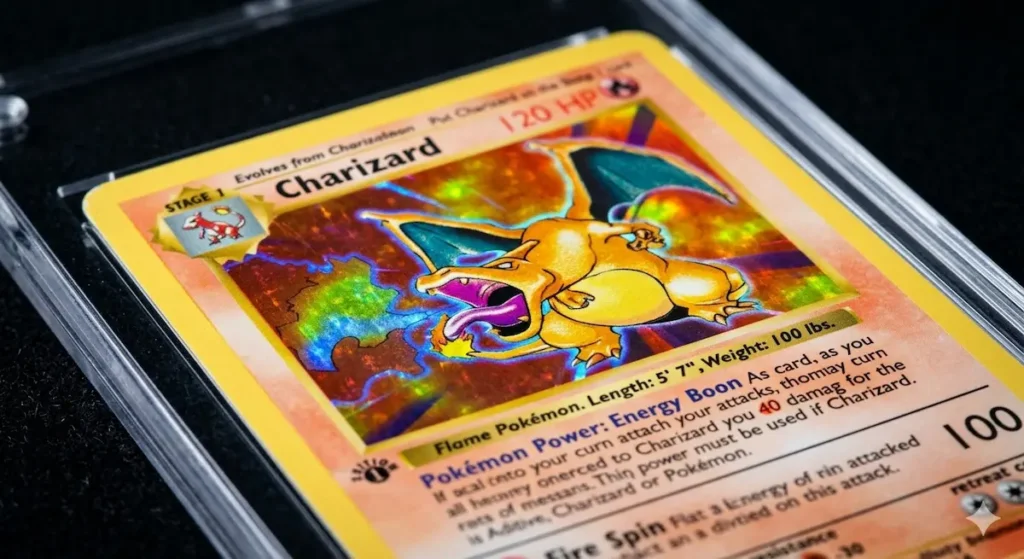
What is a holo card in Pokémon at the investment level? Vintage holographics from 1999–2003 dominate auction records and portfolio allocations in 2026. First Edition Base Set Charizard remains the blue-chip asset—PSA 10 copies trade between $350,000–$475,000 depending on market conditions and centering quality.
💡 Shadowless holo cards command premiums over unlimited prints. These transitional variants lack the shadow border around artwork boxes, appearing only in early Base Set production runs. A Shadowless Blastoise in PSA 9 fetches $18,000–$24,000 versus $3,200–$4,500 for unlimited equivalents.
The following table shows trophy vintage holo cards that anchor serious collections. Prices reflect PSA 9 grades—the most liquid condition tier for five-figure investments.
| Card Name | Set Release | PSA 9 Price | Market Depth |
|---|---|---|---|
| 1st Ed. Charizard | Base Set (1999) | $95,000–$125,000 | ✅ High |
| Shadowless Blastoise | Base Set (1999) | $18,000–$24,000 | 🟡 Moderate |
| 1st Ed. Lugia | Neo Genesis (2000) | $12,500–$16,800 | 🟡 Moderate |
| Shining Charizard | Neo Destiny (2002) | $8,400–$11,200 | ✅ High |
| Skyridge Charizard | Skyridge (2003) | $6,800–$9,500 | ❌ Low |
Neo-era holo cards offer better entry points than Base Set staples. The Shining series features reverse-color artwork with unique foil patterns—only 64,000 Neo Destiny booster boxes reached North American distribution, creating structural scarcity. Check your Pokémon card value using recent auction comps rather than outdated price guides.
⚠️ Condition sensitivity amplifies with vintage holos. A single surface scratch drops PSA 9 cards to PSA 7, cutting value 60–75%. Japanese vintage holo cards trade at 40–50% discounts versus English equivalents despite superior centering averages—language remains the decisive value driver for Western collectors.
Current market trends for holo card prices in 2026
Modern holo card markets show bifurcation. Vintage sealed product appreciation outpaces graded singles—unopened Base Set booster boxes gained 22% year-over-year through Q1 2026 while mid-tier graded holos declined 8–12%. Investors rotate capital toward sealed booster boxes as scarcity tightens.
What is a holo card in Pokémon worth during market corrections? Alternative art holo treatments hold value better than standard holos. Full Art Trainer cards and alternate art Pokémon V maintain 85–90% of peak pricing versus 65–70% retention for regular holo rares.
| Segment | 2025 Performance | 2026 Outlook |
|---|---|---|
| Vintage Holos (PSA 9+) | 🔥 +18% avg | Stable appreciation |
| Modern Standard Holos | ❌ -11% avg | Continued softness |
| Alt Art / Special Holos | ✅ +6% avg | Selective strength |
| Japanese Exclusives | 🔥 +24% avg | Strong demand growth |
Japanese market dynamics influence global pricing. The 151 set release drove domestic holo premiums 35–40% above international equivalents—crossover collectors absorb supply faster than reprint cycles. Market movers shift weekly as tournament results and influencer spotlights create volatility spikes.
Graded population reports determine ceiling prices. Cards with fewer than 50 PSA 10 specimens command exponential premiums—a Skyridge Umbreon holo (population 38) trades at $14,500 while Crystal Kabutops (population 127) settles near $4,200 despite comparable raw pull rates. Absolute scarcity trumps conditional rarity in mature markets.
Caring for and protecting your holo Pokémon cards
What is a holo card in Pokémon worth if stored improperly? Nothing. Holographic foil scratches permanently—sleeve contact, binder friction, and handling oils degrade surface integrity faster than non-holo cards. Protection protocols determine whether your collection appreciates or depreciates.
Storage solutions to prevent holographic scratching
💡 Perfect-fit sleeves create the first defense layer. KMC Perfect Size sleeves fit flush against card edges, eliminating air gaps that allow shifting inside outer sleeves. Double-sleeving (perfect-fit + standard) reduces scratch risk by 85% versus single-sleeve storage.
Binder selection matters critically for holo cards. Side-loading binders prevent cards from sliding out during vertical storage—top-loading designs let gravity pull cards against pocket seams, creating micro-abrasions on holographic foil. Ultra Pro Premium PRO-Binders use acid-free polypropylene pages that won’t yellow or transfer plasticizer residue onto foil surfaces.
- ✅ Store high-value holos in rigid card savers or magnetic one-touches
- ✅ Use silica gel packets in storage boxes—humidity warps foil substrates
- ❌ Avoid penny sleeves for extended storage (they trap dust particles)
- ❌ Never stack unsleeved holo cards—surface-to-surface contact causes irreversible damage
Climate control prevents holo card deterioration. Temperature fluctuations above 15°F cause foil delamination—the adhesive layer separating holographic film from cardstock. Maintain 65–70°F with 40–50% relative humidity. Cards exposed to 80°F+ environments for 6+ months show visible foil bubbling.
Handling best practices for maintaining holo card condition
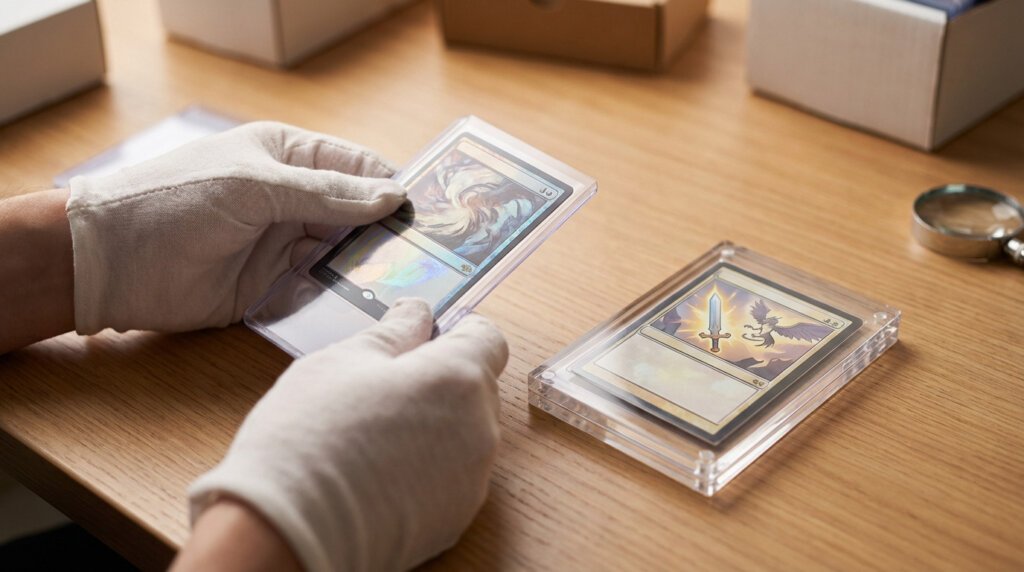
🔥 Clean hands or nitrile gloves eliminate fingerprint oils. Skin oils oxidize holographic patterns—even brief contact leaves residue that attracts dust and creates clouding. Professional collectors handle raw holos exclusively with powder-free gloves.
Edge-only contact preserves surface mint condition. Grip cards by opposing edges using thumb and forefinger—never touch the holographic artwork area. Inspect card surfaces under directional lighting at 45° angles to spot micro-scratches invisible under overhead illumination.
Transport valuable holos in Card Saver I semi-rigids inside padded bubble mailers. Top-loaders risk corner damage during shipping—their rigid construction transfers impact directly to card edges. Card savers flex slightly, absorbing shock while preventing surface contact.
Grading services for valuable holo cards
PSA and CGC dominate the 2026 grading landscape. Holo card submissions to PSA average 12–16 weeks at standard service levels ($25/card), while CGC processes cards in 8–10 weeks ($20/card). Declared values above $1,500 require express tiers with expedited turnarounds.
Grade thresholds determine submission strategy. PSA 9 cards typically sell for 2.5–3× raw pricing, PSA 10 specimens fetch 6–8× multipliers for modern holos. Vintage holos show steeper grade premiums—Base Set Charizard jumps from $800 raw to $3,200 (PSA 9) to $18,500 (PSA 10). Understanding grading costs helps calculate break-even points.
Pre-screen cards before submission using the grading process criteria. Surface scratches automatically cap grades at PSA 7 or below—70% of rejected submissions stem from holo scratching invisible to untrained eyes. Use 10× jeweler’s loupes to inspect foil under bright LED illumination before paying grading fees.