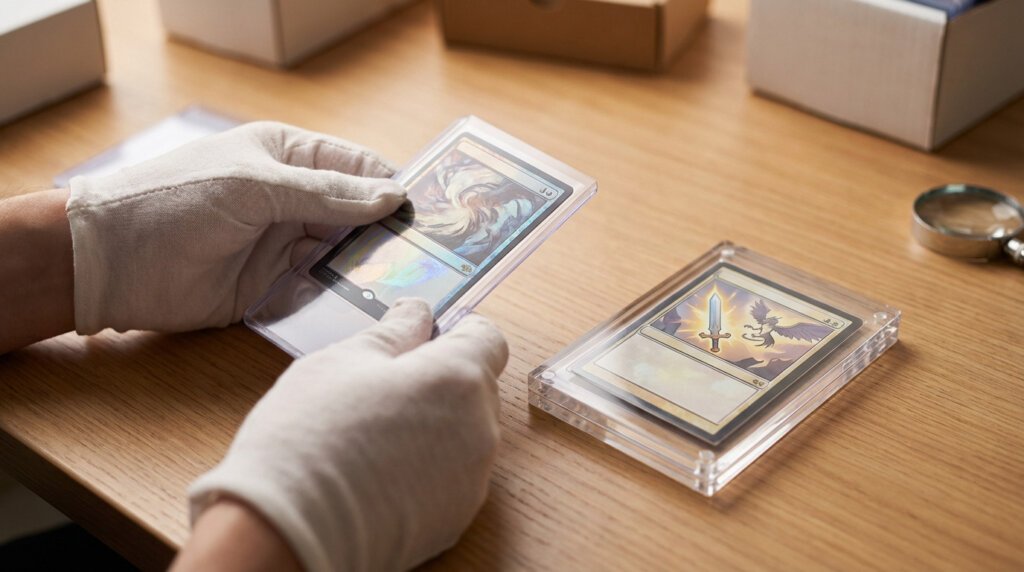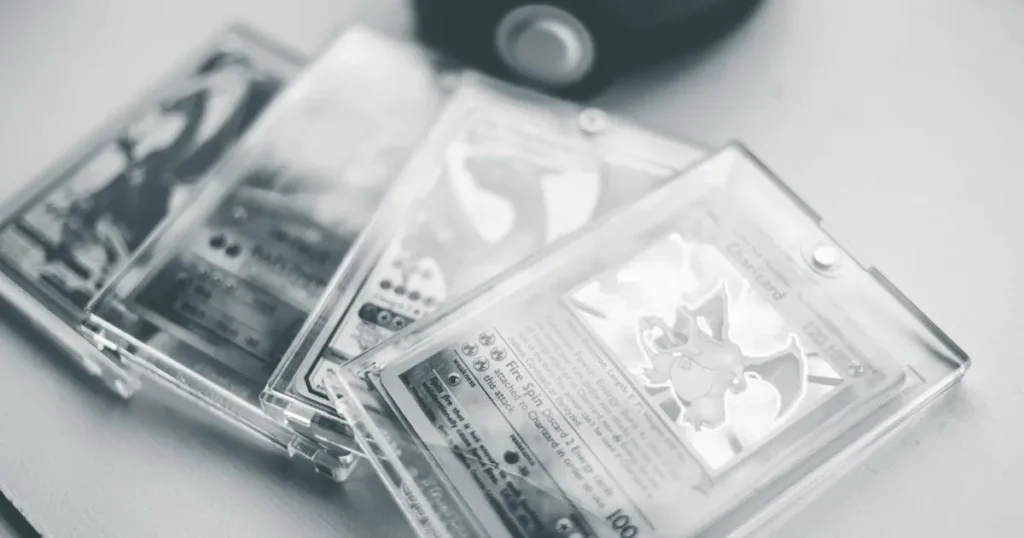
Key takeaways
Pokémon card value depends on rarity, condition, edition, and current market demand. Most cards are worth pennies, but rare first editions and graded mint cards can fetch thousands or even hundreds of thousands of pounds.
Understanding how to accurately check your collection saves time and maximizes profit. Here’s what you need to know:
- ✅ Identify set symbols and rarity markers before checking prices—these directly impact Pokémon card value
- 💡 Use free scanning apps and compare sold listings across multiple marketplaces for accurate valuations
- 🔥 Condition is everything—a graded mint card can be worth 10x more than a played copy
- ⚠️ First editions, shadowless prints, and promotional cards command premium prices over standard reprints
- 🎯 Not all valuable cards are obvious—some common-looking promos and error cards are worth serious money
- 💡 Professional grading costs £15-£100 but can multiply Pokémon card value significantly for high-end pieces
How to check your Pokémon card value in 3 simple steps
Step 1: Identify your card’s set, rarity, and edition
Pokémon card value starts with accurate identification. Flip the card over and locate the set symbol (bottom right corner near the card number). This icon tells you which expansion it belongs to—Base Set, Jungle, Fossil, or modern releases.
Check the rarity symbol next to it:
- ⚫ Circle = Common (usually pennies)
- 💎 Diamond = Uncommon (low value)
- ⭐ Star = Rare (potential value)
- 🔥 Three stars / special icons = Ultra Rare, Secret Rare (high value)
Look for edition markers on the left side. A “1st Edition” stamp or shadowless print (no shadow under the artwork box on early Base Set cards) dramatically increases Pokémon card value. Holographic cards with these features can be worth 5-50x their unlimited counterparts.
Write down the card number (e.g., “4/102”). This precision matters when cross-referencing prices—reprints and variants share names but differ hugely in worth.
Step 2: Assess the card’s condition and grading potential
Condition determines everything. A mint card sells for 10x more than a damaged copy—sometimes 100x for rare pieces.
Examine under good lighting:
- ✅ Edges: Sharp corners or rounded/white damage?
- ✅ Surface: Scratches, print lines, or clean holo?
- ✅ Centering: Is the border even on all sides?
- ✅ Back: Creases, stains, or pristine?
Use this quick scale before checking Pokémon card value:
- Near Mint = Looks pack-fresh, tiny flaws only under magnification
- Lightly Played = Minor edge wear, still displayable
- Moderately Played = Obvious wear, scratches, whitening
- Heavily Played = Creases, bends, major damage
Cards worth over £50 in Near Mint condition deserve professional grading. A PSA 10 grade can multiply value 3-20x versus raw copies. Authentic cards in top condition dominate the market—verify your cards are genuine before investing in grading.
Step 3: Compare prices across multiple marketplaces
Never trust a single source. Pokémon card value fluctuates wildly between platforms and regions.
Check these three categories:
- 💡 Sold listings on eBay UK (filter “Sold items” for real prices, not wishful asking prices)
- 💡 Price guide databases like TCGPlayer, Cardmarket, or PriceCharting (aggregated market data)
- 💡 Active marketplace listings on Facebook groups, Whatnot, or dedicated UK sellers
Take the median of 5-10 recent sales. Ignore outliers—one £500 sale doesn’t mean your card is worth that if ten others sold for £50.
Account for condition differences. A Near Mint sale at £100 means your Lightly Played copy is worth £40-60, not the full amount. Graded cards (PSA 9, CGC 8.5) command premiums—adjust raw card estimates down 30-50% from graded comparables.
Currency matters for UK collectors. US prices dominate online databases, so convert and factor in import duties when comparing international Pokémon card value benchmarks.
Best Pokémon card value checker tools and apps in 2026
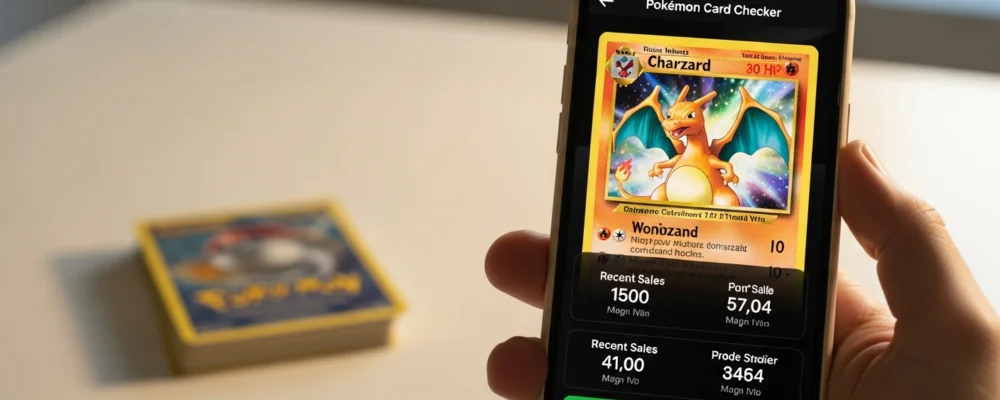
Free Pokémon card price checker apps with scanning features
Pokémon card value apps with camera scanning deliver instant estimates—snap a photo and get results in seconds. These tools suit bulk collections and casual checks.
Top free scanners in 2026:
- ✅ TCG Scanner – recognises cards via image, pulls TCGPlayer prices, works offline after initial download
- ✅ CollX (formerly Collectors) – iPhone/Android scanning, condition adjustment sliders, portfolio tracking
- ✅ CardMavin – database of 180,000+ Pokémon cards, barcode scanning for sealed products, UK price filters
Accuracy varies wildly. Scanners struggle with foreign-language cards, misprints, or damaged surfaces. Always cross-reference automated estimates against sold listings—apps typically show market average, not condition-specific Pokémon card value.
Most free apps limit scans (10-50/day) or push premium subscriptions. CollX allows unlimited scans but monetises through selling integrations. For serious valuation work, combine app convenience with manual database checks.
Online databases and price guide websites
Dedicated price guides aggregate thousands of sales. They beat apps for accuracy but require manual card entry.
The table below compares leading platforms for checking Pokémon card value across UK and international markets:
| Platform | Coverage | Data Source | UK Focus |
|---|---|---|---|
| TCGPlayer | 500,000+ cards | US marketplace sales | ❌ No |
| Cardmarket | European + UK | Direct seller listings | ✅ Yes |
| PriceCharting | Graded + raw cards | eBay sold data | 🟡 Partial |
| PWCC Marketplace | High-end auction sales | Verified auction results | ❌ No |
| eBay Price Guide | Comprehensive | 90-day sold history | ✅ Yes |
Cardmarket dominates European Pokémon card value research—prices display in GBP, EUR, or CHF, with seller ratings and condition filters. TCGPlayer excels for US comparisons but requires currency conversion for UK collectors.
PriceCharting tracks graded card premiums. Search “Charizard Base Set PSA 10” to see how grading multiplies value versus raw copies. This data informs grading decisions before spending £30-150 per card.
Pro tip: bookmark three databases. Check TCGPlayer for global trends, Cardmarket for actual UK selling prices, and PriceCharting for graded card benchmarks. Cross-reference eliminates platform-specific anomalies.
Marketplace sold listings for real-time Pokémon card values
Forget asking prices. Real Pokémon card value lives in completed sales—what buyers actually paid, not seller wishful thinking.
🔥 eBay UK remains the gold standard. Filter search results by “Sold listings” to see transaction history with dates, conditions, and final bids. Check the past 30 days for current market rates—older sales don’t reflect 2026 demand shifts.
Additional live marketplaces:
- Facebook Marketplace and UK Pokémon groups – negotiate directly, lower fees than eBay, harder to verify authenticity
- Whatnot – live auction app, real-time bidding reveals collector enthusiasm for specific cards
- StockX – graded cards only, transparent transaction data, instant sale option at market price
Compare at least 5 identical sales. One outlier doesn’t set value—a card selling for £200 once and £50 four times means the real Pokémon card value is £50. Ignore listings still active; they prove nothing until someone buys.
Watch for condition discrepancies. A PSA 9 Charizard at £800 doesn’t mean your raw Near Mint copy is worth the same—expect 40-60% of graded prices for raw cards. For authentication tips, review our fake versus real guide before listing valuable finds.
UK sellers should check both eBay.co.uk and eBay.com sold listings. US prices run 10-30% higher for vintage cards due to stronger demand, but international shipping and customs duties eat into profit margins. For selling strategies, explore where to sell Pokémon cards in the UK for maximum returns.
What makes a Pokémon card valuable: Key factors that determine worth
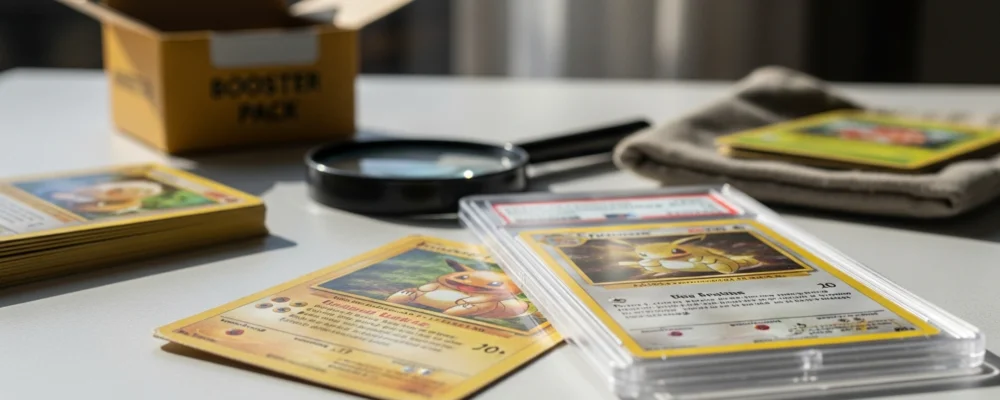
Pokémon card value hinges on three pillars: rarity, condition, and printing variant. Master these factors and you’ll spot a £5 bulk card versus a £5,000 investment piece in seconds. Collectors pay premium prices for cards that combine scarce availability with pristine preservation and historical significance.
The gap between a common Pikachu and a first-edition shadowless Base Set Charizard isn’t luck—it’s measurable attributes that determine market demand. Understanding what drives Pokémon card value lets you prioritize which cards deserve protective sleeves and which belong in trade binders.
Rarity symbols and what they mean for Pokémon card value
Check the bottom-right corner of every card. 🎯 That tiny symbol dictates your card’s baseline value before condition and edition enter the equation. Modern sets use a standardized rarity system that signals print run size and pack pull rates.
| Symbol | Rarity Level | Typical Value Range |
|---|---|---|
| ● | Common | £0.10 – £2 |
| ◆ | Uncommon | £0.25 – £5 |
| ★ | Rare | £1 – £20 |
| ★★ | Double Rare (Ultra) | £10 – £100 |
| ★★★ | Triple Rare (Secret) | £30 – £500+ |
Vintage cards (1999–2003) lack these symbols or use different markers. Holo cards from Base Set, Jungle, and Fossil rely on foil patterns and numbered sets to indicate scarcity. The absence of a symbol on early Japanese cards doesn’t mean low value—context matters with older releases.
Secret Rares (numbered above the set’s official count) command highest premiums. A card marked 203/202 signals secret status, often featuring alternate art, gold borders, or rainbow foil treatments. These variants increase Pokémon card value by 5–20× compared to standard versions of the same character.
Condition grading: PSA, CGC, and Beckett scales explained
Raw cards lose 40–70% of graded value. ✅ Professional grading authenticates your card and locks condition in tamper-proof cases that buyers trust. Three companies dominate the market, each using 10-point scales with crucial differences at the top end.
| Grade | PSA Term | Market Impact |
|---|---|---|
| 10 | Gem Mint | 🔥 2–5× PSA 9 price |
| 9 | Mint | ✅ Strong collector demand |
| 8 | Near Mint-Mint | 🟡 50–70% of PSA 9 |
| 7 | Near Mint | ❌ 30–50% of PSA 9 |
| 6 or below | Excellent–Poor | ❌ Rarely worth grading |
PSA remains the market leader for vintage English cards—their population reports and brand recognition drive liquidity. CGC appeals to budget-conscious submitters with faster turnaround times and consistent modern card grading. Beckett’s Black Label (pristine 10) represents the hobby’s ultimate grade, awarded to fewer than 1% of submissions.
Grading fees range from £15 (bulk economy) to £150+ (express 2-day), so calculate whether potential value increases justify the cost. A card worth £50 raw shouldn’t pay £100 to grade—even a PSA 10 won’t recoup expenses. For detailed grading economics, explore our complete grading process guide.
Centering matters most. Inspectors measure border widths—cards with 55/45 or worse front/back centering rarely achieve PSA 10. Surface scratches, edge whitening, and corner wear drop grades instantly, making proper storage critical from the moment you pull a valuable card.
First editions, shadowless prints, and special variants
💡 Print timing multiplies base value by staggering amounts. First-edition stamps (small “1st Edition” logo left of card art) signal initial production runs with lowest print numbers. Shadowless Base Set cards—printed without drop shadows around the card border—represent the second wave from 1999 and command 3–10× unlimited edition prices.
Japanese cards carry different premium logic. No Rarity Symbol cards from early Japanese sets fetch higher prices due to limited distribution outside Asia. Trophy cards awarded at official tournaments exist in quantities under 100 copies—some in single digits—making them six-figure treasures.
Modern equivalents include Illustration Rares (textured full-art), Special Art Rares, and regional exclusives from Pokémon Centers. These variants boost Pokémon card value by appealing to completionists who chase every version of popular Pokémon like Charizard, Pikachu, or Umbreon.
Error cards occupy a niche market. Misprints, wrong evolution stages, or missing HP values create accidental scarcity, though values vary wildly based on notoriety and collector interest. Document errors thoroughly before claiming premium pricing—casual print variations rarely justify inflated asks.
How to know if you have a valuable Pokémon card: Red flags and indicators
High-value sets and years to look for
Pokémon card value spikes dramatically in specific sets from 1999–2003. Base Set, Jungle, Fossil, and Team Rocket represent the original era when print runs stayed small and quality control varied wildly. Cards from these expansions—especially first editions—routinely exceed £500 even for moderately played copies.
Neo Genesis through Neo Destiny (2000–2002) house undervalued gems. Shining Pokémon from these sets fetch £2,000+ in PSA 9, yet raw copies often sit in childhood collections unnoticed. ✅ Expedition, Aquapolis, and Skyridge closed the e-Reader era with microscopic distribution, making every holo card a potential four-figure asset.
Modern danger zones include Hidden Fates (2019), Shining Fates (2021), and Evolving Skies (2021). Their “Baby Shinies” and Alternate Art cards hold £100–£800 ranges, while 151 (2023) reprints command premium pricing due to nostalgic artwork. Japanese 25th Anniversary sets contain gold-stamped classics worth checking against current market data.
- 🔥 Base Set (1999): Charizard, Blastoise, Venusaur holos
- Skyridge (2003): Crystal Pokémon, reverse holos
- EX era (2003–2007): Gold Stars, ex cards
- Black & White (2011–2013): Full Arts, Secret Rares
Chase cards and promotional releases worth checking
💡 Promo cards bypass set distribution entirely. Pokémon Center exclusives, pre-release promos, and event giveaways create artificial scarcity that multiplies Pokémon card value. The Pikachu Illustrator trophy card sold for £4.2 million in 2022, but accessible promos still deliver returns.
Movie theater distributions from Japan—especially Ancient Mew variants—range from £20 to £300 depending on language and corrected errors. McDonald’s collaboration sets seem worthless until you discover sealed 25th Anniversary packs trading at £40 each.
Championship deck exclusives reward tournament attendance. World Championship cards feature unique backs and alternate artwork, yet playable versions of the same card tank in value. Verify authenticity before assuming rarity—counterfeit promotional cards flood resale markets.
- ❌ Avoid: League promos with unlimited reprints
- ✅ Target: Numbered promos (e.g., “025/SM-P”)
- 🟡 Research: Sealed promo blisters vs. loose cards
Common cards that are actually worth money
Reverse holos from specific sets defy bulk pricing. Legendary Collection reverse-holo commons trade at £15–£50 due to nostalgic foil patterns. Certain Trainer cards—Computer Search (Ace Spec), Tropical Beach (Worlds promo)—eclipse rare Pokémon in competitive demand, pushing prices past £200.
Error commons break all rules. The Blastoise Commissioned Presentation card exists as a “common” with million-dollar valuations due to prototype status. More accessible errors like pre-release Raichu or no-damage Ninetales command £300–£1,200 verified prices.
Pokémon card value hides in bulk commons from McDonald’s 2021 25th Anniversary sets. Pikachu and starter Pokémon holos reach £8–£25 despite “common” pull rates, while misprinted non-holos that should display foiling sell for triple standard versions.
Check every Trainer card from Base through Neo sets. Item Finder, Pokémon Breeder, and energy removal cards rarely get second looks, yet first-edition shadowless copies hit £40–£80 in Near Mint condition—far above typical common expectations.
Pokémon card value by region: UK, US, and international price differences
Pokémon card value fluctuates wildly across borders. A card fetching £200 in London might sell for $180 in New York—not equivalent once converted. Regional demand, grading service availability, and currency volatility create pricing gaps collectors exploit for profit or fall victim to when selling internationally.
🔥 US markets dominate high-end sales. PSA headquarters in California and major auction houses in New Jersey concentrate serious buyers, inflating prices 15–30% above UK equivalents for graded vintage cards. Japanese markets favour domestic releases, paying premiums for Japanese-exclusive promos while discounting English prints.
European collectors face fragmented markets. German and French cards carry language-specific valuations—German first-edition Base Set Charizard trails English versions by 40–60% despite identical rarity. UK prices split the difference between US highs and EU lows, with Pokémon card value often middling at 10–20% below American PWCC sale records.
Currency conversion and market demand variations
Exchange rates deceive. Today’s £1 = $1.27 conversion makes US listings appear cheaper, yet shipping, import fees, and PayPal conversion charges erase savings. Track actual landed costs—a $150 card becomes £135 after fees, negating the £118 direct conversion advantage.
✅ Monitor eBay’s currency toggle: same card, different regional listings
❌ Ignore shipping tiers: US to UK adds £25–£40 for tracking
🎯 Check TCGPlayer (US), Cardmarket (EU), UK-specific platforms for triangulation
Demand spikes regionally. Pikachu Illustrator peaks in Japan at ¥45M (£235K), while US sales plateau near $200K. UK buyers chase WOTC nostalgia—Base Set, Jungle, Fossil—over modern Japanese alt-arts that command premiums in Tokyo.
Where to sell for maximum Pokémon card value
US auctions yield highest returns for PSA 10 graded chase cards. Heritage, PWCC, and Goldin attract serious money—expect 20–35% higher hammer prices than UK equivalents. Fees run 15–25%, but liquidity justifies costs for cards exceeding £1,000.
UK sellers maximize Pokémon card value through eBay.co.uk for mid-tier cards (£50–£500). Lower fees than US eBay, faster shipping, and GBP-native buyers eliminate conversion losses. Specialized UK dealers offer instant cash at 60–75% market rate—ideal for bulk or ungraded inventory.
💡 Facebook groups and Discord servers bypass fees entirely. Vetted UK communities like “Pokémon TCG UK Trading” move £100–£1,000 cards in 24–48 hours at near-market prices. International shipping remains viable for ultra-rare cards where a £500 FedEx cost means nothing against a £50K sale.
Most valuable Pokémon cards to watch in 2026
Cards worth £1,000 to £10,000: Accessible investments
Pokémon card value in this range offers entry-level serious collecting. 💡 Graded vintage holos, modern alt-arts, and first-edition non-chase cards dominate. Most see 5–15% annual appreciation when PSA 9+ graded.
Base Set Charizard (unlimited) in PSA 9 trades at £1,200–£1,800. Not rare, but iconic—demand never fades. Skyridge Charizard holo (PSA 8) pushes £3,500 thanks to low pop counts. Gym Heroes first-edition Giovanni’s Gyarados (PSA 10) hits £2,000, under-recognized outside UK/EU markets.
Modern cards with staying power: Giratina VSTAR alt-art (Lost Origin) at £600 raw, £1,400 PSA 10. Umbreon VMAX alt-art (Evolving Skies) holds £1,800–£2,400 graded. These modern chase cards attract new collectors—liquidity exceeds vintage counterparts.
| Card | Condition | 2026 Range (£) | Trend |
|---|---|---|---|
| Base Set Charizard (unlimited) | PSA 9 | £1,200–£1,800 | 🟡 Stable |
| Skyridge Charizard holo | PSA 8 | £3,200–£3,800 | 🔥 Rising |
| Umbreon VMAX alt-art (Evolving Skies) | PSA 10 | £1,800–£2,400 | ✅ Strong |
| Lugia ex (Unseen Forces) | PSA 8 | £1,500–£2,200 | 🟡 Steady |
| Japanese Neo Genesis Lugia | PSA 9 | £800–£1,100 | ✅ Undervalued |
⚠️ Avoid unlimited Base Set commons—even PSA 10 Machamp caps at £80. Focus on holo cards from sets with print-run constraints: Skyridge, Aquapolis, Crystal-type Pokémon. Japanese exclusive promos (Masaki Gengar, Tropical Mega Battle winners) climb steadily—£4,000–£8,000 PSA 9 for TMB cards in 2026.
Ultra-rare cards exceeding £100,000 in value
❌ These aren’t investments—they’re trophies. Pokémon card value here hinges on provenance, perfect grades, and collector ego. Only PSA 10 examples matter; PSA 9 drops value 60–80%.
Pikachu Illustrator leads at £200K–£300K for PSA 7–8 copies. PSA 10? Last sale: ¥50M (£260K) in Tokyo, 2025. Only 39 graded copies exist worldwide. Shadowless first-edition Charizard PSA 10 trades £150K–£220K—83 known copies drive scarcity premium over 121-pop Base Set first-edition PSA 10s (£80K–£120K).
Trophy Pikachu cards (No. 1, 2, 3 Trainer) command £100K–£180K PSA 9. Gold Star Pokémon in PSA 10—Charizard, Rayquaza, Mew—range £40K–£80K. University Magikarp, Master’s Key, Tropical Wind first-edition: £25K–£60K depending on grade. Million-dollar territory remains theoretical outside auction spikes.
| Card | Grade | 2026 Estimate (£) | Pop Count |
|---|---|---|---|
| Pikachu Illustrator | PSA 7–8 | £200K–£300K | 🔥 39 total |
| Shadowless 1st Ed Charizard | PSA 10 | £150K–£220K | 🔥 83 copies |
| Base Set 1st Ed Charizard | PSA 10 | £80K–£120K | 🟡 121 copies |
| Trophy Pikachu (No. 1 Trainer) | PSA 9 | £120K–£180K | ✅ 7 known |
| Gold Star Charizard (Dragon Frontiers) | PSA 10 | £60K–£80K | 🟡 41 copies |
🎯 Authenticity risk spikes here. Counterfeiters replicate Illustrator, TMB promos, Trophy cards—use verification guides and buy only encapsulated PSA/CGC examples. Ungraded ultra-rares? Assume fake until proven otherwise. Insurance and secure storage become non-negotiable—standard card sleeves won’t cut it for six-figure cardboard.
Common mistakes when checking Pokémon card value and how to avoid them
Pokémon card value estimates collapse when collectors rush checks without proper research. Speed kills accuracy. Common pitfalls inflate expectations or miss genuine treasure—both waste time and money. Here’s how to dodge the worst valuation traps.
❌ Relying on a single price source skews results. One marketplace listing doesn’t define Pokémon card value—sellers often anchor prices to outlier sales or wishful thinking. Cross-reference TCGPlayer, eBay sold listings, and Cardmarket to establish true range. Single-source pricing overvalues cards by 30–60% on average.
🟡 Ignoring condition nuances destroys projected worth. “Near Mint” means different things to different buyers. Whitening edges, surface scratches, centering issues—each knocks 20–40% off ungraded Pokémon card value. Use a jeweller’s loupe and compare against professional grading standards before quoting six-figure sums. Most self-assessed “Mint” cards grade PSA 7–8, not PSA 10.
⚠️ Confusing reprints with originals happens constantly. Evolutions Charizard mimics Base Set artwork but trades £15–£30, not £300+. Check set symbols, copyright dates, and print quality. Fake cards flood the market—authenticating before valuation saves embarrassment and cash.
- ✅ Verify population reports: Low PSA/CGC pop counts = scarcity premium. High pop? Market saturation kills value.
- ✅ Factor in regional demand: Japanese cards often command different premiums than English equivalents.
- ✅ Account for grading costs: £150–£250 per card erases profit on sub-£500 raw cards.
- ❌ Never trust unverified “rare error” claims: 99% are print variations, not errors. True errors need documented precedent.
💡 Timing matters. Checking Pokémon card value during set-release hype inflates prices 40–70% above stabilized rates. Wait 60–90 days post-launch for realistic comps. Panic-selling into crashes? You’ll hemorrhage 50% versus patient holds. Market cycles repeat—know where you stand before acting.
When to get your Pokémon cards professionally graded for maximum value
Grading costs versus potential Pokémon card value increase
Grading makes sense only when profit margins justify the expense. PSA Standard runs £60–£90 per card; CGC Regular costs £50–£70; Beckett Basic lands around £55–£75. Add shipping, insurance, and 90–180 day turnarounds. Budget £150–£250 total per card for most collectors. That upfront cost must deliver Pokémon card value gains exceeding £400 minimum to break even after selling fees.
Raw near-mint cards trading £100–£300 rarely justify grading. A PSA 9 might fetch 1.5× raw value—sounds promising until you subtract grading costs and marketplace fees. You lose money. Cards worth £500+ raw show better math: PSA 10 premiums often hit 3–5× raw prices, turning £800 raw cards into £2,400–£4,000 graded slabs. That £2,000 spread absorbs grading expenses and leaves profit.
The table below maps realistic grading economics across price tiers. 🔥 High-value candidates justify the investment; ❌ low-tier cards bleed cash even with perfect grades.
| Raw Value | PSA 10 Multiple | Graded Value | Net Profit | Verdict |
|---|---|---|---|---|
| £50–£150 | 2–3× | £100–£450 | -£50 to +£50 | ❌ Skip |
| £200–£400 | 2.5–4× | £500–£1,600 | £0 to +£200 | 🟡 Marginal |
| £500–£1,500 | 3–5× | £1,500–£7,500 | +£600 to +£5,000 | ✅ Recommended |
| £2,000+ | 4–8× | £8,000–£50,000+ | +£5,000 to +£40,000+ | 🔥 Essential |
💡 Turnaround speed matters for trending cards. Express grading costs £200–£400 but locks in 10–20 day results. Use it when hype windows close fast—new set chase cards, viral TikTok spikes. Standard service suits stable vintage holdings where 6-month waits don’t kill momentum.
Which cards are worth the grading investment
First Edition Base Set holos always grade. Charizard, Blastoise, Venusaur, Chansey—raw PSA 9 candidates worth £800+ justify grading even at premium tiers. Shadowless holos follow the same logic. Population reports show PSA 10 copies command 6–10× raw multipliers, turning £1,200 raw Charizards into £12,000 slabs. Master the Pokémon card grading process before submitting these blue-chip cards to maximize your returns.
Modern chase cards need stricter filters. Send only pack-fresh pulls you sleeved immediately. Pokémon card value collapses on anything below PSA 9 for modern releases. Check centering under bright light: if borders show 60/40 or worse front-to-back, you won’t hit PSA 10. Surface scratches from factory handling? PSA 8 ceiling. Save grading fees for visibly flawless specimens.
- 🎯 Vintage holos (1999–2003): Base Set, Jungle, Fossil, Rocket, Neo series. Grade any NM+ copy worth £300+ raw.
- 🔥 Gold Star cards: Low population counts and collector obsession push PSA 10 multipliers to 8–12×. Grade everything.
- ✅ Trophy cards and promos: Tournaments, staff releases, regional exclusives. Authenticity certification alone justifies costs.
- ⚠️ Modern Alt Arts and SIRs: Grade only if raw value exceeds £400 and centering measures 55/45 or better.
Avoid grading unlimited commons, damaged vintage, or reprints. A graded Evolutions Charizard PSA 10 sells £60–£90—you lose £100 on grading fees. Focus capital on cards where holo patterns and scarcity create measurable premiums. When uncertain, check PSA population reports: if 5,000+ PSA 10 copies exist, market saturation caps upside regardless of grade.