Estimated reading time: 9 minutes
Key Takeaways
- Card sleeves are non-negotiable — they’re the first and cheapest line of defence against scratches and moisture.
- Binders work best for display, toploaders and card savers for long-term storage of high-value cards.
- Avoid PVC sleeves — they off-gas over time and can permanently damage cards.
- Temperature and humidity matter — store your collection away from direct sunlight, heat, and damp.
- Graded slabs need their own storage — stacking them wrong cracks cases and destroys value.
How to Store Pokémon Cards: The Complete Collector’s Guide
Wondering how to store Pokémon cards properly without damaging them? The short answer: sleeve every card immediately, use acid-free binders or toploaders for organisation, and keep your collection away from heat, light, and humidity. Do those three things and you’re already ahead of most collectors. But if you’ve got valuable holos, first editions, or graded slabs in the mix, there’s a bit more to it — and getting it wrong is expensive. Let me break it all down.
Why Proper Storage Is the Most Underrated Part of Collecting
As a collector, I’ve seen beautiful cards destroyed by nothing more than a rubber band, a damp basement, or a cheap binder. Poor storage is the number one reason cards lose value — not play wear, not age, but storage mistakes that could have been prevented for less than $10.
Card condition directly impacts price. The difference between a Near Mint and a Lightly Played copy of the same holo can cut 30–40% off the value. For PSA-graded cards, even a tiny nick on a case from improper storage drops you from a PSA 10 to a PSA 9 — and that gap can be hundreds of dollars. Good storage isn’t optional — it’s part of the investment.
Card Sleeves: Your First Line of Defence
Every card — every single card — should go into a sleeve the moment it leaves a pack. Sleeves protect against fingerprints, scratches, moisture, and the dreaded “table scuff” from sliding cards around during deck building.
Here’s what actually matters when choosing sleeves:
- Material — always choose polypropylene (PP) or polyethylene (PE) sleeves. Never PVC — PVC off-gasses plasticizers over time that bond to card surfaces and cause irreversible staining.
- Perfect fit vs. standard — for valuable cards, double-sleeve: a tight “perfect fit” inner sleeve, then a standard outer sleeve. This eliminates movement inside the sleeve.
- Brands that deliver — Dragon Shield, KMC, and Ultra Pro (non-PVC) are collector staples. Avoid cheap no-name bulk sleeves for anything valuable.
Pro tip: Double-sleeving costs about $0.10 per card extra. For any card worth over $5, that’s a no-brainer. For raw cards you plan to grade, perfect fit sleeves only — graders like PSA require cards to be removed from outer sleeves before submission.
Binders vs. Toploaders vs. Card Savers: Which to Use and When
This is the question I get most often from newer collectors. The honest answer: it depends on the card’s value and whether you want to display or archive it.
| Method | Best for | Value threshold | Display-friendly |
|---|---|---|---|
| Binder (D-ring) | Bulk collection, browsing | Up to ~$20/card | Yes |
| Toploader | Mid-value cards, short-term | $20–$200 | Moderate |
| Card Saver I/II | Pre-grading, long-term | $50+ | No |
| PSA/BGS Slab | Graded cards only | $100+ | Yes |
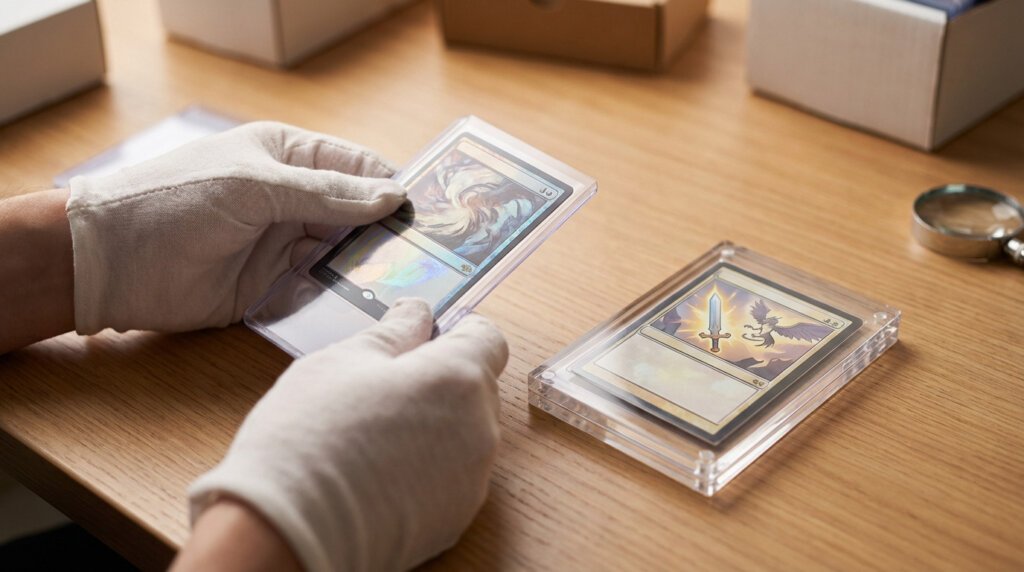
| Magnetic case | Display singles | Any value | Yes |
Binders are the most practical for the bulk of a collection. Go for D-ring binders (not O-ring — O-rings warp pages over time) with side-loading pockets. Vault X is the gold standard: acid-free, no PVC, and the side-loading design prevents cards from slipping out.
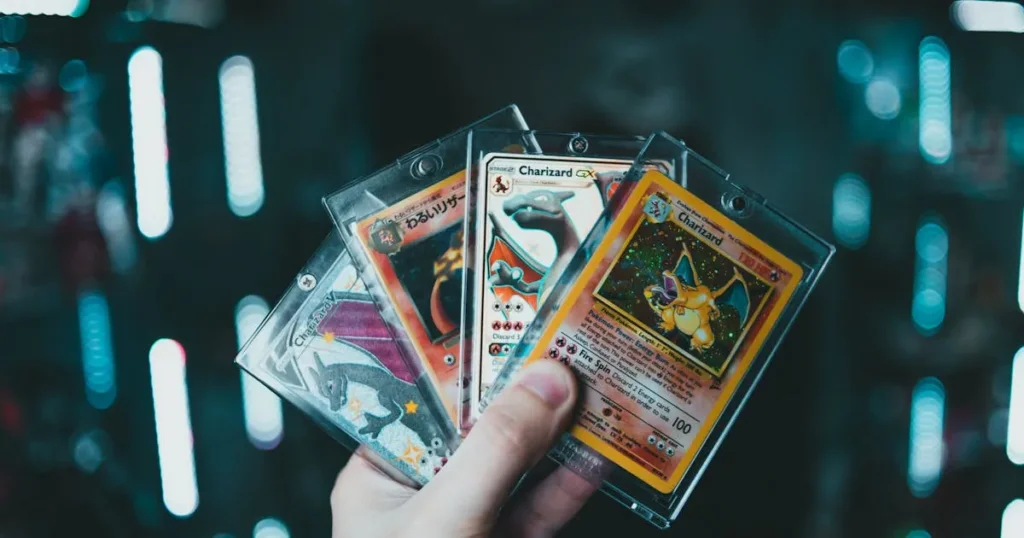
Toploaders are rigid plastic sleeves that protect individual cards better than binders for mid-value cards. Stack them vertically in a card storage box, never horizontally — horizontal stacking puts pressure on the bottom cards over time.
Card Savers (semi-rigid holders) are what PSA and BGS actually recommend for grading submissions. They’re softer than toploaders, which means less risk of edge damage during transit.
Storage Boxes for Bulk Collections
If you’re sitting on hundreds or thousands of sleeved cards, binders alone won’t cut it. BCW and Ultra Pro cardboard storage boxes are the go-to for bulk — they’re cheap, stackable, and sized for standard sleeved cards.
- 800-count and 1600-count boxes — for bulk commons and uncommons, sorted by set or alphabetically.
- 100-count boxes — for set-specific storage where you want quicker access.
- Plastic storage boxes (like Quiver or Feldherr cases) — better moisture resistance if you live in a humid climate.
Watch out: Cardboard boxes absorb moisture in humid environments. If you live somewhere with high humidity or seasonal damp, go plastic — or add silica gel packets inside cardboard boxes and replace them every 3–6 months.
Temperature, Humidity and Light: The Environmental Enemies
This is where most collectors drop the ball — and it’s where long-term damage quietly accumulates. Cards are paper and cardboard: they react to their environment. Here’s what to avoid and what to aim for.
- Temperature — aim for a stable 60–75°F (15–24°C). Avoid attics, garages, and cars — extreme heat causes warping and adhesive failure on holos.
- Humidity — keep relative humidity between 45–55%. Above 60% causes curling and mould. Below 40% causes brittleness and cracking. A $20 digital hygrometer tells you exactly where you are.
- Light — UV light fades card colours over years, especially on older sets. Keep binders in drawers or boxes, not on open shelves near windows.
- Magnetic fields — not a concern for raw cards, but keep graded slabs away from strong magnets (they can affect the holographic surface over time).
How to Store Graded Slabs Safely
Graded slabs need different treatment to raw cards. The case protects the card, but the case itself can be damaged by poor storage. A cracked PSA case costs $30–$50 to reholder — and PSA charges a fee even if the damage was your fault.
- Store vertically — never stack slabs flat on top of each other. Vertical storage in a slab box (BCW makes dedicated ones) distributes weight evenly.
- Use slab bags — thin polypropylene bags designed for slabs protect the surface from micro-scratches when sliding in and out of boxes.
- Padded cases for transport — if you’re taking slabs to a show or shipping them, use padded slab cases or wrap each one in bubble wrap. Never ship slabs loose in an envelope.
This is a game changer: Dedicated slab display cases with UV-filtering acrylic let you show off your best cards while protecting them from light damage. Way better than leaving slabs propped up on a shelf where they collect dust and get knocked over.
Frequently Asked Questions
What is the best way to store Pokémon cards long-term?
Double-sleeve in acid-free polypropylene sleeves, then store in a D-ring binder (Vault X) or Card Saver I holders for high-value cards. Keep in a stable environment of 60–75°F and 45–55% humidity, away from light. For the longest lifespan, avoid cardboard boxes in humid climates — use plastic storage instead.
Should I use binders or toploaders to store Pokémon cards?
Use binders for your bulk collection and cards under $20 — they’re organised, accessible, and space-efficient. Use toploaders or Card Savers for cards worth $20 or more, where the extra rigidity justifies the bulk. For anything you plan to grade, Card Savers are the preferred choice.
Are PVC sleeves bad for Pokémon cards?
Yes — PVC sleeves are harmful over time. They release plasticizers that can permanently bond to card surfaces, causing cloudiness and staining. Always check that sleeves are labelled “acid-free” and “PVC-free.” Dragon Shield, KMC Hyper Mat, and Ultra Pro PRO-Matte sleeves are all safe options.
Can Pokémon cards get damaged by humidity?
Absolutely. High humidity causes cards to curl, warp, and eventually grow mould. Aim for 45–55% relative humidity. If you live in a humid climate, store cards in airtight plastic boxes with silica gel packets, and check humidity levels with a digital hygrometer. A $20 investment that can save hundreds.
How should I store holographic Pokémon cards?
Holos need the same treatment as other cards but with extra care: double-sleeve to prevent holo scratching, keep away from UV light (which fades the foil pattern over time), and store flat or vertically — never at an angle where gravity causes long-term warping. Magnetic display cases with UV-filtering acrylic are ideal for valuable holos you want to display.
Is it safe to store Pokémon cards in a garage or attic?
No — garages and attics are among the worst places to store Pokémon cards. Both experience extreme temperature swings and high humidity, which warp and damage cards irreversibly. Keep your collection inside your home in a stable room, ideally in a cupboard or drawer away from windows and radiators.
Protect Your Collection — Starting Today
Now you know exactly how to store Pokémon cards: sleeve everything immediately, choose the right holder based on card value, control your environment, and give graded slabs their own dedicated space. The tools you need cost very little — a pack of Dragon Shield sleeves, a Vault X binder, and a digital hygrometer will cover 90% of collectors. The cost of not doing it? Potentially hundreds of dollars in lost value on cards you already own. Let’s talk cards — and let’s make sure yours stay in the best possible condition for years to come.