Estimated reading time: 10 minutes
Key Takeaways
- → The card back is your fastest fake detector — colour shift or blurry Poké Ball = red flag.
- → Real holos have a fine-grid sparkle; fakes show blurry, overly shiny, or flat patterns.
- → Text errors, wrong fonts, and smudged print are near-certain signs of counterfeits.
- → Fake booster packs exist — sealed product is not automatically safe.
- → A jewellery scale and a UV light are two cheap tools every serious collector should own.
Pokémon Card Fake vs Real: The Complete Authentication Guide (2026)
If you’re staring at a card wondering whether it’s the real deal, you’re not alone — the pokemon card fake vs real problem has exploded in 2025 and 2026, with counterfeits so convincing they fool casual buyers every day. You can spot a fake Pokémon card by checking the card back colour, print quality, holo pattern, texture, and text errors — authentic cards have sharp, consistent printing with no colour shift or smudging. In this guide, I’ll walk you through every test I personally use as a collector, from the quick 30-second checks any beginner can do to the advanced techniques that even experienced players overlook.
Why Fake Pokémon Cards Are a Bigger Problem Than Ever
Let’s be clear: fake Pokémon TCG cards are not a niche issue. The market for counterfeit cards has grown dramatically, fuelled by sky-high prices on chase cards, the popularity of card openings on social media, and the sheer volume of product moving through secondary markets like eBay, Facebook Marketplace, and card shows.
As a collector, I’ve been handed fakes at local events and spotted them in bulk lots that looked completely legitimate at first glance. The bad news: counterfeiters have gotten better. The good news: real cards still have consistent tells that fakes can’t fully replicate — if you know what to look for.
Heads up: Even sealed booster packs can contain fakes. Counterfeiters have moved beyond single cards and are now producing fake packaging. Never assume sealed = safe.
The Card Back Test: The Fastest Way to Spot a Fake
Flip the card over. Seriously — this is the single fastest fake pokemon card check, and it takes about five seconds. The back of an authentic Pokémon card has a very specific shade of blue, a crisp Poké Ball design, and clean white borders. Fakes almost always fail here.
What to look for on the card back:
- → Colour accuracy: real cards have a deep, consistent navy-to-blue tone. Fakes often appear lighter, greener, or washed out.
- → Poké Ball sharpness: the lines should be crisp. Blurry, jagged, or slightly off-centre Poké Ball = counterfeit.
- → Border width: borders should be even on all four sides. Uneven borders are a classic printer-quality failure.
- → Texture through the back: if the card feels glossy and slick on both sides, suspect a fake — real cards have a slightly textured back.
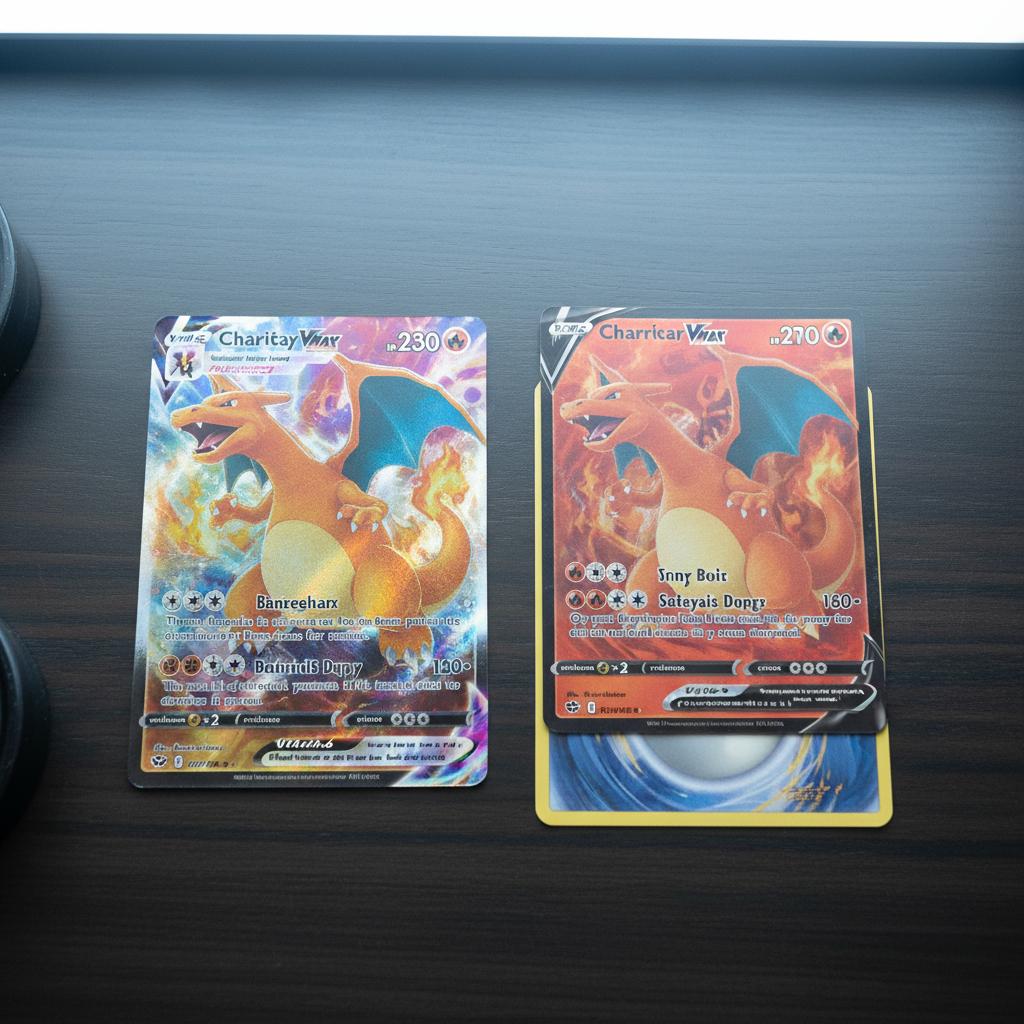
Example: I once picked up what looked like a near-mint Charizard VMAX at a card show. Everything seemed fine until I turned it over — the blue was slightly turquoise and the Poké Ball had fuzzy edges. Immediately returned it. That’s the back test saving me £80 in under 10 seconds.
Print Quality, Font & Text Errors: What to Look For
Print quality is where many fakes fall apart on close inspection. The Pokémon Company prints cards to extremely tight tolerances — the fonts, colour registration, and resolution don’t vary. Fakes, by contrast, are produced on commercial printers that can’t match those specs.
Run through this checklist on the card front:
- → Font consistency: Pokémon uses proprietary fonts for attack names, HP values, and card text. Fakes often have slightly wrong weight, spacing, or letterforms.
- → Spelling and grammar: this sounds obvious, but fakes frequently contain typos in attack descriptions or flavour text. Read the whole card.
- → Colour saturation: real cards have vivid, accurate colours. Fakes can look dull, over-saturated, or slightly off in hue.
- → Dot pattern under magnification: look at the card through a loupe or phone macro lens. Real cards show a tight, uniform CMYK dot pattern. Fakes show irregular dots or blurring.
- → Energy symbols: the tiny energy cost icons in attack boxes should be sharp and perfectly formed. Fake energy symbols are often blurry or slightly the wrong colour.
Pro tip: The copyright line at the bottom of the card is often a dead giveaway. Fakes may have the wrong year, wrong company name format, or missing language codes. On English-language cards, look for “©” followed by the correct year and “Pokémon”/”Nintendo”.
Holo Pattern, Texture & the Light Test
This is where the real vs fake holo pokemon card distinction becomes clear — and where a lot of collectors get tripped up. Holographic cards are expensive, so they’re a prime target for counterfeiters. But the holo layer is also one of the hardest things to fake correctly.
The light test: tilt the card under a bright light or lamp. On a genuine holo card, you’ll see a fine, almost crystalline sparkle pattern — a grid of tiny reflective squares or stars depending on the set. Fakes typically show one of these failure modes:
- → Overly mirror-like shine: looks like a sticker more than a card.
- → Blurry or smeared sparkle: no defined pattern, just general glimmer.
- → Wrong holo zone: on cards like V, VMAX, or ex, the holo effect should appear in specific areas only. Fakes often apply it incorrectly.
- → Peeling edges: fake holo is often a laminated sticker layer — if it’s starting to lift at the edges, it’s definitely not real.
The texture check: run your fingertip lightly over a genuine holo card — you’ll feel a subtle raised texture in the holo area. On basic non-holo cards, the surface is smooth but not slippery. Fakes often feel uniformly slick, plasticky, or papery.
UV blacklight test (advanced): this is underused and incredibly effective. Under a UV/blacklight torch, genuine Pokémon cards will show specific fluorescent responses in the card stock. Many fakes glow very differently — either too brightly or not at all. This test won’t replace a visual check, but it’s a powerful second layer of verification for high-value cards.
Fake Booster Packs: Sealed Products Are Not Safe Either
Let’s talk about something that most fake pokemon tcg guides don’t cover: fake booster packs. For years, counterfeiters focused on singles. Now they’ve moved into sealed product — and the results are convincing enough to catch even experienced buyers off guard.
Signs of a fake booster pack:
- → Packaging weight: a real booster pack has a consistent weight. Weigh it against a known genuine pack — discrepancies of even 1–2g are suspicious.
- → Crimp quality: the heat seal at the top and bottom should be even and clean. Fakes often have uneven or poorly-aligned crimps.
- → Print on the wrapper: same rules as cards — check for colour accuracy, font sharpness, and any text errors on the pack itself.
- → Set code location: each pack has a set code printed in a specific position. Fakes sometimes omit it or put it in the wrong place.
- → Sourcing: always buy sealed product from official retailers, licensed hobby stores, or directly from Pokémon Centre. Marketplace deals that seem impossibly cheap usually are.
Example: A collector in our community purchased a Prismatic Evolutions booster box from a private seller. Everything looked sealed and legit — until they opened the first pack and found cards with no texture and blurry holos. The box itself had been resealed. Buy sealed product from authorised sources only.
Comparison Table: Real vs Fake Pokémon Cards at a Glance
No sugarcoating here — I’ve compiled every check into a single reference table so you can run through it quickly whenever you’re evaluating a pokemon card fake vs real situation.
| Check | Real Card | Fake Card |
|---|---|---|
| Card back colour | Deep, consistent navy blue | Too light, greenish, or washed out |
| Poké Ball (back) | Crisp, centred, sharp edges | Blurry, off-centre, jagged lines |
| Border alignment | Even on all four sides | Uneven, wider on one side |
| Print quality | Sharp, vivid, consistent CMYK dots | Blurry, over/under-saturated, irregular dots |
| Font & text | Proprietary fonts, no errors | Wrong weight/spacing, typos |
| Holo sparkle | Fine-grid crystalline pattern | Blurry glimmer, mirror-like, or wrong zone |
| Texture (front) | Subtle raised feel on holo area | Uniformly slick or papery |
| Card weight | ~1.7g (consistent) | Often lighter or heavier |
| UV blacklight | Specific fluorescent response | Too bright, absent, or wrong colour |
| Copyright line | Correct year, format, language code | Wrong year, missing info, or misspelled |
Collector’s toolkit recommendation: For any card worth over £20, invest in a jewellery scale (under £10) and a UV blacklight torch (under £8). These two tools together catch the vast majority of fakes that pass a visual check.
Frequently Asked Questions
How can you tell if a Pokémon card is real by weight?
Real Pokémon cards weigh approximately 1.7 grams. A jewellery scale is the simplest tool here — if the card you’re testing is noticeably lighter or heavier, that’s a strong signal it’s counterfeit. Weight isn’t a definitive test on its own (worn or damaged real cards can vary slightly), but combined with a visual check it’s highly reliable.
Do fake Pokémon cards scan on the Pokémon TCG app?
Most fakes fail to scan correctly, or scan but return the wrong card data. The official Pokémon TCG Live app uses image recognition tied to official print runs — if a card doesn’t scan or shows mismatched data, treat it as a major red flag. That said, some sophisticated fakes can partially fool the scan, so don’t rely on this test alone.
What does a real Pokémon card look like under light?
Tilt a genuine holo card under a lamp and you’ll see a fine, crystalline sparkle pattern — think tiny reflective squares or stars depending on the set era. Fakes show blurry general glimmer, a mirror-like flat shine, or a completely wrong pattern. Non-holo real cards under light should look flat and matte with sharp, clear printing — no unexpected reflections.
Are Pokémon cards from China always fake?
Not all Chinese-manufactured cards are fake, but cheap listings from Chinese marketplaces like AliExpress, DHgate, or Temu are extremely high risk. The Pokémon Company does manufacture some product in Asia through licensed facilities, but those cards reach consumers through official retail channels — not discount import platforms. If the price is suspiciously low, it almost certainly is.
Is there an app to check Pokémon card authenticity?
The Pokémon TCG Live app can scan cards and verify them against official data. TCGplayer’s app lets you scan and compare card details against their verified database. For high-value cards, professional grading services like PSA or Beckett offer the gold standard of authentication — both companies can definitively confirm whether a card is genuine before you buy or sell.
Buy Smart, Collect with Confidence
The pokemon card fake vs real challenge isn’t going away — if anything, counterfeits will keep improving as the market grows. But armed with the right knowledge, you’re always one step ahead. Check the card back first, trust your hands for texture, use a UV torch on anything valuable, and always buy sealed product from authorised sources.
As a collector, I’d rather spend five minutes authenticating a card than lose money on a convincing fake. The tools are cheap, the checks are fast, and the peace of mind is worth every second. Let’s break it down one card at a time — and keep fakes out of our collections for good.