Pokémon TCG scalping means buying sought-after cards or sealed products in large quantities, then reselling them at much higher prices when ordinary buyers cannot find them at retail. It frustrates collectors, players, parents, and local game stores. Still, empty shelves do not prove that scalpers caused every shortage. Demand, uneven allocations, release timing, and regional supply also shape availability.
What makes someone a Pokémon scalper?
A Pokémon scalper is defined less by reselling itself than by the pattern of the buying. The usual goal is to clear or sharply reduce retail inventory around a new release or online restock, then list the same sealed products on the secondary market at a markup. Booster packs, booster boxes, collection boxes, and Elite Trainer Boxes (ETBs) are common targets because they are easy to store, ship, and market as sold out.
Scalping is not the same as collecting, trading, or ordinary resale
A collector may sell duplicates to fund a collection. A player may trade cards to build a deck. A store may price products above the suggested retail price to cover costs, limited allocation, event space, or the risk of holding inventory. These actions can be debated, but they are not automatically scalping. The clearer warning sign is intentional bulk buying designed to exploit immediate scarcity, followed by rapid resale at a price disconnected from normal retail availability.
Individual-card speculation is also different from sealed-product scalping. A rare card can rise or fall in value because of competitive play, artwork, rarity, grading, or collector interest. By contrast, buying every ETB from a shelf leaves later customers with no chance to decide whether they want to open, play, gift, or keep the product. That access problem explains why sealed-product buyouts attract so much criticism.
Why Pokémon products disappear so quickly
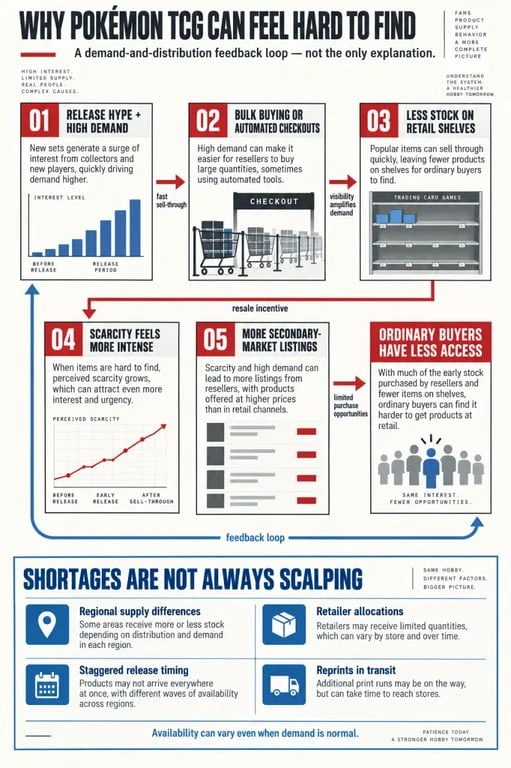
Scalpers benefit when several pressures arrive together: high demand, limited stock at a particular retailer, attention around a new set, and the expectation that prices will rise. The Pokémon TCG attracted increased interest during the COVID-19 period, while influencer attention and high-value card sales drew speculative buyers. Those forces can turn an ordinary restock into a race.
Restocks create a short window for bulk buyers and bots
In physical stores, buyers may monitor delivery days, ask staff about incoming shipments, or visit several locations. Online, automated purchasing bots can worsen the imbalance by placing orders within seconds of a restock. A product that appears to sell out instantly may therefore reflect genuine demand and faster purchasing tools, rather than a huge number of individual collectors checking out at the same time.
An empty shelf has an echo effect. It does more than show that stock is gone. It tells the next buyer that the product may be rare, which can trigger panic buying, constant restock monitoring, and a willingness to accept inflated listings. That reaction reinforces scarcity even when another release wave or reprint may arrive later. Checking whether the item is still in production can prevent a temporary stockout from becoming an expensive decision.
Supply is not identical everywhere
Availability can differ sharply by country, retailer, and even neighborhood. A local game store may receive a smaller allocation than a major chain. An online shop may sell through its stock before a nearby store puts products on shelves. Distribution routes, shipment timing, and retailer policies all affect what customers see.
Community reports from the United States, Canada, Mexico, and elsewhere offer useful clues, but they do not measure the total scale of scalping in every market. A line outside one store or a rapid online sell-out can describe a real experience without proving that the same pattern exists across an entire country.
How scalping changes prices for buyers and stores
The central economic loop is simple: bulk purchasing reduces retail availability, reduced availability makes a product feel scarce, scarcity supports higher listings on eBay, Facebook Marketplace, and similar platforms, and high resale prices encourage more buyers to repeat the process. Reports describe products being resold for two to four times their purchase value, especially when release-weekend demand is intense.
| Product type | Typical retail role | Why it attracts scalpers | Who feels the impact |
|---|---|---|---|
| Booster packs | Low-cost entry point for opening and play | Easy to clear from a display and relist in bundles | Children, parents, and casual collectors |
| Elite Trainer Boxes (ETBs) | Giftable sealed product with accessories | Recognizable format and strong sold-out appeal | Collectors and budget-conscious buyers |
| Booster boxes | High-volume opening for collectors and players | Large resale value per transaction | Players, group buyers, and serious collectors |
| Rare singles | Targeted way to complete a deck or binder | Speculation can follow hype or perceived rarity | Competitive players and set collectors |
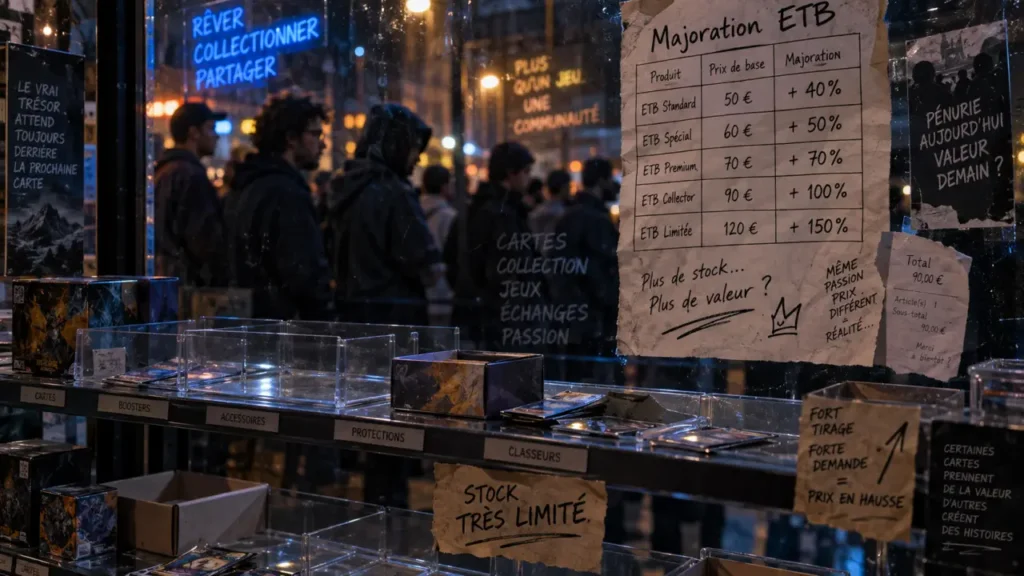
One reported example placed Prismatic Evolutions ETBs at $160 on release weekend and approximately $250 at a local game store. The example shows how severe local pricing can become, but it should not be treated as a universal market rate. A listing is an asking price, not proof that an item sells consistently at that level.
Local game stores are not always the villain
It is understandable to feel angry when an LGS charges more than a big-box retailer. Yet a local store may face smaller allocations, higher wholesale costs, rent, staffing, event costs, and the need to avoid selling scarce stock instantly to one reseller. The useful questions are whether the store is transparent, supports its player community, applies sensible limits, and offers a reasonable alternative to opportunistic resale.
Who loses when Pokémon TCG access becomes a resale contest?
Children and parents are often affected first because sealed products are commonly bought as affordable gifts or as a shared activity. Casual collectors may stop participating when every release feels like a queue, lottery, or markup. Players can struggle to find packs for prerelease excitement, while dedicated collectors may feel pushed toward overpriced sealed products simply to avoid missing a set.
The damage is also social. Pokémon cards work best as a hobby built around binder swaps, game nights, local tournaments, and opening packs with friends. When every purchase is framed as an investment opportunity, newcomers may feel that the hobby is reserved for people with faster alerts, deeper budgets, or resale connections. That concern remains valid even when a sold-out product was not entirely bought by scalpers.
Ways to reduce the incentive to scalp Pokémon cards
No single measure can eliminate scalping, but several practical responses can reduce its payoff. Retailers can use purchase limits, keep high-demand products behind the counter or in a glass case, and spread stock across several days instead of putting an entire shipment out at once. Online sellers can improve bot defenses and cancel suspicious duplicate orders when their policies allow it.
- Compare before buying: Check more than one retailer and distinguish an asking price from a completed sale.
- Set a personal ceiling: Decide what the product is worth to you before release-day pressure takes over.
- Buy singles for a specific card: Opening sealed product is fun, but it is rarely the cheapest route to one chase card.
- Support transparent local stores: Purchase limits, clear pricing, and organized events help maintain access for regular customers.
- Avoid panic purchases: Paying an extreme markup signals that rapid buyouts can be profitable.
Manufacturers and distributors can also help by increasing production capacity for in-demand sets that are still in production and improving how products reach retailers. Direct-to-retail distribution has been proposed as a way to reduce bottlenecks, though distribution changes are complex and do not guarantee equal stock everywhere.
The realistic goal is not permanent abundance of every product. It is fairer retail access while products are still intended to be available. Regional differences, retailer allocations, release timing, and later production waves all matter, so one store’s shortage cannot establish the scale of the problem by itself. Consumers can limit the incentive to scalp by checking prices carefully and refusing inflated listings, while retailers can make scarce stock harder for one buyer to control.