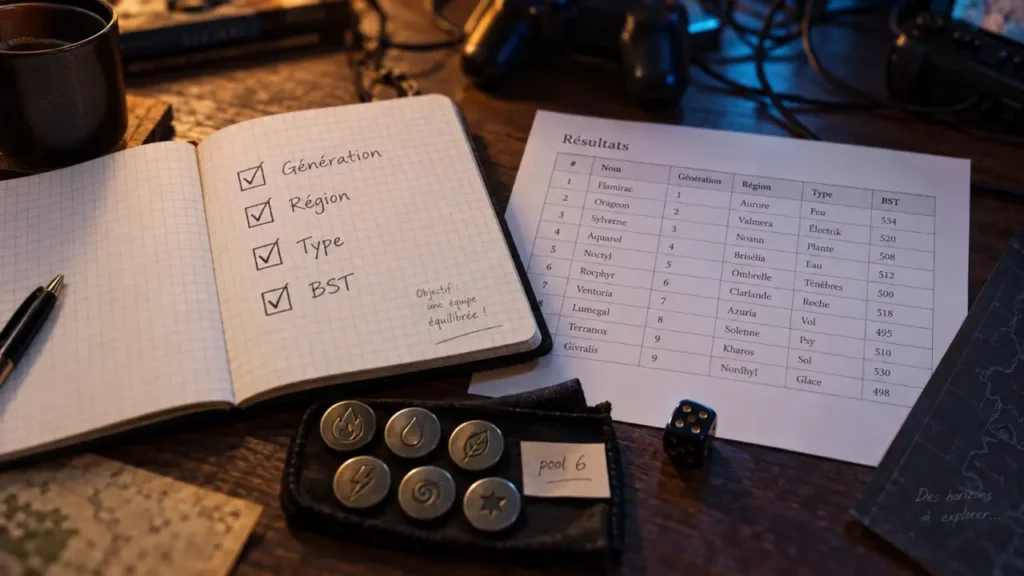
Use the generator to choose one surprise Pokémon, a starter, or a full six-Pokémon squad in seconds. Start with no filters for a genuine surprise, then add limits when the result needs to fit a game, challenge rule, or team-building idea.
Pick the right random mode before you roll
A random Pokémon generator is most useful when the output matches the decision you need to make. One result works well for choosing a starter, settling a friendly debate, or adding an unexpected partner to a playthrough. A larger roll helps when you want to build around rules instead of selecting the first familiar name that appears.
Discover Galarian Pokémon and Their Regional Forms · Explore the official guide to Pokémon species with unique appearances and evolutions in the Galar region.
One Pokémon, a full team, or a draft pool
Choose one Pokémon for a fast surprise selection. Generate three when you need a small choice pool, such as three possible starters or replacements. A set of six Pokémon creates a complete party, while 12 results can serve as a draft pool or an elimination bracket. Before rolling a team, decide whether duplicates are allowed. Duplicate species can make a casual run chaotic, while excluding them usually produces a more varied party.
Random does not always mean unrestricted
An open Pokédex can pair a low-powered early-route Pokémon with a Legendary or a special battle form. That may be entertaining, but it can also undermine the rules of a challenge. Treat filters as guardrails rather than as a way to remove the fun. Set the boundaries first, then let chance choose within them.
Build a candidate pool that fits your game
The quality of a random result depends on the candidate pool behind it. Generations, regions, and game-specific Pokédex selections answer different questions, so they should not be treated as interchangeable filters.
Generation, region, and game pool are different filters
A generation filter limits results by the era in which a species was introduced, from Generation 1 through Generation 9. A region filter focuses on places such as Kanto, Johto, Hoenn, Sinnoh, Unova, Kalos, Alola, Galar, or Paldea. A game-specific pool is more practical for a playthrough because it aims to reflect the Pokémon relevant to that game rather than every species introduced in its generation.
For example, a Generation 9 selection can include species introduced in Paldea, but that does not automatically mean every result is usable in the exact version or expansion you are playing. If your rule is “only Pokémon I can realistically encounter,” use the game pool whenever it is available. If your rule is “only new Pokémon,” use the generation filter instead.
Types and evolution stages create better themed rolls
All 18 Pokémon types can be used to narrow the field. A Fire-type roll is useful for choosing a themed partner, while a single-type restriction provides the foundation for a monotype team. Evolution-stage controls add another layer: select unevolved species for an early-game feeling, middle evolutions for a specific challenge, or fully evolved Pokémon for a battle-ready squad.
Base Stat Total filters can also make a mixed-generation roll feel fairer. They do not guarantee a balanced team, since typing, movepools, abilities, and availability still matter, but they can reduce the widest power gaps. Use a modest range for a story challenge, or a higher minimum when generating a fully evolved battle group.
Exclude the picks that would break the challenge
Rarity and form settings turn a basic Pokémon picker into a more useful planning tool. They let you control power level, availability, and the meaning of “random” for your own ruleset.
Legendary is not the only special category
Exclude Legendary and Mythical Pokémon when you want conventional team members or a more even Nuzlocke-style experience. Depending on the generator, you may also be able to include or remove sub-legendary Pokémon, Ultra Beasts, and Paradox Pokémon. These labels are separate classifications with different roles in the series, so a good tool should show each one rather than placing every unusual Pokémon in one vague “rare” group.
Forms deserve the same attention. A regional variant is a version of a species adapted to another region. Mega Evolutions and Gigantamax forms are battle transformations, while Paradox Pokémon are distinct species. Decide whether forms should count as separate possible results before generating a team. Including every alternate form expands variety, while excluding temporary battle forms can make a playthrough-oriented roll easier to interpret.
Optional details add personality, not balance
Some generators can assign one of the 25 Pokémon natures, a random ability including a hidden ability, and a gender based on the species’ gender ratio. These options suit role-playing, mock battles, or draft ideas. They do not turn the tool into a competitive team builder: a random nature or ability may be legal in concept but unavailable or impractical in the game you have chosen.
Shiny results add another optional layer of chance. A tool that applies a 1 in 512 shiny result can make a roll feel special, but shiny status is cosmetic unless your own challenge rules give it a specific meaning. For a cleaner run, keep it separate from the species-selection rules.
Use the generator for challenges without making them unfair
Challenge formats work best when the random rules are written down before anyone rolls. This prevents rerolls motivated by a disappointing result and gives every player the same expectation of what counts as valid.
Nuzlocke, Soul Link, and randomizer preparation
For a Nuzlocke, restrict the pool to the relevant game, exclude categories your rules prohibit, and choose an evolution stage that fits the point in the adventure. For a Soul Link, generate paired results from the same filtered pool, then check type overlap and any shared rules before locking them in. In a randomizer playthrough, use the picker as a planning aid rather than a replacement for in-game encounter logic. It can suggest a replacement or theme, but it does not know the encounter tables of your save file.
Keep the difficulty progression manageable. Start with unevolved or lower-BST picks for the opening stretch, unlock middle or final evolutions after badges or other milestones, and reserve special classes for a late-game reward. This creates tension without forcing a sudden jump from an easy route encounter to an overpowered party member.
Draft and monotype rules need a transparent roll
For a draft league, generate a larger pool, agree on exclusions, and keep the full output visible before participants choose. If the tool supports a seed, save it so the same result can be reproduced and checked later. For a monotype run, select one type first, then generate six distinct eligible Pokémon. A monotype team still benefits from varied roles, including physical and special attackers, defensive options, speed control, and coverage moves. Judge the roll by those roles rather than by familiar names alone.
What to look for in a reliable Pokémon picker
When comparing generators, prioritize clarity over a long list of switches. The best interface shows exactly which filters are active and how many eligible candidates remain. A candidate counter is especially helpful: if only a few Pokémon match every condition, the outcome is less unpredictable than it first appears.
| Feature | Why it matters | Best use |
|---|---|---|
| Generation and game pools | Keeps results aligned with an era or playable Pokédex | Story runs and regional themes |
| Type and evolution filters | Creates a focused roster without hand-picking it | Monotype teams and starter-style rolls |
| Rarity and BST controls | Helps manage difficulty and power gaps | Nuzlockes, drafts, and fair group challenges |
| Form settings | Clarifies whether variants and battle forms are eligible | Expanded Pokédex discovery |
| Seeds or shareable results | Makes a roll verifiable and repeatable | Drafts, streams, and shared challenges |
Finally, check the result card. At minimum, it should display the Pokémon’s name, Pokédex number, types, artwork, and base stats. Extra information such as ability, nature, gender, and form can make the roll more useful, provided the tool clearly separates a species from a regional variant or battle-only transformation. Generate freely for discovery, then apply only the filters that make your next team fit the game or challenge you have in mind.