Key takeaways
Pokemon grading prices vary more than most collectors realize, and picking the wrong service or tier can cost you serious money. Here’s everything you need to know before you submit a single card.
- PSA Economy starts at $24.99 per card, but faster turnaround tiers can push costs above $300 — knowing which tier fits your card’s value is critical.
- CGC and BGS offer genuine PSA alternatives at competitive price points, often with shorter wait times for mid-range submissions in 2026.
- ⚠️ Hidden costs like shipping, insurance, and packaging routinely add $20–$50+ to any submission, a figure many first-time collectors completely overlook.
- A card worth less than $50 raw will almost never recoup grading fees — checking value before submitting is non-negotiable.
- ✅ Free price checker tools let you estimate a card’s market value in minutes, saving you from expensive mistakes.
- 🎯 The most counterintuitive insight in this guide: a PSA 9 sometimes sells for more than a PSA 10 on specific vintage cards — the full breakdown is inside.
Pokemon Grading Prices Compared: PSA, CGC, and BGS in 2026
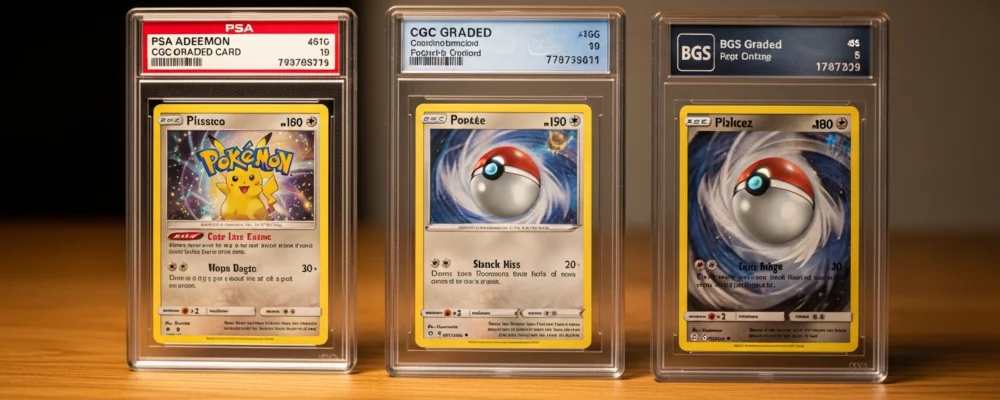
Grading costs vary wildly depending on the company and tier you pick. Before submitting anything, you need to know exactly what you’re paying and why. Here’s the full breakdown of every major service in 2026.
PSA grading prices: tiers from $24.99 to $9,999 per card
PSA remains the gold standard for Pokémon grading. But its tiered pricing system confuses a lot of first-time submitters. According to PSA’s official trading card grading page, fees scale based on declared card value and desired turnaround speed.
Here’s a clear look at PSA’s current pricing structure:
| Tier Name | Price Per Card | Max Declared Value | Est. Turnaround |
|---|---|---|---|
| Economy | $24.99 | $499 | ~65 business days |
| Regular | $49.99 | $499 | ~20 business days |
| Express | $149 | $2,499 | ~10 business days |
| Super Express | $299 | $4,999 | ~5 business days |
| Walkthrough | $9,999 | Unlimited | ~2 business days |
💡 A critical nuance here: if your card grades out higher than its declared value, PSA will hold it and request additional payment. Many collectors underdeclare and get caught off guard. Always research your card’s potential PSA 10 value before choosing a tier. For a deeper dive, check out this complete PSA grading prices guide for 2026.
CGC and BGS grading prices: what each tier actually costs
CGC and Beckett (BGS) offer real alternatives to PSA, especially for mid-value modern cards. CGC’s standard tier sits around $25 per card, with faster options climbing toward $150+. BGS starts at roughly $22 per card at its economy level, though Beckett’s subgrades system appeals more to collectors focused on centering and surface quality than raw pop report numbers.
One underrated advantage: CGC’s modern card turnaround times have been consistently faster than PSA Economy in 2026, making it a smart pick for bulk submissions on recent sets.
UK grading options: ACE Grading, CGC UK, and PSA international fees
UK collectors face a different cost reality. Sending cards to PSA’s US facility adds shipping, insurance, and customs fees that can easily push total costs 30–50% higher per card.
Domestic UK options have grown significantly. Here’s how the main services compare:
| Service | Entry Price | Turnaround | PSA-Level Recognition |
|---|---|---|---|
| PSA (US, international) | ~£30–£40 effective | 65+ business days | ✅ |
| CGC UK | ~£20–£25 | ~30–45 business days | 🟡 |
| ACE Grading | ~£12–£15 | ~20–30 business days | 🟡 |
ACE Grading is the most affordable UK-native option, though its secondary market resale premium is still growing. If resale value on eBay UK is your priority, CGC UK currently carries stronger buyer confidence. For more on selling graded cards in the UK market, this guide on where to sell Pokémon cards in the UK is worth reading alongside your grading decision.
Bottom line: Pokémon grading prices range from under $25 to nearly $10,000 per card. Matching the right tier to your card’s actual value is the single most important decision in the entire grading process.
Is Pokemon Grading Worth the Price? Raw vs Graded Card Value
Grading costs money. The real question is: does it make you money?
The honest answer depends on the card, the grade, and the current market. Not every submission is a smart financial move, and plenty of collectors learn this the hard way.
Is a PSA 9 worth more than a raw card?
For high-demand cards, a PSA 9 almost always commands a meaningful premium over raw. Take a Charizard VMAX from Darkness Ablaze: a raw Near Mint copy might sell for $15–$20 on eBay, while a PSA 9 typically fetches $40–$60. That’s a 2x to 3x multiplier, easily covering a $24.99 Economy submission.
The premium logic works because grading eliminates buyer uncertainty. A PSA 9 label signals condition more credibly than any seller’s own description. Buyers pay for that confidence, especially on cards valued above $30.
- ✅ PSA 10s carry the biggest premium, often 3x to 10x over raw on sought-after cards.
- ✅ PSA 9s still beat raw for cards with real collector demand.
- 🟡 PSA 8s are tricky: the premium shrinks fast and sometimes disappears entirely.
According to PriceCharting, graded PSA 10 copies of popular cards regularly sell for multiples of their ungraded counterparts. That gap is what justifies the grading fee on the right card.
For a deeper breakdown of which cards grade best, the Pokémon card grading process guide covers card selection strategy in detail.
When grading costs more than the card is worth
This scenario is more common than collectors admit. Submit a $10 common to PSA at $24.99 and you’re already underwater before the result even arrives.
⚠️ The break-even rule: a card needs a realistic PSA 9 sale price of at least 2x the total grading cost to make financial sense. Below that threshold, grading is a passion project, not an investment.
Cards that rarely justify grading costs in 2026:
- ❌ Common and uncommon cards from recent sets with low secondary market demand
- ❌ Reverse holos worth under $15 raw
- ❌ Duplicates of cards where PSA pop reports show tens of thousands of copies already graded
The counterintuitive insight: high pop count often kills the grade premium. A PSA 10 means less when 50,000 other PSA 10s already exist in the market. Check pop reports before submitting, not after.
If you’re unsure whether a card clears the value threshold, reviewing a full Pokemon card grading cost breakdown alongside current raw prices will sharpen your decision-making fast.
Pokemon Grading Prices: Hidden Costs Most Collectors Miss
The advertised grading fee is just the starting point. Most collectors get surprised by what stacks on top of it before a single card is even opened.
Shipping, insurance, and packaging costs
Shipping a submission to PSA or BGS is not free. Round-trip shipping typically adds $20 to $50 for a US-based submission, depending on weight, speed, and carrier. International collectors pay significantly more.
- 💡 Use rigid card savers, team bags, and sturdy boxes. Improper packaging can void insurance claims if cards arrive damaged.
- Always ship with tracking and signature confirmation. Without it, you have no recourse if the package goes missing.
- Insurance is often undervalued. If you’re submitting $500 worth of cards, insure for $500, not the default minimum.
For UK collectors, the costs compound faster. Cheevo’s 2026 UK grading guide notes that international shipping, customs duties, and VAT can add meaningful overhead to every PSA submission crossing borders. A $25 grading fee can quietly become a $60+ total cost per card once transit is factored in.
Packaging materials are often overlooked entirely. Team bags, penny sleeves, card savers, foam, and a reinforced mailer: budget at least $5 to $15 per submission for supplies, especially if you’re just starting out.
Membership fees and bulk submission discounts
PSA membership changes the math significantly. A PSA Collector tier membership unlocks lower per-card rates at most service levels. Without it, you’re paying retail pricing on every submission.
- ✅ PSA memberships start around $9.99/month and can reduce per-card fees noticeably on regular-tier submissions.
- 🎯 Bulk submissions (typically 20+ cards) often unlock better per-card pricing but require patience: turnaround times on economy tiers regularly stretch to several months.
- ❌ Paying for a premium membership and only grading two or three cards a year is rarely cost-efficient.
The smart play is to batch submissions strategically. Collect enough cards worth grading, then submit together to hit bulk thresholds. For a full breakdown of how service tiers interact with membership pricing, the Pokemon Card Grading Cost guide covers every current tier in detail.
Hidden costs rarely sink a single submission. They sink a habit of submitting carelessly without totaling the real per-card cost first.
How to Check Your Pokemon Card Value Before Submitting for Grading
Knowing a card’s raw market value before grading is the single most important step collectors skip. Without it, you risk paying $25 to $100+ in grading fees on a card that sells graded for less than your total cost.
Best free Pokemon card price checker tools in 2026
Three tools cover most use cases for checking Pokemon card values before any submission.
- 💡 PriceCharting is the most reliable free database for both raw and PSA-graded card prices. According to PriceCharting, their database tracks thousands of Pokemon card listings across grades, giving you a side-by-side view of ungraded versus PSA 9 and PSA 10 premiums in real time. This is the tool I use first, every single time.
- TCGPlayer shows live buylist and market prices for raw cards. It’s especially useful for modern sets where the graded premium is often thin.
- eBay sold listings remain the ground truth. Filter by “Sold” and search the exact card name plus grade. Raw data beats aggregated averages when a card is moving fast.
The key metric to calculate is simple: graded sale price minus total grading cost. If the spread is under $15 to $20, grading rarely makes financial sense. Check the full Pokemon card grading process guide to understand how each grade tier affects final resale value.
⚠️ Always check recently sold listings, not asking prices. A card with a $300 asking price but no sales in 90 days is not a $300 card.
Is a 60/40 centering still a PSA 10 in 2026?
Short answer: no, not reliably. PSA’s published standard allows up to 55/45 centering on the front for a PSA 10. A 60/40 split technically falls outside that window and will typically land a card at PSA 9, not 10.
This matters enormously for Pokemon grading prices ROI. A PSA 10 on a popular vintage card can be worth three to five times a PSA 9. That single grade point is the difference between a profitable submission and a break-even one.
- ✅ Use a centering tool or ruler before submitting. Free mobile apps like Card Dealer Pro offer centering measurement features.
- ❌ Do not eyeball centering. It is almost always less accurate than you think.
- 🎯 Even a borderline 55/45 card carries risk. PSA graders also weigh surface, edges, and corners together. A centered card with light scratches still caps at PSA 9.
Decluttering your submission list based on centering checks alone can save real money. For cards already in your collection, cross-reference their current market momentum before deciding whether to submit now or wait for a stronger price environment.
Frequently Asked Questions
How much does it cost to grade a Pokémon?
Pokemon grading prices vary by service tier and company. In 2026, PSA’s most popular tiers range from roughly $25 to $150 per card, while CGC and Beckett offer competitive alternatives. Faster turnaround times always cost significantly more than standard submissions.
How much is PSA in the UK?
UK collectors pay PSA prices in USD plus international shipping and any applicable import duties. Expect to add $30 to $60 in shipping and handling costs on top of the standard tier price, making budget-tier submissions less economical for lower-value cards.
Is 60/40 still PSA 10?
A 60/40 centering standard applies to PSA 10 grades, meaning the card front must fall within that ratio. However, PSA graders also weigh corners, edges, and surface condition equally, so perfect centering alone does not guarantee a PSA 10 result.
Is PSA 9 worth more than raw?
In most cases, yes. A PSA 9 authenticated card commands a premium over an ungraded raw card because grading confirms authenticity and condition. The exception is very low-value commons, where grading fees can exceed any realistic price increase the grade provides.