Key takeaways
Every Pokemon card ever printed, from a battle-worn Charizard to today’s freshest full-art secret rare, fits one universal mold. Know this size and you’ll never buy the wrong sleeve or toploader again.
- 2.5 x 3.5 inches (6.3 x 8.8 cm) is the exact standard: this measurement applies to every regular Pokemon card, no exceptions by set or era.
- Rarity changes nothing about size: a common and a VMAX card share identical dimensions, so your storage supplies never need adjusting for rarity.
- Japanese prints run slightly thinner than Western cards, which matters when stacking mixed collections in the same binder.
- Jumbo cards break the rule entirely: oversized promos require their own dedicated sleeves, not standard-size protection.
- Sleeve fit depends on thickness, not just size: choosing between 35pt and 55pt toploaders protects your cards without crushing them.
- Getting the millimeter-precise dimensions right is the key to designing custom cards or proxies that actually feel official at the table.
Pokemon Card Size in Inches and CM: The Exact Standard
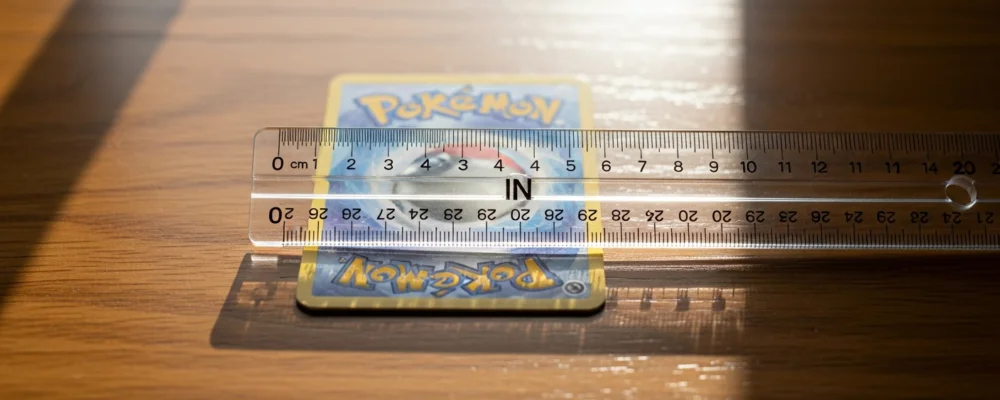
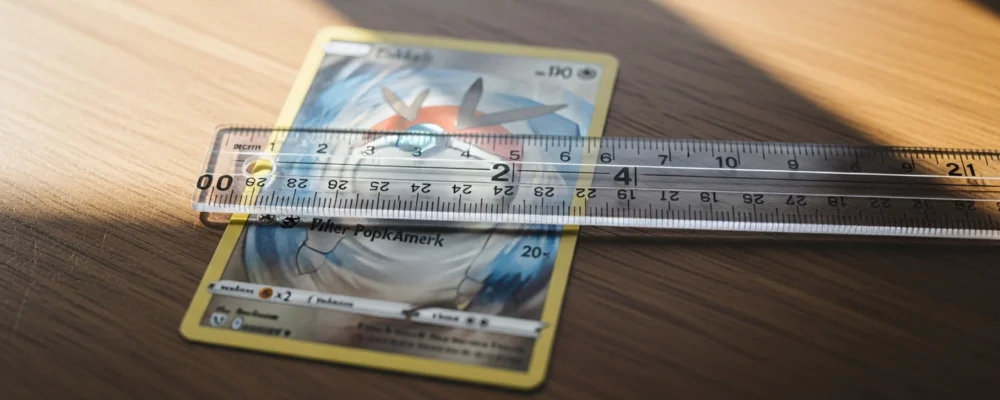
Let’s settle this once and for all. Every Pokemon card ever printed measures 2.5 x 3.5 inches, which converts to 6.3 x 8.8 cm. That’s the number to memorize before you buy a single sleeve, binder page, or toploader.
This measurement hasn’t budged since the game launched, and according to Wargamer, standard cards have stayed locked at 63mm by 88mm since 1996. In tournament terms, that’s a Base Set Charizard and a Scarlet & Violet chase card sharing the exact same footprint. At the table, this consistency is what lets you shuffle a deck spanning multiple eras without a single card sticking out.
Why 2.5 x 3.5 Inches Became the Universal Standard
This wasn’t an arbitrary choice by Wizards of the Coast or The Pokemon Company. In practice, that size traces back to standard playing card dimensions, the same footprint used by a classic 52-card deck. Manufacturers already had die-cutting machines, shufflers, and packaging calibrated for that exact size, so adopting it meant instant compatibility with existing production lines.
Parlons cartes concrètement: this is also why Pokemon cards share identical dimensions with Magic: The Gathering cards, a detail confirmed by Candimension. If you play both games, your MTG deck box works perfectly for your Pokemon binder pulls, and vice versa. That cross-compatibility isn’t a coincidence, it’s an industry-wide agreement that has quietly saved collectors money for decades.
Thickness and Weight of a Standard Card
Size alone doesn’t tell the whole story. Thickness varies more than most collectors realize, and it directly affects which protective gear actually fits.
| Spec | Standard Card | Holo / Full-Art |
|---|---|---|
| Length x Width | 2.5 x 3.5 in (63 x 88 mm) | Same |
| Thickness | 0.01–0.02 in (0.25–0.51 mm) | Up to 0.03 in (0.76 mm) |
| Weight | 1.8–2 g | Slightly heavier due to foil |
A booster pack itself weighs between 22.4 and 22.8 grams on average, a detail worth knowing if you’ve ever eyeballed a pack to guess whether it’s been weighed and resealed by a scalper. As detailed in this complete guide to standard Pokemon card size, that foil layer on holographic cards is the main reason your shiny pulls feel just slightly stiffer in hand than a common. It’s a subtle difference, but it’s exactly why 55pt toploaders exist alongside 35pt ones.
Does Pokemon Card Size Change by Rarity or Card Type?
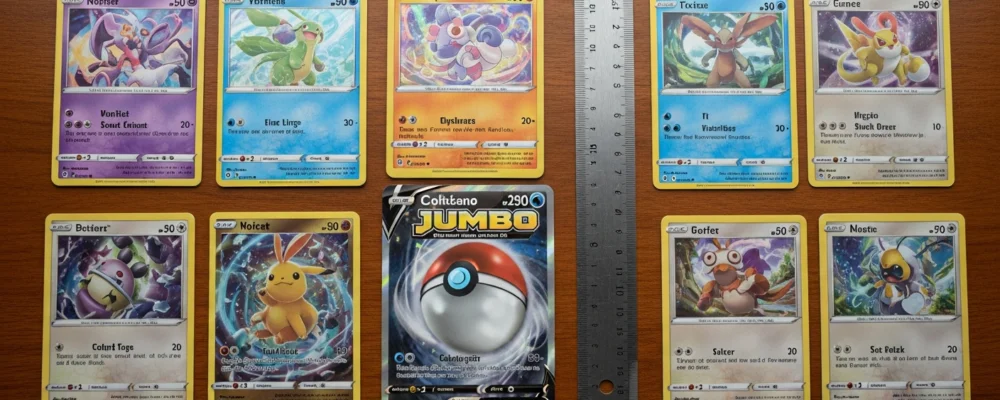
Short answer: no. Rarity changes the price tag, never the paper cutout. Whether you’re holding a Charizard VMAX or a bulk-bin Caterpie, the card sits at the exact same footprint. Rarity is a market signal, not a manufacturing spec, and that’s easy to forget when you’re chasing a chase pull.
V, VMAX, VSTAR, ex and Full-Art Cards: Same Dimensions
Every modern mechanic, from V and VMAX to VSTAR and ex, gets printed on the exact same die-cut sheet as a plain common. All card types in the Pokemon TCG, including full-art and Trainer Gallery cards, measure the standard 63.5 x 88 mm regardless of rarity, according to Wargamer. What changes is the finish, not the frame.
A full-art Arceus VSTAR feels beefier in hand mostly because of its foil coating and texture, not because the printer added extra millimeters. In competitive terms: your deck box, your binder pages, your toploaders all handle a full-art alt just as easily as a common energy card. If you want the deep-dive on exact tolerances across every card category, this complete Pokemon card size guide breaks it down set by set.
Japanese Pokemon Card Size vs Western Prints
Here’s where collectors sometimes get tripped up. Japanese cards and Western (English, French, German) prints share the same 2.5 x 3.5 inch standard on paper. In practice, though, many players report Japanese cards feeling marginally thinner and more flexible than their English counterparts, a texture difference tied to cardstock choice rather than actual measured dimensions.
This nuance matters at the sleeve level more than the binder level. Ultra-thin Japanese cards can rattle loose inside a snug 35pt toploader designed with Western cardstock in mind. As collectors on Reddit’s custom trading card community often note, the width-and-height numbers stay locked, but thickness perception shifts by region. My advice: sleeve Japanese pulls individually before stacking them, especially if you’re prepping for a graded submission. 💡
📏 Jumbo Pokemon Cards and Other Non-Standard Sizes
Not every Pokemon card follows the 2.5 x 3.5 inch rule. Jumbo cards throw the standard out entirely, and they’re the one category where size genuinely changes the experience. These oversized promos show up in tin exclusives, prize packs, and convention giveaways, and they’re built purely as display pieces, not tournament-legal cardstock. 📏
As a collector, I always tell newer players: jumbo cards are gorgeous shelf pieces, but they won’t fit in a deck, a binder, or a standard toploader. They’re a different animal altogether, closer to a poster than a playable card.
Jumbo Card Dimensions: Pre-2020 vs Current Prints
Here’s the twist most guides skip: jumbo sizing itself changed over time. Cards from 2000 to 2020 run larger than the jumbo promos being printed today, according to PrintMTG’s breakdown of Pokemon card dimensions.
| Print era | Inches | Millimeters |
|---|---|---|
| Standard card (any era) | 2.5 x 3.5 in | 63.5 x 88 mm |
| Jumbo, 2000-2020 | 5.7 x 7.87 in | 145 x 200 mm |
| Jumbo, current prints | 5.37 x 7.37 in | 136 x 187 mm |
That gap matters if you’re mixing old and new jumbo pulls in the same display case. A 2000s-era jumbo Charizard will sit noticeably larger than a current jumbo VMAX promo, even though both are labeled “jumbo” on the packaging. In practice, this trips up collectors buying protective sleeves online, since a listing rarely specifies which era it targets.
Beyond jumbo, you’ll occasionally spot other oddball formats: oversized “cheer” cards handed out at premieres, or mini promo cards bundled with certain McDonald’s-style tie-ins. None of these follow tournament regulation sizing, so treat them strictly as collectibles. For the full breakdown of every non-standard format and how to store each one safely, this jumbo card dimensions guide covers sourcing sleeves and display cases by era.
Choosing the Right Sleeve Size for Your Pokemon Cards
Sleeving your cards sounds simple until you’re stuck with a stack that won’t slide in smoothly. The fix is matching sleeve size to what you actually own. Standard Pokemon cards need a sleeve built for 2.5 x 3.5 inches, and according to Cardshellz’s sleeve size guide, the industry standard sits at 67 mm x 92 mm, which covers everything from a 1999 Base Set Charizard to a fresh Scarlet & Violet pull.
Where collectors trip up is thickness, not width or height. A double-sleeved holo, a graded slab candidate, or a thick foil full-art needs breathing room a paper-thin sleeve won’t give. That’s where toploaders come in as the second layer of protection.
35pt vs 55pt Toploaders: Which Fits Best
The “pt” number refers to thickness in points, not card dimensions. Both sizes accommodate the same 2.5 x 3.5 inch footprint.
| Toploader | Best for | Fit notes |
|---|---|---|
| 35pt | Single unsleeved or lightly sleeved cards | Snug fit, minimal rattle |
| 55pt | Double-sleeved or penny-sleeved cards | Extra room, slight movement |
| 75pt-100pt | Cards headed for grading submission | Fits thick semi-rigid holders too |
My advice: buy 35pt for everyday storage and 55pt if you’re prepping a card for a grading service that requires a penny sleeve underneath. Mixing the two in one binder box just wastes space. 📌
Templates and Pixel Dimensions for Custom Card Design
Designing a custom card or proxy for casual play? Stick to the same physical ratio. At 300 DPI, a 2.5 x 3.5 inch template converts to 750 x 1050 pixels, the resolution most print shops expect for sharp text and clean foil edges. Go with 600 DPI for professional-grade printing, and you’re looking at 1500 x 2100 pixels.
Some hobbyists on forums discussing custom card sizing add a small bleed margin around the template to avoid white edges after trimming. Skip that step and your homemade card ends up looking noticeably off next to a real printed one. For a deeper dive into official measurements before you start designing, check this complete Pokemon card size guide.
Frequently Asked Questions
Are Pokémon cards 35PT or 55pt?
Both fit, depending on the card. Standard commons and uncommons, at 0.01-0.02 in thick, slide easily into a 35pt toploader. Holo, full-art, or VMAX cards run thicker (up to 0.03 in) because of foil, so a 55pt toploader avoids bending or cracking them. 🎴