Key takeaways
Every Pokemon card shares the same footprint as a standard playing card, yet getting that size wrong by even a millimeter costs you a cracked sleeve, a rejected toploader, or a dinged grade. Here’s what you need to know before you buy a single protective sleeve.
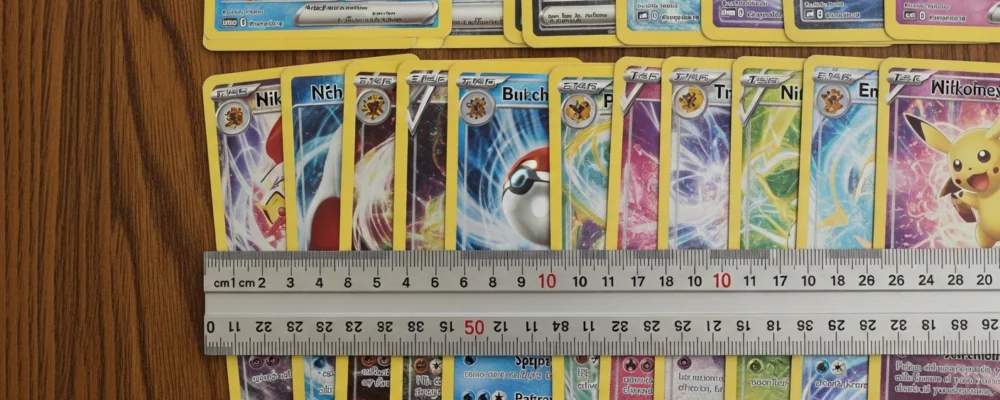
- Exact dimensions are 2.5 x 3.5 inches (63.5 x 88.9 mm) — the universal “poker size” standard shared across most modern TCGs.
- 🎯 Card thickness sits at 35pt for standard English cards, meaning not all toploaders are equal — grabbing a 55pt holder leaves your card rattling and unprotected.
- Japanese Pokemon cards measure slightly smaller (59 x 86 mm), so standard English sleeves will be loose and offer weaker protection.
- Jumbo promo cards scale up to roughly 4 x 5.5 inches and are never tournament legal — knowing this saves you an embarrassing deck check rejection.
- ✅ Pixel dimensions for digital mockups land at 747 x 1038 px at 300 DPI, essential for accurate print-on-demand projects.
- The most overlooked insight in this guide: card thickness directly impacts PSA and BGS grading outcomes — and most collectors don’t know why.
Pokemon Card Size: Exact Dimensions in Inches, mm and cm
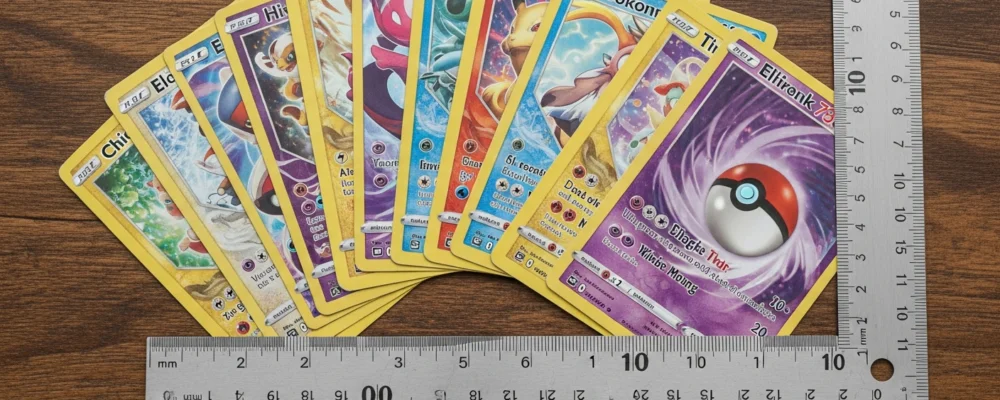
Let’s get precise. Every number here is the one that matters when you’re buying sleeves, printing proxies, or sending cards to a grading service.
Standard Pokemon card size: 2.5 x 3.5 inches explained
The standard Pokemon card size is 2.5 x 3.5 inches, a format known in the industry as poker size or bridge-standard. The Pokemon Company has used this footprint consistently across English-language releases since the Base Set launched in 1999.
This matters beyond trivia. Every sleeve, toploader, and binder page on the market is engineered around that exact footprint. Miss it by a millimeter and you introduce unwanted movement inside the sleeve, which scratches surface holo foil and risks a lower centering grade.
For a deeper look at how that footprint translates to real-world protection choices, check out this complete guide to standard Pokemon card size.
Pokemon card size in mm, cm and pixels for digital use
Physical dimensions convert cleanly across measurement systems. The table below gives you every unit you’ll need, whether you’re ordering custom sleeves or building a print-on-demand template.
| Unit | Width | Height | Use Case |
|---|---|---|---|
| Inches | 2.5 in | 3.5 in | US retail sleeves |
| Millimeters | 63.5 mm | 88.9 mm | EU sleeve specs |
| Centimeters | 6.35 cm | 8.89 cm | Quick reference |
| Pixels (300 DPI) | 747 px | 1038 px | Print / digital mockups |
| Pixels (72 DPI) | 180 px | 252 px | Web display only |
According to CandDimension, the 63.5 x 88.9 mm measurement is consistent across all modern English print runs. For digital work, always build at 300 DPI minimum. Designing at 72 DPI and scaling up produces pixelated artwork that looks nothing like the original card.
How thick is a Pokemon card: 35pt vs 55pt
Thickness is the most underestimated dimension. Standard English Pokemon cards measure 35pt (approximately 0.89 mm). That single number determines which toploader actually protects your card.
A 55pt toploader is built for thicker cards like relic patches in sports cards. Drop a 35pt Pokemon card inside one and it shifts freely, corner-dinged with every move. This is one of the most common mistakes I see new collectors make at trade nights.
| Thickness | Approx. mm | Fits Standard Pokemon? | Impact on Grading |
|---|---|---|---|
| 35pt | 0.89 mm | ✅ Yes | 🔥 Optimal fit |
| 55pt | 1.40 mm | 🟡 Partial | ❌ Card rattles, risks corners |
| 100pt | 2.54 mm | ❌ No | ❌ Not appropriate |
Card thickness also intersects directly with grading submission costs: graders like PSA handle cards in bulk, and improper holders that cause surface contact can generate scratches visible under inspection lighting. Getting the thickness right before submission is a simple win that costs nothing.
Read also: Pokemon Card Size Explained: Exact Dimensions in Inches and CM
Read also: Pokemon Brick Bronze: 7 Tips to Master the Game in 2026
Pokemon Card Size vs Other TCGs and Playing Cards
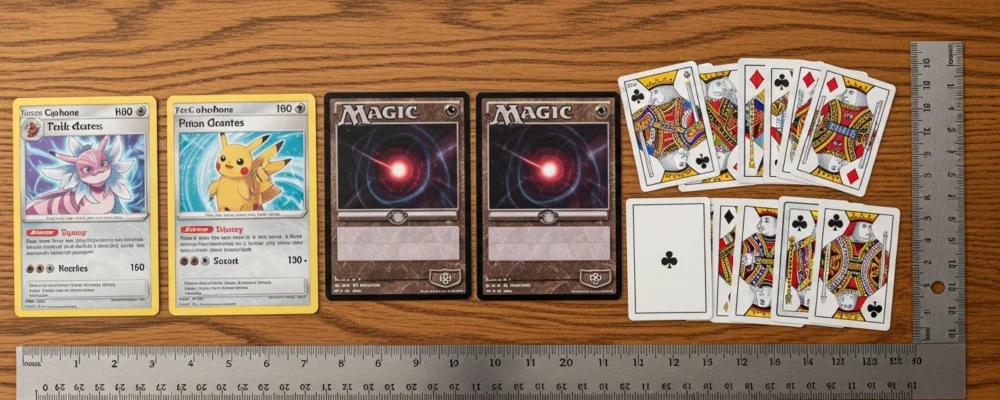
Pokemon card size compared to Magic: The Gathering and One Piece TCG
Size matters more than most players realize. A card that fits a Pokemon sleeve perfectly will rattle inside a Magic sleeve, and vice versa.
Standard English Pokemon cards measure 2.5 x 3.5 inches (63.5 x 88.9 mm). That exact format is called the poker card standard, and it is shared by more TCGs than you might expect. Magic: The Gathering cards match that size precisely. So do One Piece TCG cards.
At the table, this means one thing: the same sleeve fits all three games. A 64 x 89 mm inner sleeve works for Pokemon, Magic, and One Piece without adjustment. That matters when you are buying sleeves in bulk for a multi-game collection.
The differences appear in thickness and card stock feel, not in surface dimensions. According to Wargamer, Pokemon cards and Magic cards share the same 63.5 x 88.9 mm footprint, making cross-game sleeve compatibility straightforward for collectors.
Here is a direct size comparison across the three major TCGs:
| TCG | Width (mm) | Height (mm) | Same Sleeve? | Notable Difference |
|---|---|---|---|---|
| Pokemon (English) | 63.5 mm | 88.9 mm | ✅ Yes | 35pt card stock |
| Magic: The Gathering | 63.5 mm | 88.9 mm | ✅ Yes | Slightly stiffer feel |
| One Piece TCG | 63.5 mm | 88.9 mm | ✅ Yes | Glossier finish |
| Yu-Gi-Oh! | 59 mm | 86 mm | ❌ No | Smaller format entirely |
💡 Yu-Gi-Oh! is the outlier that catches collectors off guard. Its cards are noticeably shorter and narrower. Never store Yu-Gi-Oh! cards in Pokemon sleeves: they swim inside them and pick up micro-scratches along the edges.
Japanese Pokemon card size vs English card size
This is where many collectors make a costly assumption. Japanese Pokemon cards are not the same size as English ones.
Japanese cards measure 56 x 87 mm, roughly 7.5 mm narrower than their English counterparts. The height difference is smaller (under 2 mm), but the width gap is significant enough that English sleeves create visible side-play on Japanese cards.
🎯 If you are building a mixed Japanese and English collection, you need two separate sleeve sizes. Using English-sized sleeves on Japanese cards is one of the most common storage mistakes I see at trade events.
| Card Edition | Width (mm) | Height (mm) | English Sleeve OK? |
|---|---|---|---|
| English Pokemon | 63.5 mm | 88.9 mm | ✅ Yes |
| Japanese Pokemon | 56 mm | 87 mm | ❌ No, too loose |
For Japanese cards, look for sleeves specifically labeled small size or Japanese TCG size (typically 60 x 87 mm). Brands like KMC and Bushiroad produce these in Japan and they are widely available through import retailers. Getting this right matters even more if you plan to submit Japanese cards for grading, since surface damage from ill-fitting sleeves is visible under inspection.
Jumbo and Oversized Pokemon Cards: pokemkn card size Variations
Jumbo card dimensions and when they were introduced
Oversized Pokemon cards are exactly what they sound like: significantly larger than standard play cards, designed for display and promotional use. The official jumbo card format measures 5 inches x 7 inches (approximately 127 x 178 mm), making each dimension exactly double the standard size.
The format has been around longer than most collectors realize. According to Evo Retro, oversized cards were introduced during the early Wizards of the Coast era, with jumbo versions of iconic cards like the Base Set Charizard appearing as promotional items. They have since become a recurring feature in elite trainer boxes, special collections, and event promo bundles.
For a deeper breakdown of storage and display options for these formats, the jumbo card dimensions guide covers every collector scenario in detail.
- ✅ Standard jumbo size: 5 x 7 inches (127 x 178 mm)
- Thickness: similar to standard cards, around 35pt
- 🔥 Most sought-after jumbo: promo versions of full-art EX and VMAX cards from recent sets
- Typical source: elite trainer boxes, Costco bundles, event giveaways
As a collectionneuse, I keep my jumbo cards in rigid top-load frames made specifically for 5×7 prints. Standard card supplies simply will not work here.
Are oversized cards tournament legal
Short answer: no. Jumbo and oversized Pokemon cards are never legal for competitive play under official Pokemon TCG rules.
The Pokemon Company’s tournament regulations require all cards used in sanctioned events to match the standard 63.5 x 88.9 mm format. Oversized cards fail this check instantly and are excluded from deck verification before a match even begins.
- ❌ Not legal in any official tournament format (Standard, Expanded, or Legacy)
- ❌ Cannot substitute for the standard version of the same card, even if the text is identical
- ✅ Fully legal as display pieces, trade items, and collection showcases
One nuance worth knowing: owning a jumbo card does not affect the value of a standard version of the same card. They are treated as entirely separate collectibles by the market. Some jumbo promos actually command strong prices on their own, particularly sealed copies from older elite trainer box releases.
If competitive play is your goal, always verify card legality on the official Pokemon TCG website before building your deck.
Pokemon Card Size for Sleeves, Toploaders and Storage: a Collector Guide
Choosing the right sleeve size for standard Pokemon cards
Getting sleeving wrong is one of the most common collector mistakes. A sleeve that’s too loose lets cards shift and scratch. Too tight, and you risk bending corners on insertion.
Standard Pokemon cards measure 63.5 x 88.9 mm. The correct sleeve size is 65 x 90 mm, sometimes labeled “standard” or “Japanese large” depending on the brand. This gives a snug fit with minimal movement.
- ✅ 65 x 90 mm: perfect fit for all English standard cards
- ✅ Double-sleeving: inner 64 x 89 mm perfect fit + outer 67 x 92 mm
- ❌ 63 x 88 mm “perfect fit” alone: too tight for long-term storage
- ❌ MTG-sized sleeves (66 x 91 mm): too loose, cards slide freely
For tournament play, double-sleeving is the gold standard. It blocks humidity, prevents edge wear, and protects high-value pulls from the moment they leave the pack.
Toploader and card binder sizing: what fits and what to avoid
Not all rigid protection is created equal. Toploaders come in different point thicknesses, and choosing the wrong one damages the cards you’re trying to protect.
The table below summarizes the most common options and their compatibility with standard Pokemon cards.
| Product Type | Size / Spec | Fits Standard Card? | Best Use Case |
|---|---|---|---|
| Standard toploader | 3 x 4 inch, 35pt | ✅ Yes | Single-sleeved raw cards |
| Thick toploader | 3 x 4 inch, 55pt | ✅ Yes | Double-sleeved or thicker cards |
| Card binder pocket | 65 x 90 mm slot | ✅ Yes | Bulk collection storage |
| Screw-down holder | 35pt standard | 🟡 Partial | Display only, not ideal for grading submission |
| One-touch magnetic | 35pt or 55pt | ✅ Yes | Premium singles, show pieces |
For binders, always choose pages with side-loading pockets. Top-loading binder pages let cards slide out during transport, which causes the very edge wear you’re trying to prevent.
Card thickness and grading: why pt matters for protection
Card thickness is measured in points (pt), where 1 pt equals roughly 0.025 mm. A standard Pokemon card sits at 35pt. Knowing this number matters more than most collectors realize.
When submitting cards to grading services like PSA or BGS, the toploader you use for shipping must match the card’s actual thickness. A 35pt card rattling inside a 130pt holder will arrive with surface damage and tank the grade. According to Candi Dimension, standard Pokemon cards weigh approximately 1.8 grams and measure 0.8 mm thick, confirming the 35pt benchmark collectors rely on.
💡 Before submitting to any grading service, check their specific packaging guidelines. Grading costs vary significantly by tier, and a preventable packaging error can void your submission entirely. If you want a full breakdown of what graders look for in terms of card condition and dimensions, the complete Pokemon card size guide covers every spec graders reference.
- 35pt toploader: correct for raw, single-sleeved standard cards
- 55pt toploader: use when double-sleeving before submission
- ⚠️ Never use penny sleeves alone for grading submissions. They offer zero structural support.
Frequently Asked Questions
What are the sizes of a Pokémon card?
A standard Pokémon card measures 2.5 inches wide by 3.5 inches tall (63mm x 88mm). This applies to virtually all modern cards in the TCG lineup. Jumbo or oversized promotional cards are larger, typically measuring around 4.5 inches by 6.25 inches.
Are Pokémon cards 3.5 inches?
Yes, standard Pokémon cards are 3.5 inches tall and 2.5 inches wide. This is the universally recognized size for the TCG. Any sleeve, binder page, or card holder designed for standard trading cards will fit Pokémon cards perfectly.
Are Pokémon cards 35pt or 55pt?
Most standard Pokémon cards measure 35pt (points) in thickness. However, some special edition, textured, or premium cards can measure closer to 55pt. Always check the specific card type before purchasing rigid card holders or one-touch cases.
What is the standard size of a TCG card?
The standard TCG card size is 2.5 x 3.5 inches (63mm x 88mm), often called the “poker card” size. Pokémon cards follow this exact standard, making them compatible with sleeves and storage accessories designed for Magic: The Gathering and other major trading card games.