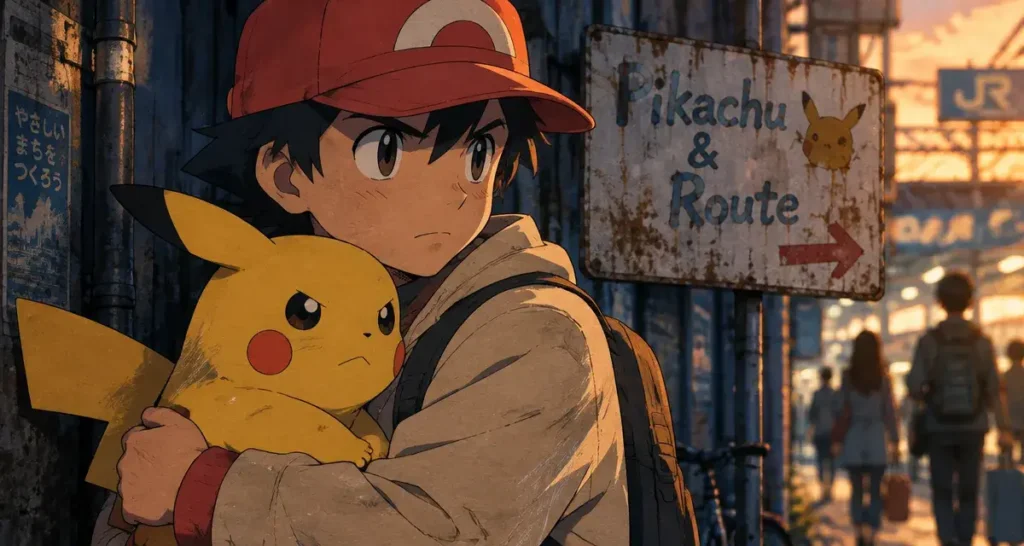
Ash Ketchum is the Pokémon Trainer who led the animated series for its first 25 seasons. Known as Satoshi in Japan, he begins as an eager but inexperienced ten-year-old from Pallet Town in Kanto. His ambition is to become a Pokémon Master. Along the way, he learns from defeats, builds trust with Pokémon, and keeps returning to the road with the same curiosity.
Ash Ketchum at a glance
For viewers who know him mainly from the English-language anime, Ash is the boy in the cap who starts his journey late, receives an unusual Pikachu from Professor Oak, and gradually becomes one of the strongest Trainers in the Pokémon world. His Japanese name, Satoshi, identifies the same character in the original version of the franchise.
Ash Ketchum’s 10 Most Iconic Traveling Companions · Explore the official retrospective of Ash Ketchum’s most memorable companions throughout his Pokémon journey.
| Key fact | Answer |
|---|---|
| Japanese name | Satoshi |
| Hometown | Pallet Town, Kanto |
| Starting age | 10 |
| First Pokémon | Pikachu |
| Core goal | To become a Pokémon Master |
| Major titles | Alola League Champion and World Champion, also called Monarch |
Ash’s goal is broader than collecting trophies. Becoming a Pokémon Master is a continuing ideal built around understanding Pokémon, testing himself against exceptional Trainers, and growing through the people and creatures he meets. A major championship is therefore a milestone in his journey, not a final definition of the character.
From a late start to the world stage
Ash begins his journey on his tenth birthday. Because he arrives late at Professor Oak’s laboratory, he receives Pikachu instead of one of the more conventional starter Pokémon. Their first encounters are difficult, since Pikachu does not immediately trust its new Trainer. Ash’s decision to protect Pikachu establishes the partnership that defines the series.
Learning through regions, Leagues, and setbacks
Across his travels, Ash catches and trains different Pokémon, earns Gym Badges, meets regional Champions, and enters Pokémon League competitions. His early results show the gap between enthusiasm and experience. At the Indigo Plateau Conference, he reaches the Top 16, a significant result for a first major campaign but still far from the title he wants. The anime uses these setbacks to show that effort must be supported by preparation, strategy, and mutual trust.
His teams change as each region introduces different environments, battle styles, friends, and opponents. This rotation forces Ash to adapt rather than rely on a finished lineup. He can be impulsive and stubborn, but those traits are balanced by kindness, resilience, and a willingness to recognize potential in Pokémon others might overlook.
What separates a Pokémon Master from a Champion
A Champion title recognizes a specific competitive achievement. A Pokémon Master is Ash’s personal horizon, a phrase that remains open because it combines battle skill with experience, empathy, discovery, and the desire to keep traveling. His later titles confirm his development, but they do not make him a character with nothing left to learn.
Pikachu, companions, and rivals: the relationships that shape Ash
Pikachu is Ash’s first Pokémon and his only constant partner across his regional journeys. More than a mascot, Pikachu is the clearest measure of Ash’s growth as a Trainer. Their partnership works because neither simply commands the other. They read danger quickly, take risks for one another, and develop battle instincts through shared experience.
Ash’s changing teams can be compared with a raft crossing a long river. The passengers and supplies change at each shore, but one stable element keeps the journey oriented. Pikachu provides that continuity. Because Ash does not have to rebuild his central bond from the beginning, he can welcome new Pokémon while carrying the experience of earlier regions, tactics, and hard-won trust.
Friends turn travel into education
Traveling companions such as Misty and Brock bring practical knowledge, disagreement, humor, and emotional support to Ash’s adventures. They prevent his journey from becoming a sequence of isolated matches. Through friendship, Ash learns that caring for Pokémon also requires patience outside the battlefield. His companions can challenge him when confidence turns into recklessness.
Rivalry gives his ambition a face
Gary Oak matters because he is both Ash’s childhood acquaintance and a visible benchmark. Their rivalry pushes Ash to compare his progress with another Trainer’s results, including the number of Pokémon caught and the quality of their training. Recurring opponents such as Team Rocket serve a different purpose. They test Ash and Pikachu’s loyalty, resourcefulness, and instinct to protect Pokémon from exploitation.
The victories that changed Ash’s status
Ash’s later achievements give a clear shape to a journey once defined by near misses. They do not erase his earlier losses. Instead, those losses become part of a long development arc. Two milestones are especially useful for understanding his status at the highest competitive level.
| Achievement | Why it matters |
|---|---|
| Alola League Champion | It marks Ash’s first regional League championship. |
| World Coronation Series winner | It establishes him as World Champion and the Monarch of the competition. |
Winning the Alola League proves that Ash can turn years of experience into a regional championship. Later, his victory in the World Coronation Series in Pokémon Ultimate Journeys: The Series raises the stakes beyond one region. The Monarch title identifies him as the leading Trainer within that global competition. Together, these achievements bring his reputation in line with his ambition.
Ash, Satoshi, and Red are related, but not interchangeable
Ash Ketchum is the English name used for the anime protagonist, while Satoshi is his Japanese name. He is loosely based on Red, the player character associated with Pokémon Red and Blue, but Ash is not simply Red transferred into animation. Red functions mainly as a game counterpart, whereas Ash has an ongoing personality, friendships, rivalries, and a long serialized history shaped by the anime.
The character design for Ash was created by Atsuko Nishida. Across different series, his clothing and visual presentation are updated, but the combination of a cap, determined energy, and Pikachu at his side preserves his identity. This allows the anime to evolve visually without losing its central point of reference.
Voice performances and appearances beyond the main anime
Rica Matsumoto voices Ash in Japanese. In the English dub, Veronica Taylor voiced him for seasons 1 through 8, while Sarah Natochenny took over from season 9 through season 25. These performances shape how different audiences recognize the character, especially because Ash’s voice must convey both youthful enthusiasm and the resolve of an increasingly accomplished Trainer.
Ash also appears in manga, video games, demos, mobile games, and related Pokémon media. These appearances should not always be treated as one uninterrupted continuity. Adaptations may use alternate interpretations, different story roles, or game-focused versions of the character. For a straightforward account of his core development, the animated series remains the main reference.
Why Ash Ketchum remains central to Pokémon
After Ash’s run as the main anime protagonist concluded, Pokémon Horizons: The Series introduced Liko and Roy as new leads. The change created space for a fresh journey, while also showing how unusual Ash’s long tenure was. From his 1997 debut to his final listed appearance in 2023, he provided a consistent human perspective on a franchise built around discovery, competition, and companionship.
Ash remains memorable because he is not presented as effortlessly perfect. He loses, misjudges situations, and has to adjust, yet he treats each failure as a reason to keep moving. His friendship with Pikachu gives that perseverance a personal form. The most memorable Ash Ketchum moments are rarely only about power. They are about choosing trust, protecting a partner, and taking the next step toward a goal that remains worth pursuing.