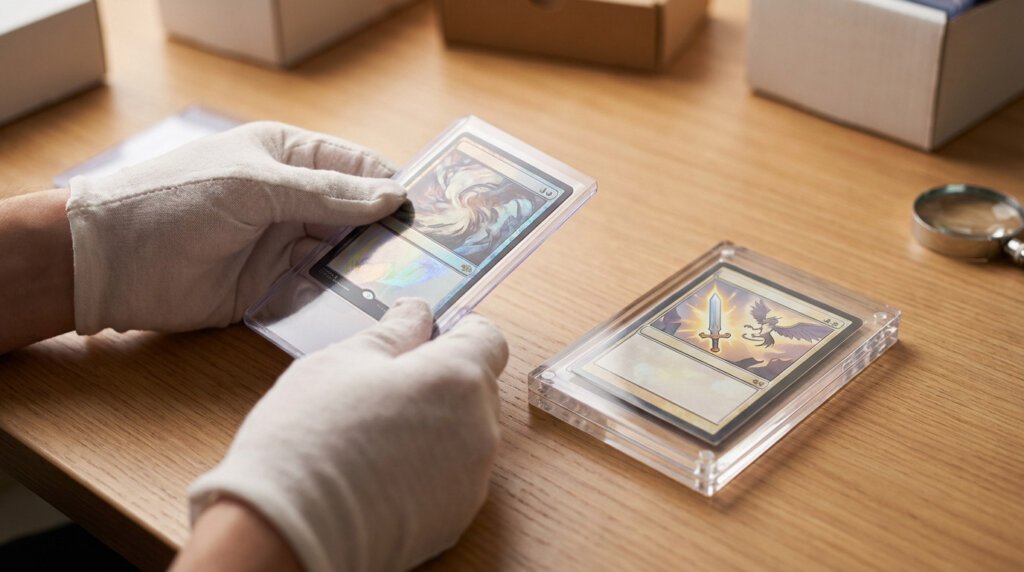
A rare Pokémon card is not automatically a valuable Pokémon card. The symbol near the card number is a useful starting point, but an accurate assessment also depends on the exact set, variant, condition, language, demand, and authenticity. A modern card with a striking finish may be easier to find than an older promo distributed at a small event. Conversely, a modest-looking playable card can attract strong demand.
Start with the card’s identity, not its price
Before searching for a value or comparing listings, identify the card precisely. Look near the lower edge for the set number, usually shown in the format XXX/XXX. The first number identifies the card within the expansion, while the second indicates the advertised size of that set. A number such as 224/198 is an important clue: because the first number exceeds the set size, the card is generally a secret rare.
Official Pokémon TCG Card Database · Find any Pokémon TCG card with filters for type, Energy, format, expansion, and more.
The rarity symbol is normally close to this number. Traditional Pokémon cards use four familiar markers: a black circle for common, a black diamond for uncommon, a black star for rare, and a black star accompanied by PROMO for a promotional card. These symbols describe the card’s official rarity within its release. They do not show how many copies still exist or guarantee a particular market value.
| Marker or category | What it usually indicates | What to check next |
|---|---|---|
| Circle | Common card | Set, age, error status, and condition |
| Diamond | Uncommon card | Variant, competitive demand, and print history |
| Star | Rare card | Holo treatment, edition, and condition |
| PROMO marking | Promotional distribution | How and where the card was distributed |
| Number above set size | Secret rare | Exact version and recent sold comparisons |
Read modern rarity labels without mixing them up
Scarlet & Violet introduced a more detailed rarity structure that includes double rare, ultra rare, illustration rare, special illustration rare, and hyper rare cards. These labels make modern collector cards easier to describe, but they do not replace a complete identification check. Two cards can feature similar artwork or the same Pokémon while belonging to very different rarity tiers.
Holo, reverse holo, and full art are different treatments
A holofoil card generally has a reflective finish in the Pokémon artwork area. A reverse holofoil usually places the reflective pattern outside the artwork box. Neither term means “rare” on its own. Some reverse holos are widely available, while a particular holo version from an older set may be much harder to replace.
Full-art cards extend the illustration across most or all of the card face and are often associated with ultra-rare categories. Illustration rare and special illustration rare cards place more emphasis on detailed artwork and scene-building. Hyper rare cards are commonly recognised by their gold finish. Mega Hyper Rare cards are described as having very low pull rates, as low as 1 in 1,260 packs.
Older terminology belongs to its own era
Vintage and older-era collecting uses its own vocabulary, including Gold Star, Crystal, Shining, Delta Species, Prime, LEGEND, BREAK, Prism Star, Tag Team, Amazing Rare, Shiny Vault, Pokémon-ex, EX, GX, V, VMAX, and VSTAR. These labels should not be ranked as if they formed one universal ladder. A Gold Star card, for example, comes from a different release context than a modern special illustration rare. Compare cards within the same era before making assumptions about scarcity or value.
Why scarcity is more complex than a rarity symbol
The most collectible cards often combine limited distribution with historical importance. Trophy cards, contest prizes, test prints, early promotional releases, and unusual regional issues can be scarce because they were never ordinary pack pulls. That is why the Pikachu Illustrator, associated with the 1997–1998 contest period and stated as having 39 distributed copies, is treated as an iconic collecting milestone rather than simply a rare card.
Other well-known examples show how provenance shapes demand. The 1998 Blastoise WOTC Presentation Galaxy Holo is presumed to have had fewer than 10 copies produced, with two known English-back copies. No. 1 Trainer Trophy cards from 1997–2001, Tamamushi University Magikarp, Ishihara GX Promo, Pre-Release Raichu, and First Edition Shadowless Charizard all attract attention for reasons beyond their printed rarity. Event history, early production, limited circulation, and cultural status all influence how collectors view them.
A collection is better understood as a mosaic than as a simple scale from “common” to “valuable.” One piece may be the set number, another the language, another the foil pattern, and another the route by which the card reached collectors. When those details align, such as a limited promo in excellent condition with documented provenance, the market picture can change. This method also helps prevent costly comparisons between different releases, such as a Japanese card and an English version with a different print population.
Assess condition and authenticity before considering grading
Condition can transform the value of the same rare Pokémon card. Inspect the centering, corners, edges, and surface under direct light. Whitening, dents, scratches, creases, print lines, fading, and foil wear all matter. A card that looks clean in a binder can still show surface flaws when tilted, particularly when it has a holofoil finish.
Raw card or graded card?
A raw card is sold without a professional numerical grade. It may cost less and can be easier to inspect in person, but its condition assessment remains subjective. A graded card has been evaluated and enclosed by a grading company such as PSA, CGC, or BGS. The holder gives buyers a shared condition reference, but grading costs money and does not guarantee a profit.
Submitting a card makes the most sense when it appears genuinely high grade, has meaningful collector demand, and would benefit from independent authentication. Do not grade a card only because it has a star symbol. A lower-grade card may be better protected in a binder or top loader if the grading fee would outweigh the likely difference in sale value.
Buy, store, and price rare Pokémon singles carefully
Buying individual singles can be more cost-effective than opening sealed products when you want one specific card. Ask for clear front and back photographs, including close-ups of the corners and reflective surfaces. Confirm the exact card number, language, edition, and variant. For graded cards, inspect the label details and check that the card inside matches the listing description.
- Compare completed sales for the same card, language, variant, and grade instead of relying on an asking price.
- Be cautious with generic photos, unusually low prices, or vague descriptions such as “rare holo” without a set number.
- Check texture, print quality, colours, borders, and spelling when assessing a possible counterfeit.
- Use a sleeve first, then a rigid holder or a quality binder with side-loading pockets.
- Store cards away from humidity, direct sunlight, heat, and pressure.
Market value is not fixed. A Base Set Venusaur Holo has a CGC 7 sale reference of $86, while an Obsidian Flames Charizard ex has a CGC 9 sale reference of $62. These examples show why age, grade, set popularity, supply, and demand can matter more than visual impact. Identify the card first, inspect it carefully, and compare like-for-like completed sales before buying, selling, or grading.