Pokémon starters are the first partners that turn an empty party into a team. In most core series adventures, you choose one Grass-, Fire-, or Water-type Pokémon near the beginning, then build your strategy, rival battles, and memories around that decision. The familiar trio is simple by design, but every generation gives its starters a different identity.
What makes a Pokémon a starter?
A starter Pokémon, also called a first partner Pokémon, is usually given to the player by a Professor, mentor, or another important character at the start of an adventure. In core series games, regional starters generally begin at level 5. They are designed to be dependable early teammates, with evolutionary lines that can support a player through the entire story.
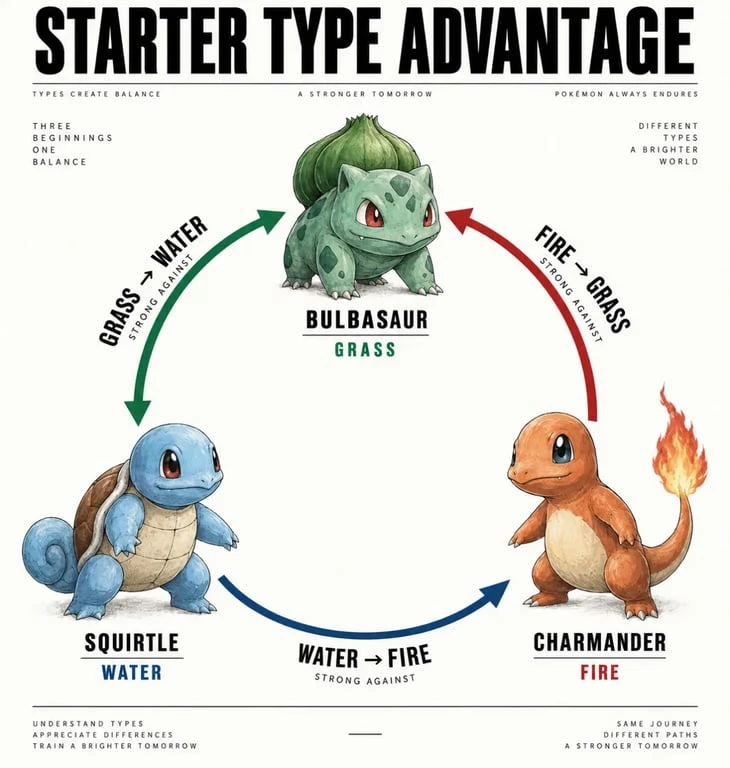
The traditional selection uses three types: Grass, Fire, and Water. Fire is strong against Grass, Water is strong against Fire, and Grass is strong against Water. This type triangle introduces battle effectiveness immediately without making one choice universally superior. Rivals often select the Pokémon with a type advantage over the player’s choice, so the decision can matter beyond the first route.
Starter Pokémon and first partners are not always identical ideas
“Starter Pokémon” remains the everyday phrase among players, while “first partner Pokémon” has been widely used in official media from Generation VI onward. The second term is broader because it can include a special companion outside a regional Grass-Fire-Water trio. Pikachu in Pokémon Yellow, for example, is both the player’s first partner and starter in that game. Eevee fills a similar role in Pokémon: Let’s Go, Eevee!.
A starter is also not simply the first Pokémon a trainer owns. A player may receive, catch, or inherit a Pokémon first in a spin-off, the anime, or a challenge run. The label matters because regional starters are usually balanced as a set. They have parallel evolutionary stages, comparable overall growth, and abilities such as Overgrow, Blaze, and Torrent, which strengthen their matching type when HP is low.
The regional Pokémon starters at a glance
The table below separates the standard regional trios from game-specific selections that follow a different pattern. Each game listed is the original core-series setting most closely associated with its trio. Remakes may offer the same choices in another presentation.
Search the Official Pokémon TCG Card Database · Find any Pokémon TCG card quickly by type, Energy, format, expansion, and more.
| Generation and region | Associated games | Grass starter | Fire starter | Water starter |
|---|---|---|---|---|
| Generation I, Kanto | Red, Blue | Bulbasaur | Charmander | Squirtle |
| Generation II, Johto | Gold, Silver | Chikorita | Cyndaquil | Totodile |
| Generation III, Hoenn | Ruby, Sapphire | Treecko | Torchic | Mudkip |
| Generation IV, Sinnoh | Diamond, Pearl | Turtwig | Chimchar | Piplup |
| Generation V, Unova | Black, White | Snivy | Tepig | Oshawott |
| Generation VI, Kalos | X, Y | Chespin | Fennekin | Froakie |
| Generation VII, Alola | Sun, Moon | Rowlet | Litten | Popplio |
| Generation VIII, Galar | Sword, Shield | Grookey | Scorbunny | Sobble |
| Generation IX, Paldea | Scarlet, Violet | Sprigatito | Fuecoco | Quaxly |
Evolution changes the decision
The base form is only the beginning. Bulbasaur becomes Ivysaur and Venusaur; Charmander becomes Charmeleon and Charizard; Squirtle becomes Wartortle and Blastoise. Every regional starter follows this three-stage pattern, but final evolutions can change a Pokémon’s role through improved stats, a wider move pool, and sometimes an additional type.
Choosing only by the first design can therefore be misleading. Rowlet may appeal to players who like its owl-inspired look, but its final evolution, Decidueye, plays differently from a pure Grass type. The same principle applies to the lines of Litten and Popplio, as well as older examples such as Torchic and Froakie. If long-term battle performance matters, look at the complete evolutionary line before making a choice.
Choose by your play style, not a universal ranking
There is no single strongest starter across every game. A useful choice depends on the early gyms, wild encounters, available teammates, move access, and the player’s preferred pace. A starter with a favorable first gym matchup can make the opening hours easier, but a difficult early matchup does not make that Pokémon weak throughout the adventure.
For a smoother first playthrough
Beginners often benefit from a starter that handles common early opponents and uses straightforward attacks. Water types are frequently valued for reliable coverage and a balanced feel. Fire types can be especially useful when early routes contain many Bug- or Grass-type opponents. Grass types may have more visible weaknesses, but they can offer status moves, recovery options, and strong matchups in the right region.
- Choose Grass if you enjoy tactical battles, status effects, and exploiting Water- or Ground-type opponents.
- Choose Fire if you prefer immediate offensive pressure and a direct attacking style.
- Choose Water if you want a flexible all-rounder that can fit easily beside many team members.
Use the “key slot” test when building a team
Think of your starter as the key that opens one early door, but do not let it dictate every other team choice. If your Fire starter already handles Grass and Bug foes, you do not need to rush into catching another Fire type because it looks powerful. Ask which team role remains open instead. You may need Electric coverage for Water types, a Flying type for travel and Grass matchups, or a sturdy defensive Pokémon. This simple check prevents a party of overlapping attackers.
Experienced players can judge a starter by more than its primary type. Consider speed, power, durability, secondary typing, and whether its level-up moves address recurring battles. A great design does not guarantee a great move pool, while a difficult opening can still lead to an excellent final evolution. Story usefulness and competitive potential are different tests, so the better choice depends on how you plan to play.
Special starters and mixed-generation choices
Not every Pokémon game follows the regional trio template. Pokémon Yellow gives the player Pikachu, while the Let’s Go games center the journey on Pikachu or Eevee as partner Pokémon. These choices focus more on character and companionship than on the standard Grass-Fire-Water triangle.
Pokémon Legends: Arceus takes another route with a mixed-generation group: Rowlet, Cyndaquil, and Oshawott. Instead of introducing one new regional trio, it asks players to choose between familiar lines from different regions. Pokémon Legends: Z-A similarly uses Chikorita, Tepig, and Totodile. These lineups matter when checking starter availability because region, generation, and game are related but are not always the same thing.
Why a favourite starter can still be the best choice
Battle comparisons are useful, but starters are also designed to create attachment. Charmander, Chikorita, Mudkip, Piplup, Snivy, Froakie, Rowlet, Scorbunny, and Fuecoco can all be the “best” choice when they make a journey feel personal. Design, nostalgia, animation appearances, and a memorable evolution can matter as much as a favorable gym battle.
Choose strategically if you want the smoothest route through a specific game. Choose based on preference if you want a partner you will enjoy training. The strongest Pokémon starters are often the ones that encourage you to learn their matchups, keep them on the team, and finish the adventure with a story that feels like your own.