Pokémon Red is the original Game Boy role-playing adventure that introduced many players to Kanto, Professor Oak, Gym battles, Team Rocket, and the goal of filling a Pokédex. It remains easy to recognize, but not always easy to buy wisely. A copy can be a playable classic, a piece of gaming history, or a collectible whose value depends on what is included and whether it still works.
Why Pokémon Red still defines the original Kanto adventure
Developed by Game Freak with Creatures and published by Nintendo, Pokémon Red Version turns a simple premise into a long-form journey. The player starts in Pallet Town, chooses a first partner Pokémon, and sets out across the Kanto region. Wild Pokémon can be caught, trained, evolved, and registered in the Pokédex.
The progression follows a clear rhythm: explore a new route or town, strengthen the team, defeat a Gym Leader, then gain the access or ability needed to move farther through Kanto. The main competitive challenge is the Elite Four and the Champion, while Team Rocket provides the recurring conflict. Mewtwo, found late in the adventure, is one of the most memorable rewards for players who reach the endgame.
More than a collection game
Collecting is central, but Pokémon Red works because every captured Pokémon can become part of a tactical team. Type matchups, move choices, level growth, and limited party space make each decision matter. A player may keep a familiar starter such as Charmander, build around Pikachu, or assemble a team designed to handle upcoming Gyms.
The game’s monochromatic pixel art and 4-bit background music are closely tied to its Game Boy identity. These technical limits shape the experience rather than simply getting in the way. Routes are easy to read, towns have distinct visual silhouettes, and each battle sound cue becomes part of the memory of travelling through Kanto.
Its central tension is between independence and exchange. You can explore, train, and defeat the Elite Four alone, but a complete collection requires help from another game. The Link Cable was more than an accessory: it connected two handheld saves, allowing a duplicate catch to become someone else’s missing Pokédex entry and a carefully trained team to be tested face-to-face.
Can you complete Pokémon Red without trading?
You can finish the story, earn every badge, defeat the Elite Four, and build a powerful team without trading. However, official game descriptions refer to access to 150 Pokémon across Pokémon Red and Blue. Because some Pokémon are available only in one version, a single Red cartridge cannot provide the full collection on its own. Trading with a compatible version is necessary to complete the Pokédex.
Pokémon World: A Fan Proposal for a Gen 10 Anniversary Game · Explore a fan-created concept for a new Pokémon World game that could introduce Generation 10 as part of an anniversary celebration.
Red, Blue, and Yellow: the practical differences
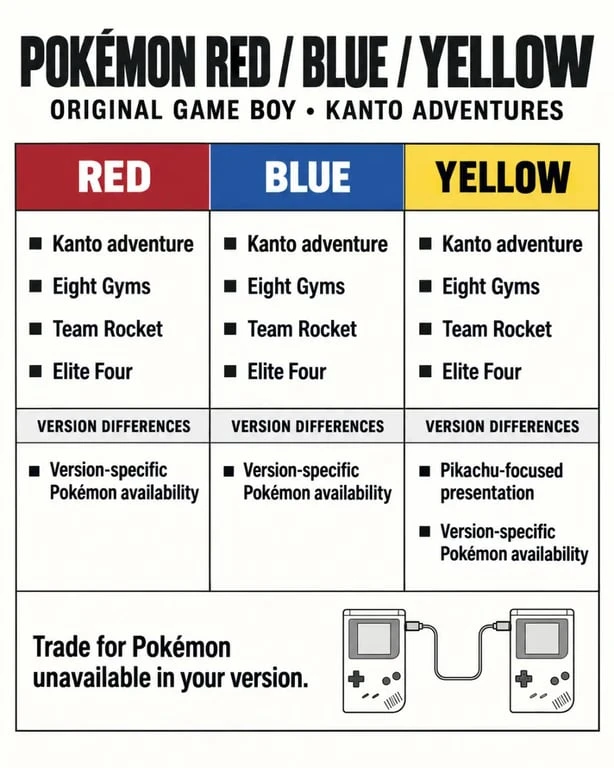
| Version | Shared foundation | What changes most | Trading role |
|---|---|---|---|
| Pokémon Red | Kanto, eight Gyms, Team Rocket, Elite Four, and turn-based battles | Its own selection of available Pokémon | Needed to obtain Pokémon unavailable in Red |
| Pokémon Blue | The same main journey and objectives as Red | Different Pokémon availability | Pairs naturally with Red for Pokédex completion |
| Pokémon Yellow: Special Pikachu Edition | Kanto adventure, collection, battles, Gyms, and Elite Four | A distinct Pikachu-focused presentation | Still useful for exchanging Pokémon with compatible versions |
For someone choosing one cartridge, Red and Blue offer the closest equivalent experience. Yellow is not simply a different label. It has its own identity and Pikachu-centered appeal. For a collector, the choice may be emotional: Red is the iconic version for many original players, while Blue and Yellow can complete a display or personal set.
Trading, battling, and later digital options
On original hardware, trading and battling used the Game Boy Link Cable with two compatible systems and cartridges. Historical Nintendo 3DS Virtual Console information also described wireless communication for these functions, removing the need for a physical cable in that setting. Those Virtual Console releases were presented as compatible with Pokémon Bank transfer functionality, including onward connections referenced for Pokémon Sun and Moon, Pokémon Omega Ruby, Alpha Sapphire, X, and Y.
Availability is separate from compatibility. The Nintendo 3DS eShop stopped allowing new purchases on 27 March 2023, so a physical Game Boy cartridge and a previously obtained digital version are very different options. Before buying for play, confirm the hardware you own and decide whether you need original trading, a working save, or simply a cartridge for display.
What an original Pokémon Red cartridge is worth
There is no single Pokémon Red price. A loose cartridge, a complete-in-box copy, and a sealed graded example belong to different collector markets. Completed-sale samples show loose copies generally around $32.00 to $79.00, while complete-in-box examples range from approximately $250.00 to $1,065.00. These figures are reference points, not guaranteed selling prices. Demand, region, condition, and timing affect each transaction.
| Condition | What the buyer receives | Why value changes |
|---|---|---|
| Loose | Cartridge only | Lowest entry cost; label condition and save functionality matter greatly |
| Tested loose | Cartridge confirmed to boot and play | Reduces uncertainty, especially when battery status is clear |
| Complete in box (CIB) | Cartridge, original box, manual, and relevant inserts | Completeness and the condition of the packaging can raise demand substantially |
| First print or packaging variation | Specific early or unusual release details | Scarcity and collector interest can add a premium |
| Graded | Professionally encapsulated collectible | Grade, authentication confidence, and case condition influence the market |
Terms such as CIB, box only, and manual only should be read literally. A seller calling an item complete should be able to show every component in photographs. A box-only or manual-only purchase can help restore a personal set, but it should not be valued like a complete game.
Five checks before buying a physical copy
Whether you want to replay Kanto or preserve a piece of Game Boy history, ask for clear photographs and test details before paying. A low price can be a bargain, but it can also reflect an incomplete, damaged, or reproduction item.
- Confirm the cartridge is authentic. Inspect the shell, label quality, screw type, molding, and regional marking. Blurry printing, incorrect colors, poor plastic fit, and generic-looking labels are warning signs. If possible, request a photograph of the circuit board from a seller who can open it safely.
- Ask whether it boots and saves. “Tested and working” should mean more than reaching the title screen. The seller should confirm that a new save can be created, retained after power-off, and loaded again. The internal save battery is a practical concern on an original cartridge.
- Clarify battery history. A replacement battery may suit someone who wants reliable saves, while an originality-focused collector may prefer an untouched cartridge. Neither preference is universally better. The key point is accurate disclosure.
- Match the item to your goal. A player may reasonably choose a clean loose cartridge. A display collector may prioritize the box, manual, inserts, and undamaged corners. Do not pay CIB-level money for a cartridge with a replacement case and reproduction artwork.
- Compare completed sales, not optimistic asking prices. Review recently sold examples in the same condition category. Separate loose sales from CIB sales, and do not use a first-print or graded result as the baseline for a standard cartridge.
For official historical product information, start with Pokémon’s official website and Nintendo’s official website. For the physical market, compare sold listings, detailed images, and functional testing. They provide more useful guidance than a single headline price.
Choosing the right Pokémon Red edition for you
A loose, authentic, working cartridge is usually the sensible choice if your priority is playing through Kanto again. It delivers the original Game Boy experience without making every crease in a cardboard box part of the purchase decision. If trading is part of the plan, budget for compatible hardware, another game, and the appropriate connection method.
A complete-in-box copy suits collectors who value the whole object: cartridge, manual, box art, inserts, and the feel of an original retail purchase. Examine each component carefully. Completeness does not erase sun fading, crushed corners, writing, moisture damage, or replacement pieces.
Pokémon Red serves both audiences. It is a focused RPG about leaving Pallet Town and becoming a stronger Trainer, but it is also a physical artifact from the beginning of a global series. Buy it as a game, a memory, or a collectible, and make sure the condition, authenticity, and price match the reason you want it.