The essential takeaway: Identifying counterfeit Pokémon cards relies on inspecting the back’s distinct blue swirl, the texture, and print sharpness. This careful examination protects your investment from worthless fakes found in cheap bundles. A simple light test acts as a definitive check, since authentic cards block light while counterfeits often appear translucent.
Spotting a worthless counterfeit in your collection is a frustration every enthusiast fears, but understanding how to tell a fake pokemon card safeguards your hard-earned investment. This guide outlines the specific visual markers and physical tests required to verify the authenticity with total precision. You will discover expert techniques for analyzing texture and holographic patterns to identify even the most convincing fakes on the market.
The First-Glance Check: What to Spot in Seconds
The Back of the Card Is Your First Clue
You might think the front matters most, but the reverse side often reveals the truth instantly. Counterfeiters constantly fail to replicate the specific ink mix and complex design used by official printers.
Look closely at a genuine card. You will see a distinct, deep swirling blue mixed with darker and lighter patches, creating a rich texture. The fine details surrounding the central Poké Ball remain incredibly sharp and defined.
In contrast, a fake card often displays a « washed-out » blue or a strange purple tint. The intricate swirl design usually looks blurry or poorly defined.
Color Saturation and Print Quality Mistakes
When figuring out how to tell a fake pokemon card, examine the front artwork carefully. Official prints boast crisp lines and colors that are vibrant without bleeding into each other.
Counterfeits usually miss this balance completely. You will often notice colors that are way too saturated and dark, or conversely, pale and lifeless. If you look closely, the text or Pokémon image might appear pixelated.
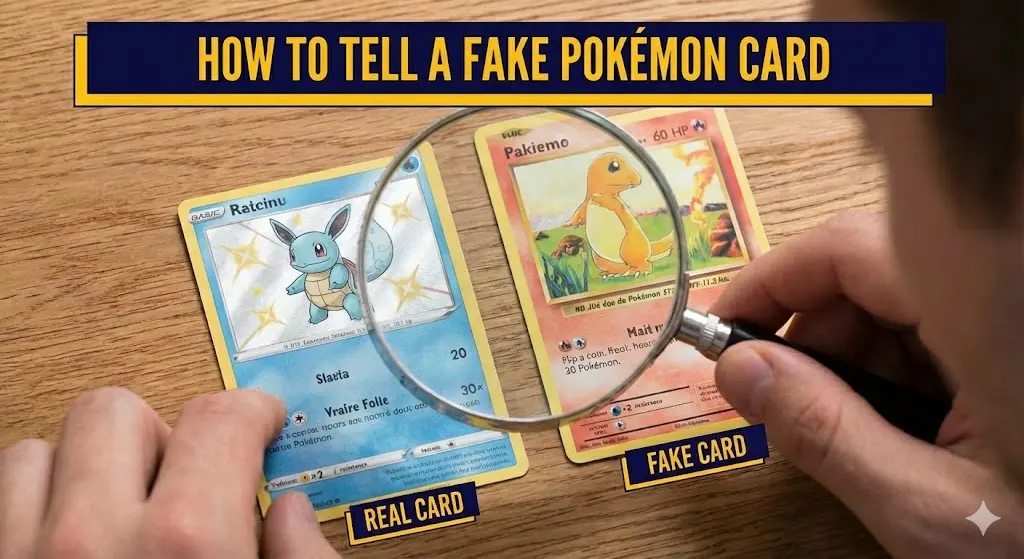
If you hold the suspect card next to a verified authentic one from the same set, the discrepancy in color depth becomes immediately obvious.
The Feel and Flexibility of the Card Stock
Your fingers can sometimes detect a scam faster than your eyes. A legitimate card possesses a specific semi-gloss finish—it is smooth but retains a slight texture, never feeling like cheap plastic.
Be wary of fake cards that feel overly waxy or slick, similar to glossy photo paper. On the flip side, some cheap knockoffs feel rough and dry, like standard cardboard, lacking the premium coating.
Finally, test the bend. Authentic stock has a snap to it, while fakes often feel flimsy, bending with little resistance and lacking structural integrity.
Decoding the Text and Symbols
Knowing how to tell a fake pokemon card starts with the letters. Official cards use standardized type. Counterfeiters grab similar fonts, but they rarely pick the exact right one.
Font, Spelling, and the Pokémon Accent
You need to inspect the letters closely. Official cards use a standardized typeface like Gill Sans. Counterfeiters grab similar fonts, but they rarely pick the exact right one.
Here is the most common mistake you will spot. Fake cards often miss the accent on the « e » in Pokémon. You should also scan the attack descriptions for sloppy spelling errors or bad grammar.
Compare the space between the letters, known as kerning. On fakes, the text looks uneven or squeezed too tight.
Verifying Energy Symbols and HP Values
Energy symbols offer another quick way to spot a fake. These icons must look crisp, clean, and perfectly proportioned.
On a counterfeit, you will see symbols that look slightly squashed or bloated. They often sit off-center in their circles or use a color that feels just a bit off.
You must watch out for values that break the game rules. Scammers rely on impressive numbers to trick buyers:
- HP values that are absurdly high (e.g., 1000 HP).
- Attack damages that don’t make sense (e.g., 5000 damage).
- Incorrect energy symbols for a specific Pokémon type.
- Misaligned or blurry retreat cost symbols.
Checking the Card Number and Copyright Info
Direct your eyes to the very bottom of the card. Every single authentic card features a specific set number (like 17/198), a unique expansion symbol, and the official copyright dates printed clearly in the corner.
On fakes, these tiny details often look blurry, use the wrong font, or are completely missing. You can use a Pokémon search engine to confirm the number matches the card and its expansion exactly.
Analyzing the Card’s Physical Structure
Now that you have examined the surface details, it is time to test the actual construction of the card. This is where most counterfeits fail miserably.
The Light Test: A Simple and Effective Trick
You might assume visual inspection is enough, but the light test is arguably the most reliable method available. Authentic Pokémon cards are constructed with a specific opaque layer sandwiched between the paper. This unique manufacturing process blocks light effectively. Most cheap replicas lack this internal barrier entirely.
Here is exactly how to tell a fake pokemon card using this technique. Hold your card directly up to a bright smartphone flashlight or ceiling bulb. If a significant amount of light floods through the artwork, you are holding a counterfeit. A real card blocks almost everything.
Card Dimensions and Edge Quality
Pokémon manufacturing is incredibly consistent regarding physical size. Counterfeiters often get this wrong, making cards slightly too small or large. Even a millimeter difference is a massive red flag for collectors.
Stack the suspect card directly behind a known authentic one. Any protrusion or size mismatch signals a problem immediately. You should verify the exact standard Pokémon card dimensions to be absolutely sure. do not ignore these tiny physical discrepancies.
Now, run your finger along the card’s edges. Authentic cuts are clean and smooth, while fakes often feel rough or fuzzy.
Genuine vs. Fake: A Quick Comparison
Sometimes, you just need a direct side-by-side breakdown to spot the scam. This table highlights the massive differences you will spot instantly.
| Genuine Card | Fake Card | |
|---|---|---|
| Back Color | Deep, varied blue swirl | Light blue, purple-ish, flat color |
| Font & Text | Sharp, correct font, ‘é’ in Pokémon | Blurry, wrong font, missing accent |
| Light Test | Opaque, very little light passes through | Translucent, light is clearly visible |
| Feel | Slightly satin finish, firm card stock | Glossy or waxy, flimsy paper |
| Holo Pattern | Moves diagonally, dynamic | Static, vertical shine, or just a flat rainbow layer |
Spotting Fake Holographic and Textured Cards
Common cards are one thing, but scammers target the big fish. Identifying a fake holographic or textured card requires an even sharper eye.
The Wrong Kind of Shine: Holo Pattern Analysis
Capturing the perfect holographic sheen is a nightmare for counterfeiters. It is actually their biggest tell. If you want to know how to tell a fake pokemon card, start right here.
On a genuine card, the light dances. Tilt it, and you will see the pattern shift, often diagonally across the artwork. It has real depth, like looking into a pool, not just at it.
Fake holo cards usually just sit there. The shine is flat, often vertical, or a static rainbow overlay that simply does not move.
The Absence of Texture on Full Art Cards
Modern heavy hitters like V, VMAX, and Full Art cards have a secret weapon against forgery: texture. It is a feature cheap printers just cannot replicate.
Run your finger lightly over the surface. A legitimate Full Art card feels etched. You will feel ridges and reliefs tracing the artwork, almost like a fingerprint.
- Fake Full Arts are flat: They have the shine but no physical texture you can feel.
- Incorrect Holo Pattern: The shine on fake VMAX cards doesn’t match the official rainbow-like pattern.
- No Embossing: The Pokémon’s outline isn’t raised or textured.
- Beware of « Gold Metal » cards: Nearly all non-official gold metal cards are fakes, not tournament prizes.
The Ultimate Proof: The Rip Test
Consider the « rip test » the nuclear option. It destroys the card, so never do this unless you are already certain it is trash and want to prove a point.
Here is the science: when you tear a genuine Pokémon card, you will expose a distinct dark layer sandwiched inside. That black core is the signature of high-quality cardstock.
A fake card just rips like standard printer paper. It is stark white inside, revealing the lack of that specific middle layer.
Buying Smart: How to Avoid Fakes Altogether
Learning how to tell a fake pokemon card is a valuable skill, but never buying one is the real victory. You need to adopt these common sense rules immediately to protect your collection and your wallet.
If the Price Is Too Good to Be True…
Here is the golden rule that every serious collector must know by heart. Rare cards and high-value items are never sold for pennies on the dollar. If a deal looks like a steal, you are likely the victim.
You need to be extremely wary of listings promising « 100 VMAX cards » or « 50 guaranteed rares » for a remarkably low price. These are systematically counterfeits that flood marketplaces daily. Sellers use these bulk terms to hide the lack of quality.
An incredible offer is actually your biggest red flag in this hobby. You must trust your gut feeling when the math simply doesn’t add up.
Where to Buy Genuine Pokémon Cards
Your safety relies on purchasing sealed products directly from reliable sources. This remains the absolute best guarantee to ensure you get authentic cards for your binder.
- Official Retailers: Large chain stores that sell toys and games.
- Specialized Hobby Shops: Local game stores with a good reputation.
- The Official Pokémon Center Website: The direct source for products.
- Reputable Online Sellers: Look for sellers with long histories and thousands of positive reviews. Avoid new sellers with no feedback.
When in Doubt, Get a Professional Opinion
Sometimes, a nagging doubt persists, especially when you face high-quality fakes. You should not remain in uncertainty when your money is on the line.
For a card holding significant value, you must consider having it authenticated by experts. The professional card grading process is the ultimate method to certify authenticity and condition. Services like CGC use advanced technology to verify every detail.
Online communities and collector forums can also give you a quick first opinion based on clear photos.
You are now equipped to identify any counterfeit Pokémon card. By scrutinizing the texture, print quality, and light transparency, you ensure the authenticity of your collection. Apply these tips during your next purchase to avoid scams. Your vigilance guarantees a genuine and valuable deck for years to come.