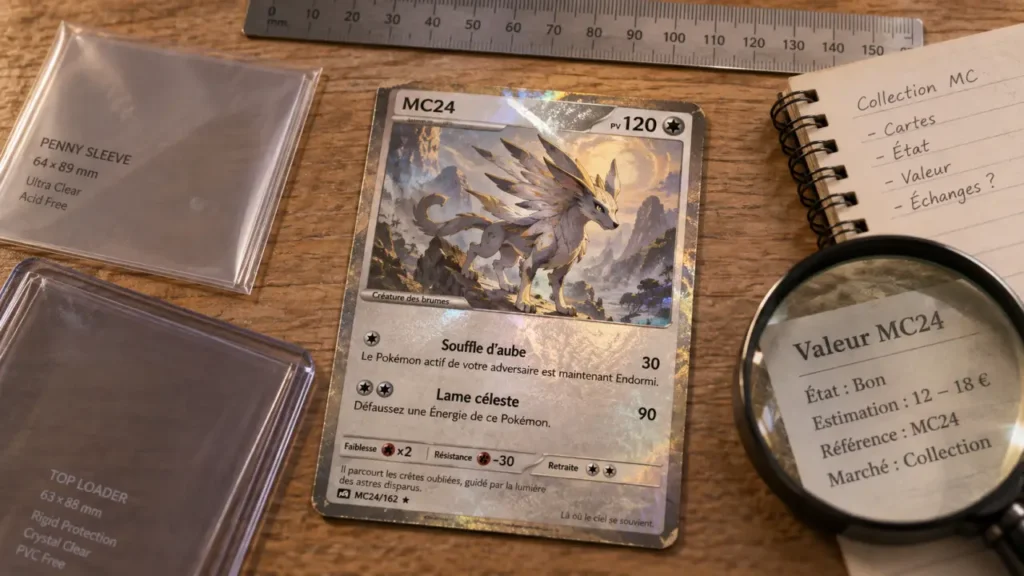
McDonald’s Pokémon cards can be worth anywhere from a few cents to several dollars, but the card name alone is not enough to price one correctly. For the MC24 promo set, common low-end values start around $0.10 to $0.60, while desirable holofoil cards in clean condition can reach roughly $5 to $9. The final price depends on the set number, foil version, condition, and recent completed sales, not the highest asking price online.
Start with the right expectation: most promos are affordable
McDonald’s Pokémon promotions were distributed widely, so most loose cards are not instant high-value collectibles. A non-holo card with edge wear, scratches, or handling marks is usually an affordable single. That does not make it worthless. Inexpensive cards can still complete a binder set, appeal to younger collectors, or serve as useful trade material.
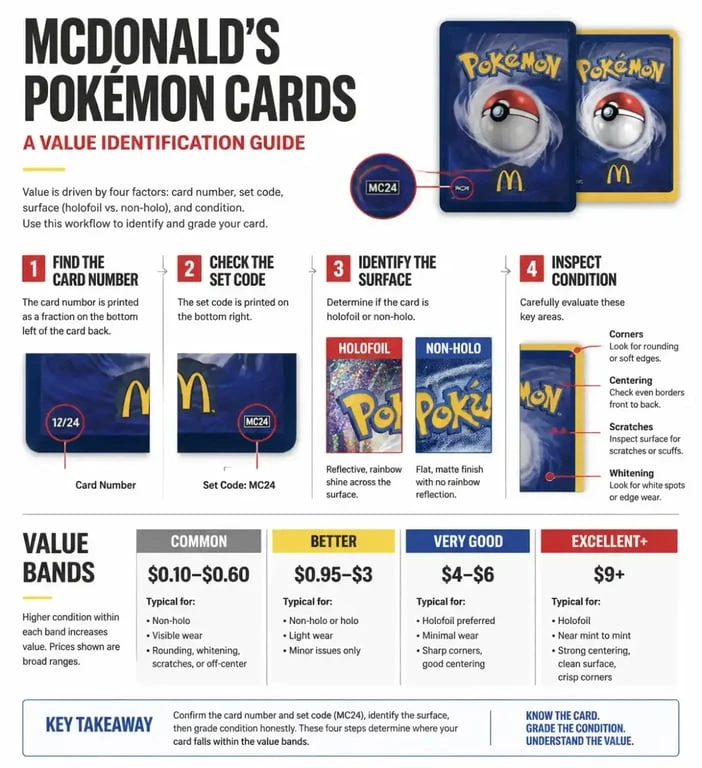
The higher end usually belongs to cards that combine several advantages: a popular Pokémon, a desirable holofoil treatment, distinctive artwork, and near-mint presentation. Graded copies can sit in a different price tier, but grading fees and the risk of receiving a lower grade mean submission is not automatically worthwhile for every card.
| Typical value band | What it often represents | What to check before selling |
|---|---|---|
| $0.10–$0.60 | Common loose cards, often non-holo or visibly played | Confirm the card number and check for surface wear |
| $0.95–$3 | Cleaner singles with steady collector demand | Compare several recent sold listings, not one listing |
| $4–$6 | Desirable holofoil cards in strong ungraded condition | Check corners, foil scratching, and centering |
| $9 and above | Higher-demand examples, exceptional condition, or a graded premium | Match the grade, certification, and exact variant |
These bands are a practical starting point rather than a fixed price list. Card markets move when a promotion is newly available, when collectors start completing sets, and when more sealed packs or loose copies enter circulation. A price guide can therefore change even when the card itself has not.
Identify the exact McDonald’s card before checking its value
Use the card number and the set code together
Look at the bottom of the card first. The number is the fastest way to separate a similar-looking promo from another version featuring the same Pokémon. In the MC24 set, cards are numbered from 001/015 through 015/015. A listing that only says “McDonald’s Pikachu” or “McDonald’s Pokémon promo” is too vague for a reliable comparison.
Record four details before searching: the Pokémon name, the card number, the set code, and whether the card is holofoil or non-holo. Search with all four details. This helps you avoid comparing your card with a regular expansion release, a different McDonald’s promotion, or a reverse-style foil that only looks similar in a thumbnail.
Separate holofoil from non-holo immediately
Holofoil status often changes resale value more than a small difference in card condition. Tilt the card under neutral light instead of relying on a phone flash. Check whether the reflective pattern appears in the illustration, across the card face, or only in a specific printed area. Then compare it only with completed sales for that same finish.
Do not assume every shiny card is rare. A foil version may still be widely available, while a non-holo card can be harder to locate in some releases. The market establishes the premium through actual sales volume and collector demand. A visual match alone is not enough.
Why one McDonald’s Pokémon card sells for more than another
Condition is visible value
Collectors pay more for cards with sharp corners, clean surfaces, balanced centering, and no whitening along the back edges. On holofoil cards, fine scratches matter because they become obvious when the card catches the light. A card described as “near mint” should not have dents, creases, pressure marks, peeling layers, or a cloudy surface.
Residue is another issue to check. Cards handled around food can pick up skin oil, moisture, or a thin film of grease, which can leave the surface looking dull over time. Do not scrub the card or use household cleaner, as either can damage the foil layer. Instead, handle it by the edges, move it into a clean penny sleeve, and place that sleeve in a rigid holder before assessing its condition.
Popularity and artwork create demand
Well-known Pokémon generally attract more buyers than less popular characters, especially when the artwork is distinctive or the card recalls a specific promotion. That demand can matter more than the original distribution method. A collector building a character collection may pay a premium for the right card even when a full set remains relatively accessible.
Grading can help, but only when the numbers work
A graded card gives buyers an independent opinion on condition and adds protection and liquidity for higher-end examples. The label does not create demand by itself. Before submitting a card, compare its likely ungraded selling price with recent sales for the same card and grade. Deduct grading, shipping, insurance, and selling fees. If the projected difference is small, selling the card raw may be the more sensible choice.
Use sold listings instead of advertised prices
An active listing shows a seller’s target, not proven market value. To estimate McDonald’s Pokémon card value, search recent completed sales on marketplaces such as eBay, then compare the results with price-guide platforms such as TCGplayer and PriceCharting. Look for several sales that match your card’s number, finish, condition, and grading status.
- Ignore extreme outliers unless several comparable sales support them.
- Exclude lots when pricing a single card, because a multi-card bundle lowers the per-card figure.
- Check whether shipping is included before comparing sale totals.
- Use sold results from a recent period when the market is active.
- For graded copies, compare the same grading company and numerical grade.
If three clean, comparable sales cluster around $2, that is more useful than one unsold $10 listing. For a scarce card with few sales, widen the comparison to similar-condition examples, but do not treat one auction result as a permanent benchmark. Recent sold listings provide the clearest reference because they show what buyers actually paid.
Decide whether to sell, keep, or buy more
Sell individual cards when you have duplicates, when a desirable holofoil has strong recent sales, or when the money matters more to you than completing the set. Photograph the front and back in indirect daylight, disclose flaws clearly, and protect the card during shipping. Accurate condition notes reduce returns and help buyers understand what they are purchasing.
Keep cards when you enjoy the artwork, are close to finishing the fifteen-card set, or own a clean copy whose collector demand may matter more than its current cash price. For buyers, singles are usually the clearest route to a specific card: you can inspect the condition and avoid paying for unwanted duplicates.
Sealed packs follow a different market from loose cards. Their value reflects uncertainty, packaging condition, and the chance of pulling a wanted holofoil, while a single card is priced according to its identity and condition. Compare sealed product only with other sealed product, and raw singles only with matching raw singles. This separation helps prevent overpriced purchases and undervalued sales.