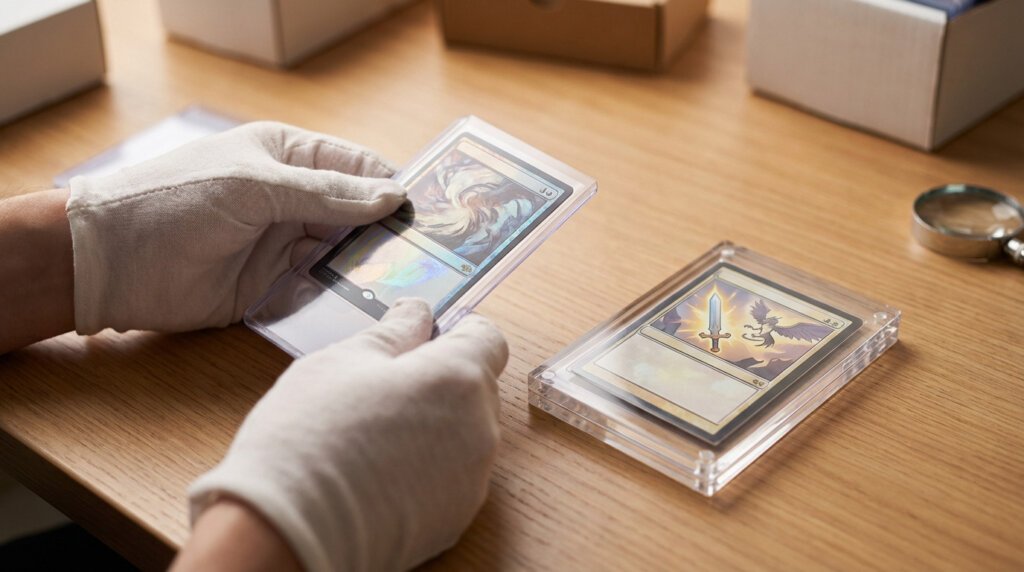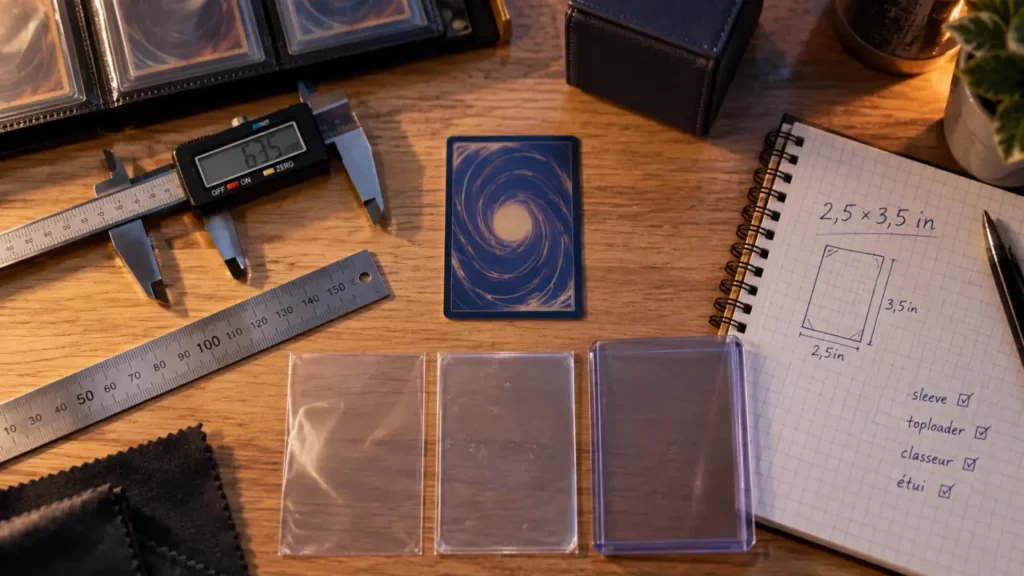
A standard Pokémon card measures 2.5 × 3.5 inches, or 63.5 × 88.9 mm (6.35 × 8.89 cm). This is the familiar standard trading card format used for regular English and Japanese Pokémon TCG cards. These measurements help you buy the right protection, prepare artwork, compare cards, and spot obvious size problems. Thickness, corner shape, and jumbo-era differences also matter.
The exact dimensions of a standard Pokémon card
The standard Pokémon card format has remained consistent since the Pokémon Trading Card Game launched in 1996. Its 5:7 aspect ratio, also written as 1:1.4, is shared by many Western trading card games. For collectors, this consistency means modern and older cards generally fit the same standard sleeve, toploader, and binder pocket.
| Measurement | Inches | Millimeters | Centimeters |
|---|---|---|---|
| Width | 2.5 in | 63.5 mm | 6.35 cm |
| Height | 3.5 in | 88.9 mm | 8.89 cm |
| Corner radius | 0.125 in (1/8 in) | 3.175 mm | 0.3175 cm |
| Typical thickness | About 0.012–0.013 in | 0.30–0.32 mm | 0.030–0.032 cm |
| Typical weight | Not listed | Not listed | About 1.70–1.80 g |
Foil, holo, and heavily finished cards can feel slightly thicker. A holo or foil card may reach roughly 0.35 mm, while card condition, humidity, print variation, and measuring tools can affect the result. Broader thickness ranges are sometimes reported for trading cards in general, so thickness should not be used as a single pass-or-fail authenticity test.
Why rounded corners and cardstock matter
The 3.175 mm corner radius is more than a visual detail. Rounded corners reduce snagging and fraying during shuffling, sleeving, and repeated binder handling. Authentic cards also use layered cardstock, with light outer paper layers around a darker core that adds opacity and stiffness. A card that is dramatically thin, unusually glossy, very flexible, or visibly translucent deserves closer inspection, especially when several clues appear together.
Choosing sleeves, toploaders, binders, and deck boxes
For ordinary Pokémon cards, look for products labeled standard size, not “Japanese size.” Japanese-size sleeves are commonly intended for smaller formats such as Yu-Gi-Oh! and Cardfight Vanguard, around 59 × 86 mm, and are too tight for Pokémon cards.
| Protection type | Useful size reference | Best use |
|---|---|---|
| Perfect Fit inner sleeve | About 2.52 × 3.54 in | Close inner protection before outer sleeving |
| Standard outer sleeve | About 2.625 × 3.625 in / 66.7 × 92.1 mm | Playing, binders, and everyday handling |
| Standard toploader | Made for 2.5 × 3.5 in cards | Rigid protection for valuable cards |
| 9-pocket binder page | Standard card pockets | Organizing regular cards |
A practical protection sequence starts with the card in a snug inner sleeve, adds an outer sleeve for handling, and uses a rigid toploader when the card needs display or transport protection. Each layer adds material and reduces available clearance. A card that fits a binder pocket may no longer fit a tight deck box once it is double-sleeved. Forcing a sleeved card into a rigid holder can also scuff its edges.
Do not buy a deck box by card count alone
A deck box advertised for 60 cards may hold 60 unsleeved cards comfortably but become cramped with thick outer sleeves or double-sleeved cards. For a playable 60-card deck, choose a box explicitly rated for double-sleeved cards if you use inner and outer sleeves. Keep toploaded cards out of normal deck boxes. They need a storage box designed for rigid holders or a dedicated display case.
Jumbo, box topper, and oversized Pokémon card dimensions
The most expensive storage mistake is treating every oversized Pokémon card as the same “jumbo” size. Pokémon jumbo cards changed format in 2020. Measure the card before ordering a sleeve, page, or frame, especially when buying vintage promotional cards.
| Card format | Approximate inches | Approximate millimeters |
|---|---|---|
| Standard card | 2.5 × 3.5 in | 63.5 × 88.9 mm |
| Box Topper | 3.5–3.54 × 4.96–5 in | About 90 × 126 mm |
| Pre-2020 Jumbo XL | 5.7–6.0 × 7.87–8.0 in | 145–152.4 × 200–203.2 mm |
| Post-2020 Jumbo L | 5.37 × 7.37 in | 136.5 × 187.3 mm |
| CoroCoro XXL promotional card | 5.7 × 8.07–8.1 in | About 145 × 205 mm |
The post-2020 jumbo format is smaller than older Jumbo XL cards. Older oversized pages can therefore leave a modern jumbo card loose, while modern pages may be too small for older promos. CoroCoro XXL cards are Japanese promotional outliers and need their own measurement rather than a generic jumbo sleeve.
How standard cards compare with everyday items
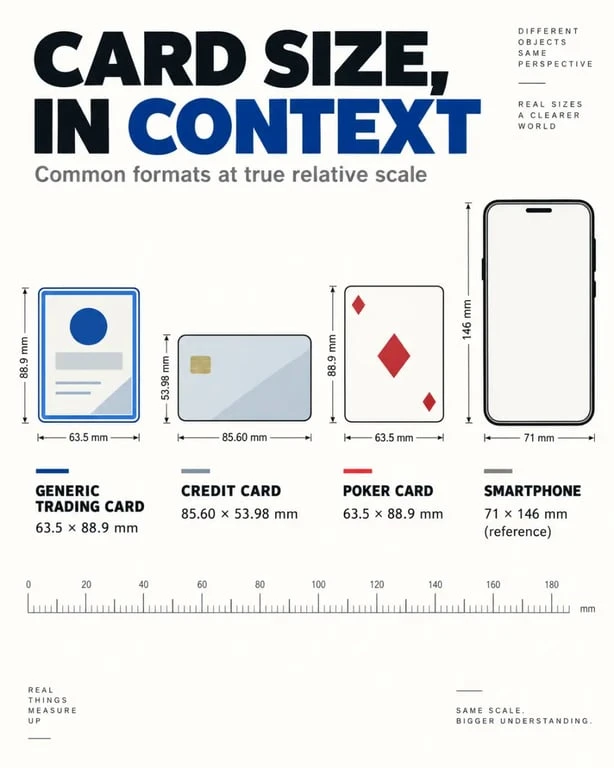
A Pokémon card is taller and wider than a credit card, which measures 85.60 × 53.98 mm. It is narrower but taller than many standard playing cards, although the common poker size is 63.5 × 88.9 mm, effectively the same dimensions as a standard Pokémon card. Poker-size sleeves can therefore fit Pokémon cards, provided they are made for standard rather than smaller Japanese-size cards.
Pixels, bleed, and canvas settings for custom card art
For digital art, use the finished card size of 2.5 × 3.5 inches as the trim area. At 300 DPI, that equals 750 × 1050 pixels. This is a practical print-quality setting for artwork intended for physical output. Higher resolution helps when detailed illustration, small type, or archival-quality work requires extra room.
| Resolution | Pixel dimensions at trim size | Suitable use |
|---|---|---|
| 72 DPI | 180 × 252 px | Web previews only |
| 150 DPI | 375 × 525 px | Rough digital drafts |
| 300 DPI | 750 × 1050 px | Standard print artwork |
| 600 DPI | 1500 × 2100 px | Highly detailed archival work |
Do not build a print file only to the trim edge. Add a 0.125-inch bleed on every side, producing a 2.75 × 3.75 inch canvas. At 300 DPI, that equals 825 × 1125 pixels. Keep important text, symbols, and facial details inside a 2.25 × 3.25 inch safe zone so slight cutting variation does not remove critical design elements. In Procreate, create the bleed-inclusive canvas first, set it to 300 DPI, and use guides for both the trim and safe-zone boundaries.
Using dimensions to check authenticity and centering
Dimensions can help identify a counterfeit, but they work best as one part of a broader inspection. An authentic standard card should be close to 63.5 × 88.9 mm, with small manufacturing variation typically around ±0.2 to ±0.3 mm. Differences approaching ±0.5 mm are more concerning, particularly if the card also has poor print sharpness, incorrect colors, a suspicious texture, or a missing dark cardstock core.
Measure without damaging the card
Use a millimeter ruler for a quick check, or digital calipers for width, height, and thickness. Measure the card flat on a clean surface and avoid pressing caliper jaws into the edges. Weight can provide another clue: normal cards are often around 1.70–1.80 g, although individual cards vary. A Full Art Pikachu from Crown Zenith was measured at 2 g, while a common Scyther measured 1.81 g. These examples show why a slightly heavier card is not automatically fake.
For centering, compare the visible border width on the left and right, then at the top and bottom. PSA and BGS graders assess alignment in very small increments, so a difference of a few tenths of a millimeter can affect perceived centering. A genuine card can still be off-center. Centering is a condition and grading issue, not proof of counterfeit production. Combine measurements with print quality, texture, stock opacity, spelling, set information, and trusted seller history before reaching a conclusion.