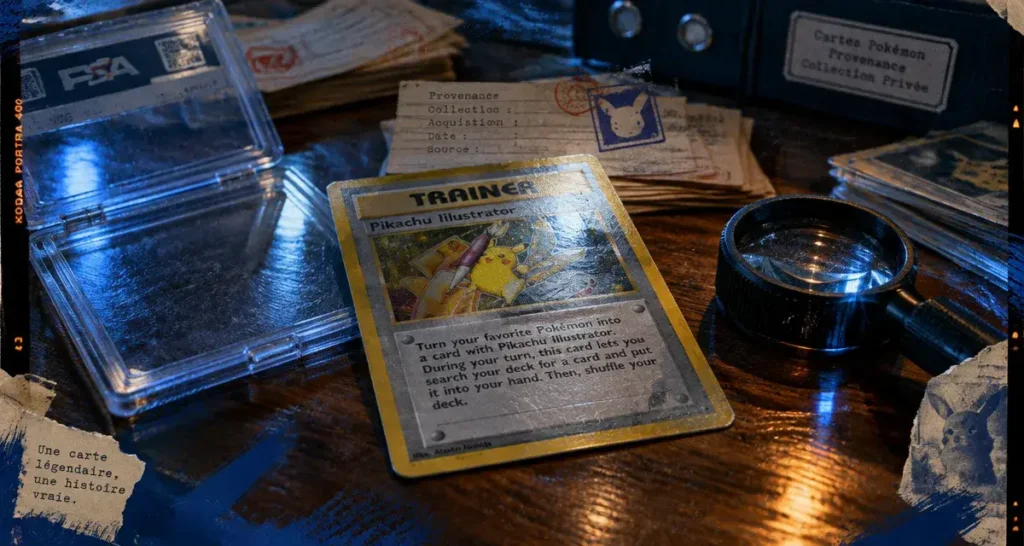
Pikachu Illustrator is the leading candidate when collectors ask for the rarest Pokémon card. Distributed in Japan in 1998 as a prize for a CoroCoro illustration contest, only 39 copies were distributed. Its scarcity, connection to early Pokémon history and PSA 10 sale of $5.275 million in July 2021 explain its status. The rarest card, however, is not always the most expensive one.
Why Pikachu Illustrator leads the rarest-card conversation
The Pikachu Illustrator card was never pulled from a booster pack or sold through ordinary retail channels. Winners of the CoroCoro contest received it as a prize, creating a very small original distribution. That history matters as much as the printed card. Each surviving copy links collectors to an early period in Pokémon’s development, when illustration contests and special events helped shape the trading card game.
PSA’s Official Online Card Grading Submission Center · Submit cards, tickets, and packs online for PSA authentication and grading services.
Its appeal comes from a combination of factors. Pikachu is one of the franchise’s most recognizable characters, the card carries a distinctive illustrator identity and well-preserved examples are difficult to find. A PSA 10 grade means that the centering, corners, edges and surface met a demanding condition standard when the card was assessed. It does not simply confirm that the card is old or valuable.
A record sale is not a universal price guide. The $5.275 million result involved one specific PSA 10 copy in July 2021. A different grade, an ungraded card, incomplete provenance or a change in buyer demand can lead to a very different result. A landmark sale shows what one buyer paid for one example at one point in time. It does not automatically establish the value of every Pikachu Illustrator card.
Rare Pokémon cards worth comparing with Pikachu Illustrator
Several cards rival Pikachu Illustrator in scarcity, historical importance or auction appeal. Some were tournament prizes, while others were English-language presentation cards or unusual production tests. The comparison below separates original distribution from recorded sales, since those details help explain why two rare cards can reach very different prices.
| Card | Year | How it was distributed | Reported scarcity | Recorded sale |
|---|---|---|---|---|
| Pikachu Illustrator | 1998 | CoroCoro illustration contest prize in Japan | 39 copies distributed | $5.275 million, PSA 10, July 2021 |
| Blastoise WOTC Presentation Galaxy Holo | 1998 | English-language presentation material | Fewer than 10 believed produced; 2 known with English backs | $360,000 in 2021 |
| No. 1 Trainer Trophy | 1997–2001 | Japanese tournament prize | Extremely limited winner distribution | PSA 10 examples cited at $90,000–$200,000 |
| Tamamushi University Magikarp | 1998 | Mail-in quiz campaign prize | Limited promotional distribution | $66,000 in 2021 |
| Ishihara GX Promo | 2017 | Private promotional issue | Around 30 copies | $50,000 in 2020 |
Blastoise presentation and test-print cards
The Blastoise Wizards of the Coast Presentation Galaxy Holo is notable because it documents Pokémon’s English-language expansion. It was made as a presentation card, not as a product for children to open in packs. A separate 1998 Test Print Blastoise Gold Border is believed to exist in approximately five copies and achieved a $216,000 sale, even though the highest stated grade was 6.5. This shows how production rarity and historical context can outweigh a lower numerical grade.
Trophies, campaigns and private promos
No. 1 Trainer Trophy cards went to tournament winners, giving them a direct connection to competitive Pokémon events. Tamamushi University Magikarp was distributed through a mail-in campaign, while Ishihara GX came from a private promotional setting. Access was restricted before most collectors had an opportunity to buy these cards. That makes them different from a modern chase card with a rarity symbol, even when the latter is difficult to pull from a pack.
What actually makes a Pokémon card rare
Rarity has several layers. Distribution rarity concerns how few people could originally receive a card. Production rarity covers prototypes, test prints, unusual backs and printing variants. Condition rarity reflects how few surviving copies remain close to mint condition. Demand then determines how strongly collectors compete for those copies.
- Trophy cards: prizes awarded at specific competitions.
- Promo cards: cards distributed outside normal booster products.
- Presentation and test prints: cards made for demonstration, approval or production testing.
- No Rarity Symbol cards: early Japanese variants missing the usual rarity mark.
- First Edition Shadowless cards: early English Base Set cards identified by their edition mark and the absence of the artwork shadow.
- Holo, secret rare, hyper rare and rainbow rare cards: product-set categories that do not automatically mean a card is historically scarce.
A card can therefore be rare without being famous, while a popular Charizard can command a higher price because demand is enormous. The 1999 First Edition Shadowless Holographic Charizard #4 reached $420,000 in PSA 10, and a signed 1996 No Rarity Symbol Charizard sold for $324,000. Both sales show how character popularity, early-print status and the survival of high-grade copies affect value.
How to inspect a potentially rare card before assigning value
Start with physical identifiers, not an online asking price
Check the language, year, set number, edition mark, rarity symbol and holographic treatment. Compare the front and back with reliable images of the exact variant. Look for the presence or absence of a shadowless layout, a No Rarity Symbol, a blue back, a gold border or a Galaxy Holo pattern. An error matters only when it matches a recognized production variation, not when it is ordinary wear, damage or inconsistent printing.
Condition requires a slower inspection than many buyers expect. Examine centering, whitening along the edges, corner compression, scratches, dents and foil damage under angled light. A small surface indentation can significantly affect a grading result. Photograph both sides before submitting or selling an ungraded card. Also record where it came from, when it was acquired and whether supporting paperwork is available.
Use provenance and grading as separate checks
PSA, BGS and CGC grading services provide standardized language for describing condition, but a slab should not end the investigation. Review the certification details, compare the stated card description with the card in hand and consider whether the grade appears visually consistent. Population reports can help with comparisons, but they count cards submitted to that grading company, not every surviving copy worldwide.
Inspect the seam where the two halves of a grading holder meet. Uneven plastic, clouding near the join, damage around the weld or signs that the holder has been forced apart deserve attention. These signs do not prove that a card was altered, but they are practical reasons to pause, inspect the label and card more closely, and seek specialist authentication before making a high-value purchase.
Buying rare singles without confusing scarcity with speculation
For most collectors, buying a single is more practical than opening sealed packs in search of one specific card. Start by defining the goal, such as a historical trophy card, a vintage Charizard variant, a Japanese promo or a modern illustrated favorite. Then compare recent completed sales for the same card, language, grade and condition. A seller’s asking price is a request. A public auction result is evidence of what one buyer paid at one moment.
High-end cards require a cautious process. Request clear front-and-back images, close-ups of flaws, certification details for graded cards and documentation for unusual provenance. Take extra care with cards described as “error,” “prototype,” “shadowless” or “no rarity,” because small visual differences can create large price gaps. When a card has significant financial value, independent authentication and a specialist auction or dealer offer more protection than an impulse purchase.
The strongest collection is not necessarily the one with the highest headline price. Pikachu Illustrator is the clearest example of extreme scarcity, but a well-chosen Shadowless Charizard, Trophy Pikachu, Snap Pikachu or Tamamushi University Magikarp can offer its own connection to Pokémon history. Learn the distribution story, verify the exact variant and buy the condition you can assess with confidence.