To check a Pokémon card’s worth accurately, identify the exact card before looking at its price. The name alone is rarely enough. The set, card number, printing, language, foil treatment, condition, and grading status can all lead to very different values. Once those details are confirmed, compare recent completed sales instead of relying on the highest current asking price.
1. Identify the card before checking its price
The quickest method is to search a card database by Pokémon name and card number. If the number is difficult to read, use the set symbol, artwork, HP, or a photo scanner as supporting clues. Camera-based search can save time, but confirm the result manually. Similar illustrations, reprints, and reverse holo versions are easy to confuse.
Official Pokémon TCG Card Database · Search and browse Pokémon TCG cards by type, Energy, format, expansion, and more.
Read the number, symbol, and printing
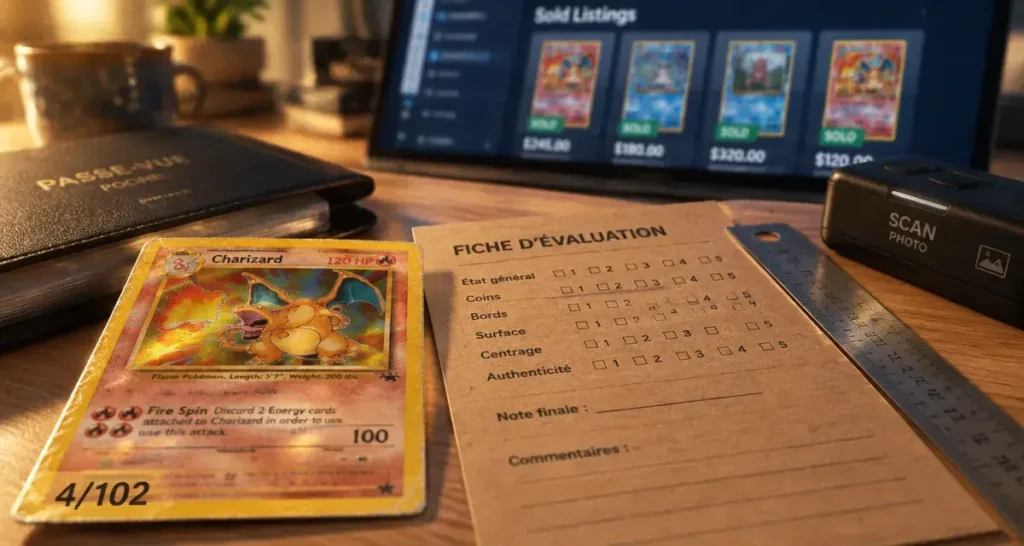
Look near the bottom of the card for a number written as a fraction, such as 4/102. This shows the card’s position in its set and often separates a common version from a chase card featuring the same Pokémon. The set symbol provides another important clue. Match both details with a set checklist before searching for the card’s value.
Printing differences matter greatly on older cards. Base Set Charizard, for example, exists as Unlimited, Shadowless, and 1st Edition. These versions should not be treated as interchangeable listings. The 1st Edition stamp, the presence or absence of a shadow around the artwork box, and the specific printing determine which market comparisons apply.
Do not overlook variants
Check whether the card is holo, reverse holo, non-holo, a promo, an alternate art, Rainbow Rare, Gold, or Special Art. Confirm the language as well. Japanese printings can have a separate collector market from English copies, while promo stamps and event releases may identify a distinct version even when the illustration looks familiar.
Before checking a price, confirm these details:
- Name: identifies the Pokémon or Trainer.
- Set symbol and card number: identify the correct release.
- Edition and printing: distinguish 1st Edition, Shadowless, Unlimited, reprints, and promos.
- Finish and artwork: separate holo, reverse holo, and special variants.
- Language: helps you compare like with like.
2. Grade the condition honestly before using a price guide
A Near Mint price is not automatically your card’s value. Remove the card from its sleeve and examine it under indirect light. Check both the front and back for edge whitening, corner wear, holofoil scratches, dents, creases, bends, stains, and surface impressions. Each flaw can reduce buyer confidence and change the final price.
| Condition | Typical signs | How to use the price |
|---|---|---|
| Near Mint | Very clean surface, sharp corners, minimal visible wear | Use Near Mint market comparisons as the baseline. |
| Lightly Played | Small edge wear, light scratches, minor whitening | Compare only with similarly described sold copies. |
| Moderately Played | Clear whitening, surface wear, noticeable handling marks | Expect a larger discount from the Near Mint baseline. |
| Heavily Played | Heavy wear, creases, bends, major scratches, or damage | Use damaged or heavily played sales, not clean-card prices. |
Lightly Played or Moderately Played cards are typically valued at 50–85% of the Near Mint price, but this range is only a starting point. A desirable vintage card with modest edge wear can still attract strong demand, while a crease or dent may have a much sharper effect. When possible, compare your card’s flaws with photos from completed sales rather than relying only on a condition label.
Think of condition as a scale, not a single label
Condition reflects buyer risk. Centering, corners, edges, surface quality, and structural damage do not affect every card in the same way. A tiny white spot may be acceptable to a binder collector, while a dent can concern a grader or high-end buyer even when it is difficult to photograph.
Record each flaw separately before selecting a condition category. Note the front and back, then check centering, corners, edges, surface, and any bends or creases. This produces a more defensible valuation and prevents a clean-looking front from hiding damage on the back.
3. Compare market evidence instead of asking prices
A current listing shows what a seller hopes to receive. A completed sale shows what a buyer actually paid. When checking Pokémon card worth, recent eBay sold listings are especially useful because they show real transactions. Filter for the same card number, printing, language, condition, and grade. Exclude results that refer to lots, sealed products, or different variants.
Use more than one market reference. TCGPlayer market pricing can help establish a raw-card benchmark, while CardMarket is useful for comparing the European market. eBay sold listings provide transaction-level evidence, particularly for rarer cards, graded copies, and unusual variants. If the figures disagree, do not simply average every number. First determine whether each source covers the same version and condition.
| Reference | Best use | What to verify |
|---|---|---|
| TCGPlayer | Raw-card market benchmarks | Condition category and exact variant |
| CardMarket | European listings and market comparisons | Language, currency, and seller condition notes |
| eBay sold listings | Evidence of completed buyer purchases | Sale date, shipping, grade, and whether it was a lot |
Prices move over time. Pull rates, print runs, reprints, tournament performance, collector demand, and attention around a set can affect supply and demand. Vintage cards and modern chase cards may respond differently to these changes. Treat a valuation as a current market range, not a permanent promise.
When comparing sales, pay attention to timing as well as price. A recent sale for the exact card is usually more useful than an older result for a similar version. A high asking price may signal what a seller wants, but it does not confirm that buyers are willing to pay that amount.
4. Decide whether to sell, trade, grade, or keep the card
Once you have a realistic range, choose the next step based on the card’s condition and your goal. For a straightforward sale, photograph the front, back, corners, and visible flaws clearly. For a trade, compare cards with the same raw or graded status on both sides. For insurance or collection tracking, keep the card identification, condition notes, photos, and comparable sales together.
When grading may be worth considering
PSA, BGS, and CGC are three major grading companies. A graded card can command more because the numerical grade gives buyers a recognized assessment of condition, while the holder protects the card. However, a raw card is not automatically worth grading. Compare its likely value at realistic grades such as 7, 8, or 10 with its raw value. Then account for grading fees, shipping, insurance, and the possibility of receiving a lower grade than expected.
Grading makes the most sense when the card is scarce, in demand, visually strong, and likely to gain enough value from authentication and greater certainty about its condition. A card with obvious whitening, poor centering, scratches, or a dent may be better sold raw with accurate photographs. Clear descriptions of flaws help the right buyer assess the card fairly and reduce disputes after the sale.
Before treating a high valuation as genuine, verify the card’s authenticity. Compare its print quality, text, colors, holofoil pattern, texture, and dimensions with a known genuine copy or trusted reference. If a card appears unusually valuable, take time to check every detail before selling it.
Accurate identification, an honest condition assessment, and recent sold evidence turn a rough guess into a useful market value. They also help you decide whether selling, trading, grading, insuring, or keeping the card makes the most sense.