A Pokémon card’s price value rarely depends on the character alone. Two cards featuring Charizard, Pikachu, or Blastoise may look almost identical yet sell for very different amounts. To reach a useful current estimate, identify the exact card, assess its condition honestly, and compare recent completed sales instead of relying on optimistic asking prices.
Start with the exact card, not the Pokémon name
Searching for “Charizard card” produces too many possible matches to establish a reliable price. Start with the combination of the card name, set name or symbol, card number, language, and visible variant. A searchable price guide, set checklist, card scanner, or photograph search can speed up this step, but the result still needs a manual check against the physical card.
Read the card number and set symbol
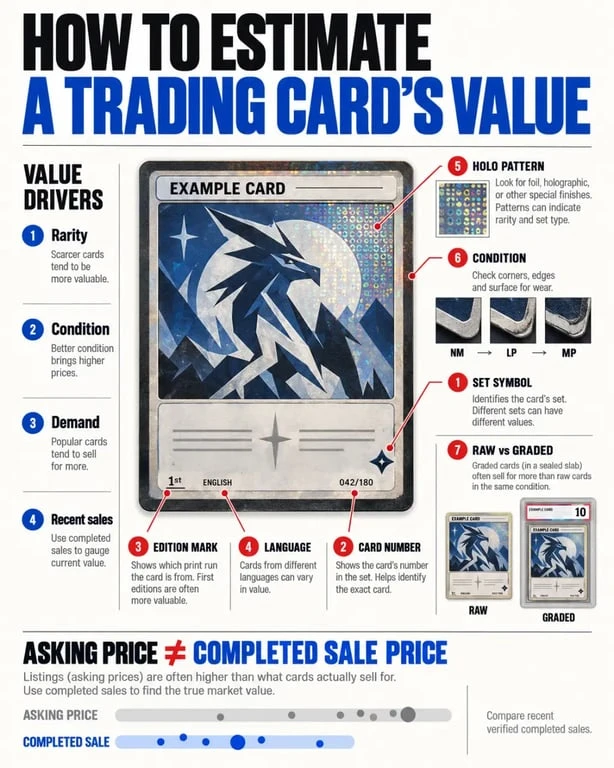
Look near the bottom of the card for a fraction-like number, such as 123/172. This identifies the card’s place in a specific set. A number beyond the usual set total may indicate a secret rare. The set symbol, usually near the lower edge, provides another important identifier. Match both details against a checklist before accepting a price result. If the card is a promo, its promo stamp and release style may matter more than a standard set number.
Separate printings and variants
For vintage cards, the distinction between Unlimited, Shadowless, and 1st Edition is fundamental. Base Set Charizard exists in all three versions, and they should never share one generic valuation. Modern cards require the same care. Regular holo, reverse holo, alternate art, Rainbow Rare, Gold card, Special Art card, stamped promo, and Japanese printing are separate market categories. The artwork helps identify the card, but the printing determines which comparisons are relevant.
Think of identification as a filter rather than a single search. Each detail removes irrelevant comparisons: first the set, then the number, language, holo pattern, and edition mark. This prevents a common valuation error, using a high-grade 1st Edition sold listing to price an Unlimited raw copy simply because both cards show the same Pokémon. The smaller the comparison group, the more useful its market price becomes.
Use completed sales to establish a realistic market range
An asking price is a seller’s target, not proof that a buyer will pay it. Recent sold listings show actual buyer behavior and should form the core of a Pokémon card price estimate. Compare several sales for the same printing in a similar condition, then use the middle of the range as a working reference. One unusually high or low transaction should not decide the value on its own.
Search Japanese and English Pokémon TCG Cards · Explore an up-to-date database of Japanese and English Pokémon cards as they are officially revealed.
| Price source | Best use | What to check |
|---|---|---|
| TCGplayer | Raw English cards and condition-based market references | Exact set, variant, and stated condition |
| CardMarket | European listings and language-specific comparisons | Currency, language, seller location, and card condition |
| Recent eBay sold listings | Evidence of completed individual sales, especially scarce cards | Sold status, date, photos, grade, and shipping context |
Each marketplace can provide a different view of the market. TCGplayer is useful for raw English cards, while CardMarket helps with European and language-specific comparisons. Recent eBay sold listings can offer useful evidence for scarce cards and individual transactions. Check the currency, shipping context, seller location, and whether the listing actually ended in a sale before comparing results.
For a frequently traded modern card, recent sales can produce a useful range quickly. For a rare vintage promo, error card, or high-grade slab, sales may be sparse. In that situation, widen the date range cautiously and compare only genuinely equivalent copies. A bundle, damaged card, misleading title, or unusual auction result is weak evidence and may distort the estimate.
Condition can move a raw card far below the headline price
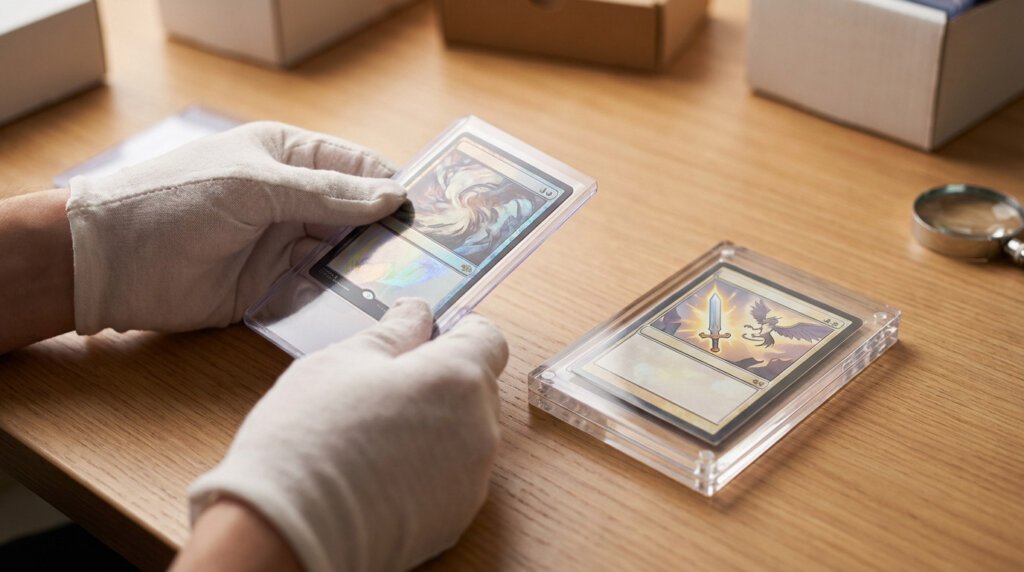
Most price guides use Near Mint as a benchmark. That does not mean every clean-looking card qualifies. Examine the card under direct light and without a sleeve. Check for whitening on the back edges, scratches across the holo surface, dents, creases, bent corners, stains, and pressure marks. Even a small defect can change which sold listings provide a fair comparison.
Grade your raw card conservatively
Use condition categories consistently. Near Mint cards show minimal handling evidence. Lightly Played cards have minor wear, while Moderately Played cards show more obvious whitening, surface wear, or edge damage. Heavily Played cards may have creases, prominent scratching, or structural damage. Lightly or Moderately Played cards may sell at a typical reduction of 50-85% from Near Mint value, depending on the card and the severity of the wear.
Do not judge condition from the front alone. Centering also matters, especially for cards that might be submitted for grading. Check the borders on the front and back, then inspect the corners, edges, and surface separately. Print lines and factory imperfections can complicate the assessment. They may be common within a release, but they can still limit the grade a collector expects. Photograph the front and back clearly before listing a valuable raw card.
Raw and graded cards belong in different price comparisons
A raw card has no third-party grade. A graded card is sealed in a slab with an assigned condition score. PSA, BGS, and CGC are distinct grading companies, so compare a grade with the same company whenever possible. A PSA 10, PSA 8, and PSA 7 are not interchangeable, and a graded price is not automatically relevant to an ungraded copy.
When grading may be worth considering
Professional grading can increase trust, improve protection, and create a clearer resale category, especially for vintage cards, iconic chase cards, or exceptionally clean copies. It is not automatically profitable. Before submitting, compare the likely raw value with recent sales for the same card and probable grade. Then account for grading costs, postage, insurance, selling fees, and the possibility of receiving a lower grade than expected.
High-grade premiums depend on scarcity and demand, not just the number on the label. A common modern card may gain little extra value in a mid-range grade, while a scarce 1st Edition or Shadowless card can attract stronger attention. For an expensive card, authentication matters as much as condition. Examine print quality, text, texture, colors, and dimensions, and seek specialist review if counterfeit or alteration is a concern.
Track the forces that make values rise, settle, or fall
Card values reflect supply and demand. Pull rate, print run, reprints, collector interest, tournament relevance, and broader collectible-market trends can all change the available price range. New chase cards often spike at release, then settle as more packs are opened and additional supply enters the market. Vintage cards may behave differently because surviving Near Mint copies and high grades can be comparatively scarce.
Reprints can change how buyers view a card’s scarcity, while tournament relevance can affect interest in playable cards. Collector demand may also shift as a set becomes older or a particular Pokémon attracts renewed attention. These factors do not replace comparable sales, but they help explain why a price moves between two checks of the same card.
Build a record before you sell, trade, or insure
Keep a collection record with the exact set, card number, printing, language, condition, purchase price, and current estimate. Add photographs and note whether the card is raw or slabbed. A collection manager or simple spreadsheet can preserve this information for later comparisons. Include the date of each estimate because market values change over time.
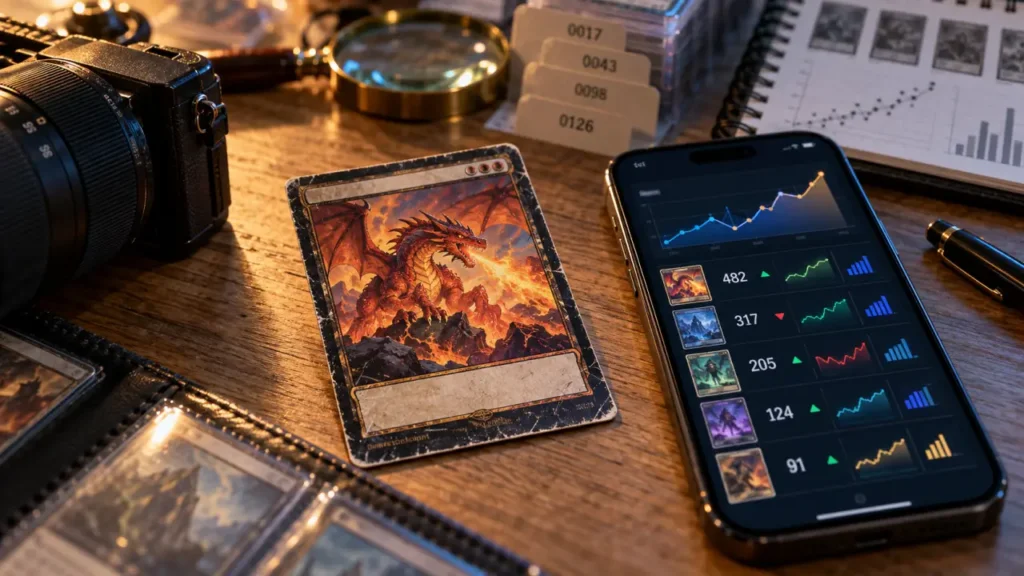
Reviewing price history is more useful than reacting to one sale. It can reveal whether a result is part of a trend, a brief release-period surge, or an isolated outlier. Historical tracking also helps separate a temporary spike from a sustained change in demand.
For selling, use a realistic range and disclose flaws clearly. For trading, compare like with like: raw against raw, graded against the same grade where possible, and the same language and variant. For insurance, document the collection with itemized evidence instead of relying on a single total. A price estimate is a decision tool, not a guaranteed sale price, but careful identification and recent comparable sales can make it a dependable one.