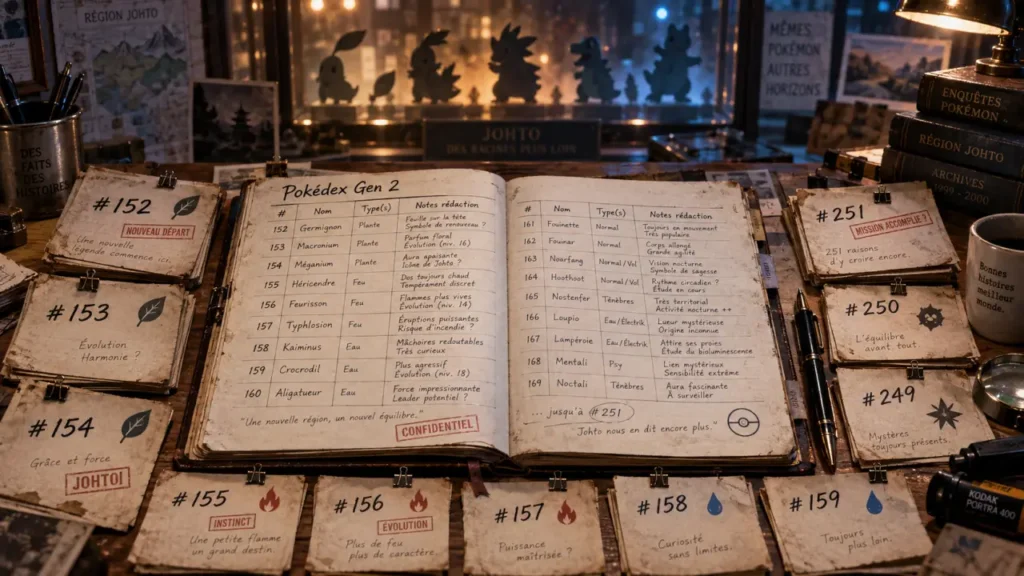
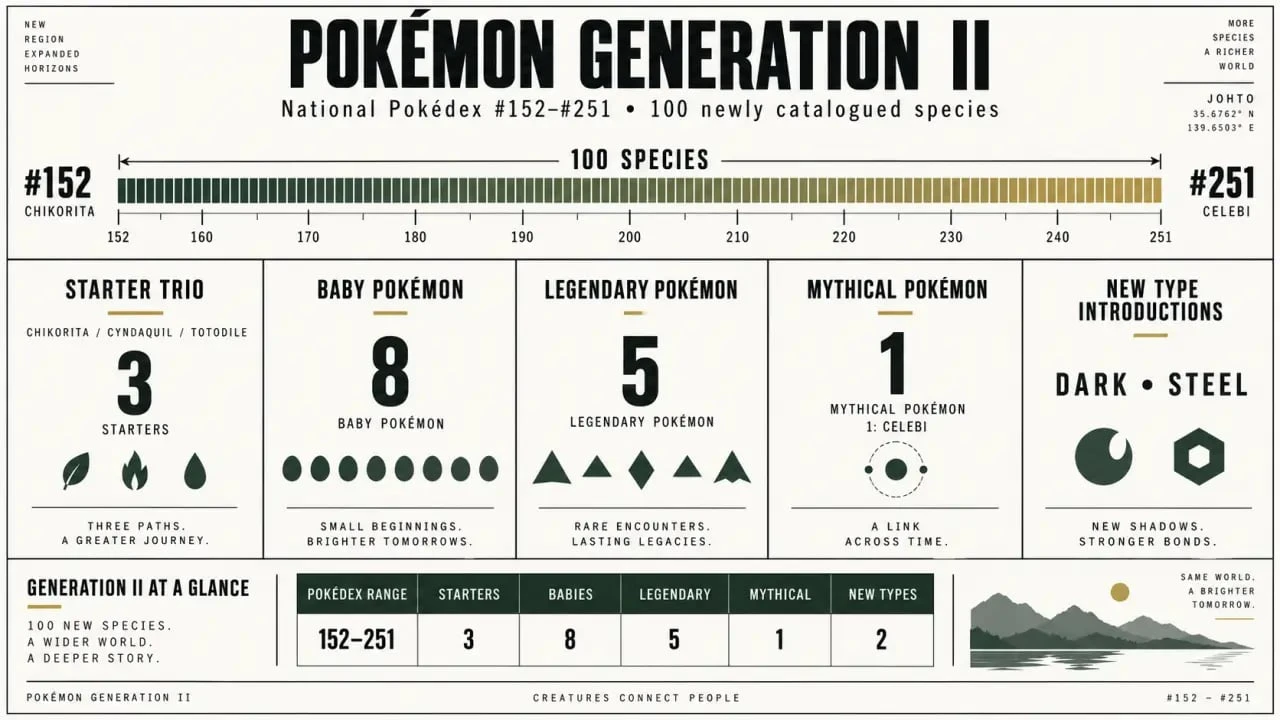
Generation II added exactly 100 species to the National Pokédex, from #0152 Chikorita to #0251 Celebi. These Pokémon debuted in Pokémon Gold and Pokémon Silver, set mainly in the Johto region. Use the list below to identify a Pokémon by number, check its current type combination, and follow its evolutionary relatives.
The complete Pokémon Gen 2 Pokédex list
This table follows National Pokédex order, not the order in which Pokémon appear during a particular game. That makes it useful when you know a number, are completing a collection, or want to find the species immediately before or after another entry. The types use the current classification, so some Pokémon now include the Fairy type even though Fairy was introduced after Generation II.
| No. | Pokémon | Type | No. | Pokémon | Type |
|---|---|---|---|---|---|
| #152 | Chikorita | Grass | #153 | Bayleef | Grass |
| #154 | Meganium | Grass | #155 | Cyndaquil | Fire |
| #156 | Quilava | Fire | #157 | Typhlosion | Fire |
| #158 | Totodile | Water | #159 | Croconaw | Water |
| #160 | Feraligatr | Water | #161 | Sentret | Normal |
| #162 | Furret | Normal | #163 | Hoothoot | Normal/Flying |
| #164 | Noctowl | Normal/Flying | #165 | Ledyba | Bug/Flying |
| #166 | Ledian | Bug/Flying | #167 | Spinarak | Bug/Poison |
| #168 | Ariados | Bug/Poison | #169 | Crobat | Poison/Flying |
| #170 | Chinchou | Water/Electric | #171 | Lanturn | Water/Electric |
| #172 | Pichu | Electric | #173 | Cleffa | Fairy |
| #174 | Igglybuff | Normal/Fairy | #175 | Togepi | Fairy |
| #176 | Togetic | Fairy/Flying | #177 | Natu | Psychic/Flying |
| #178 | Xatu | Psychic/Flying | #179 | Mareep | Electric |
| #180 | Flaaffy | Electric | #181 | Ampharos | Electric |
| #182 | Bellossom | Grass | #183 | Marill | Water/Fairy |
| #184 | Azumarill | Water/Fairy | #185 | Sudowoodo | Rock |
| #186 | Politoed | Water | #187 | Hoppip | Grass/Flying |
| #188 | Skiploom | Grass/Flying | #189 | Jumpluff | Grass/Flying |
| #190 | Aipom | Normal | #191 | Sunkern | Grass |
| #192 | Sunflora | Grass | #193 | Yanma | Bug/Flying |
| #194 | Wooper | Water/Ground | #195 | Quagsire | Water/Ground |
| #196 | Espeon | Psychic | #197 | Umbreon | Dark |
| #198 | Murkrow | Dark/Flying | #199 | Slowking | Water/Psychic |
| #200 | Misdreavus | Ghost | #201 | Unown | Psychic |
| #202 | Wobbuffet | Psychic | #203 | Girafarig | Normal/Psychic |
| #204 | Pineco | Bug | #205 | Forretress | Bug/Steel |
| #206 | Dunsparce | Normal | #207 | Gligar | Ground/Flying |
| #208 | Steelix | Steel/Ground | #209 | Snubbull | Fairy |
| #210 | Granbull | Fairy | #211 | Qwilfish | Water/Poison |
| #212 | Scizor | Bug/Steel | #213 | Shuckle | Bug/Rock |
| #214 | Heracross | Bug/Fighting | #215 | Sneasel | Dark/Ice |
| #216 | Teddiursa | Normal | #217 | Ursaring | Normal |
| #218 | Slugma | Fire | #219 | Magcargo | Fire/Rock |
| #220 | Swinub | Ice/Ground | #221 | Piloswine | Ice/Ground |
| #222 | Corsola | Water/Rock | #223 | Remoraid | Water |
| #224 | Octillery | Water | #225 | Delibird | Ice/Flying |
| #226 | Mantine | Water/Flying | #227 | Skarmory | Steel/Flying |
| #228 | Houndour | Dark/Fire | #229 | Houndoom | Dark/Fire |
| #230 | Kingdra | Water/Dragon | #231 | Phanpy | Ground |
| #232 | Donphan | Ground | #233 | Porygon2 | Normal |
| #234 | Stantler | Normal | #235 | Smeargle | Normal |
| #236 | Tyrogue | Fighting | #237 | Hitmontop | Fighting |
| #238 | Smoochum | Ice/Psychic | #239 | Elekid | Electric |
| #240 | Magby | Fire | #241 | Miltank | Normal |
| #242 | Blissey | Normal | #243 | Raikou | Electric |
| #244 | Entei | Fire | #245 | Suicune | Water |
| #246 | Larvitar | Rock/Ground | #247 | Pupitar | Rock/Ground |
| #248 | Tyranitar | Rock/Dark | #249 | Lugia | Psychic/Flying |
| #250 | Ho-Oh | Fire/Flying | #251 | Celebi | Psychic/Grass |
Why Generation II begins at #152
Generation II follows the original 151 Pokémon in the National Pokédex, which explains why Chikorita starts at #152. Pokémon Gold and Pokémon Silver were first released in Japan on November 21, 1999. They expanded the series with the Johto region, new species, and a stronger connection to the previous generation.
Official Pokémon National Pokédex · Search Pokémon by name or National Pokédex number and explore the complete official list.
Johto’s starters establish the generation’s central trio: Grass-type Chikorita, Fire-type Cyndaquil, and Water-type Totodile. The Pokédex then moves through early-route species, evolved forms linked to older Pokémon, standalone designs, and rare late-game creatures. The numbering therefore helps with more than identification. It gives the generation a clear sequence to browse.
For collectors, follow the range from start to finish instead of choosing entries at random. Mark each Pokémon you own, note incomplete evolution families, and return to the earliest missing number. This approach helps prevent entries such as Crobat, Politoed, Steelix, Kingdra, Porygon2, and Blissey from being overlooked because their earlier forms belong to Generation I. It creates a practical completion route based on the Pokédex rather than memory.
Families, Baby Pokémon, and notable rarities
Evolution lines that connect Johto to earlier generations
Generation II expanded several existing families. Crobat evolves from Golbat, Bellossom branches from Gloom, Politoed branches from Poliwhirl, and Slowking evolves from Slowpoke. Scizor comes from Scyther, Steelix from Onix, Kingdra from Seadra, Porygon2 from Porygon, and Blissey from Chansey. These additions matter when building a living Pokédex because their evolutionary families cross generational boundaries.
Johto also introduced complete or near-complete three-stage lines of its own. These include Chikorita, Bayleef, and Meganium; Cyndaquil, Quilava, and Typhlosion; Totodile, Croconaw, and Feraligatr; Mareep, Flaaffy, and Ampharos; and Larvitar, Pupitar, and Tyranitar. Comparing these groups makes it easier to see how the generation mixes new families with extensions of older ones.
Baby, Legendary, and Mythical Pokémon
The Baby Pokémon introduced in Generation II are Pichu, Cleffa, Igglybuff, Togepi, Tyrogue, Smoochum, Elekid, and Magby. They expanded familiar lines with earlier evolutionary stages and gave breeding a larger role in collection goals.
Raikou, Entei, and Suicune form Generation II’s Legendary beast trio. Lugia and Ho-Oh are also Legendary Pokémon and are closely associated with the two main game versions. Celebi is the generation’s Mythical Pokémon. These categories should remain separate when tracking completion because “Legendary” and “Mythical” are different labels.
Types, abilities, and base stats: how to compare entries
Generation II introduced the Dark and Steel types, changing type matchups from Generation I. Umbreon, Murkrow, Houndour, Houndoom, Sneasel, and Tyranitar show different uses of the Dark type. Forretress, Steelix, Scizor, and Skarmory provide notable Steel-type combinations.
When comparing individual Pokémon, consider more than type. A detailed Pokédex entry can list an ability and six base-stat categories: HP, Attack, Defense, Special Attack, Special Defense, and Speed. Base stats describe a species’ starting profile. They do not determine which Pokémon is best for every battle or game mode.
- Blissey has 255 base HP.
- Shuckle has 230 base Defense and 230 base Special Defense.
- Steelix reaches 200 base Defense.
- Lugia and Ho-Oh each have 106 base HP.
- Celebi has 100 in every listed base-stat category, giving it an even all-round profile.
Generation II also introduced Shiny Pokémon. A Shiny is a rare color variation, not a separate Pokédex species, so it does not increase the total of 100 Pokémon. For a deeper lookup, search an individual Pokémon’s name with “Pokédex” to check abilities, moves, evolution requirements, and version-specific availability.