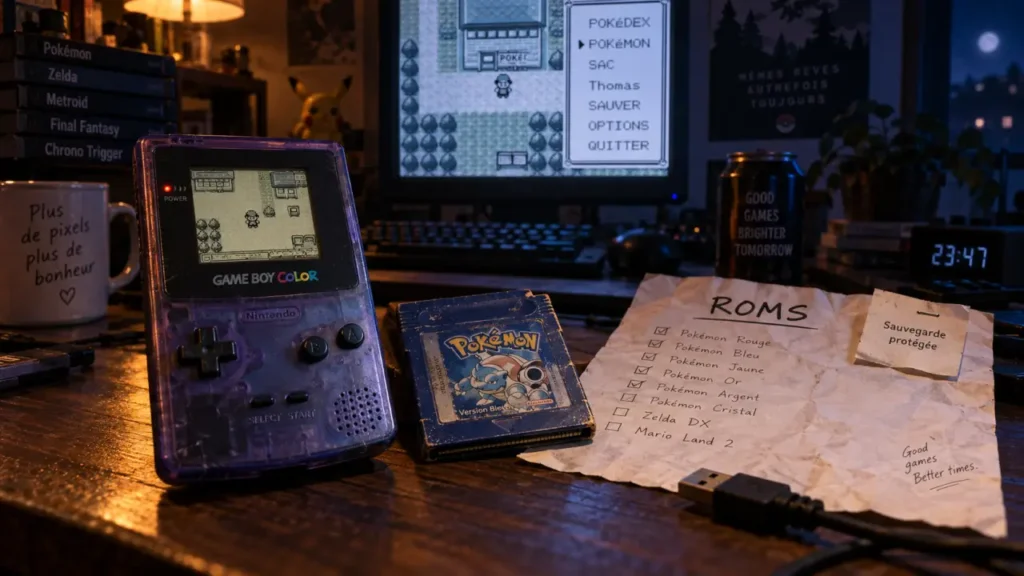
Classic Pokémon adventures are well suited to emulation because their original hardware spans three closely related handheld systems: Game Boy, Game Boy Color, and Game Boy Advance. The right starting point depends less on the “best game” than on the experience you want, whether that means Kanto’s simple beginnings, Johto’s two-region journey, or Hoenn’s deeper team-building options. Before choosing a title, learn what an emulator does, what a ROM file is, and which features may not carry over perfectly.
Start with the game era that matches your Pokémon goal
The main Pokémon games share a familiar loop: explore a region, catch Pokémon, build a team, win turn-based battles through type advantages, challenge Gym Leaders, and work toward the Pokémon League. Each handheld era changes the pace, available mechanics, and amount of strategic detail. For a first emulator playthrough, choosing a game by platform is often more useful than browsing a long, unfiltered collection.
| Original platform | Recommended games | Region | Why play them |
|---|---|---|---|
| Game Boy | Pokémon Red, Blue, Yellow | Kanto | The foundational 151-Pokémon adventure and a direct introduction to the series. |
| Game Boy Color | Pokémon Gold, Silver, Crystal | Johto and Kanto | Day-and-night cycles, breeding, held items, friendship, shiny Pokémon, and an expansive journey. |
| Game Boy Advance | Pokémon FireRed, LeafGreen, Ruby, Sapphire, Emerald | Kanto or Hoenn | A more polished presentation and, in Hoenn, abilities, natures, double battles, and Pokémon Contests. |
Game Boy: choose Kanto for the original adventure
Pokémon Red and Blue established the formula that still defines the series: pick a starter, assemble a party of up to six Pokémon, exploit elemental matchups, and complete a Pokédex. Pokémon Yellow revisits Kanto with a different presentation and a closer connection to the animated series. These games suit players who want a compact, historic RPG without later systems such as abilities or held items. Their simplicity is part of the appeal, although the earliest games can feel less balanced and less polished than later remakes.
Game Boy Color: choose Johto for discovery and collection
Gold, Silver, and Crystal broaden the original formula with 100 new Pokémon and systems that make raising a team feel more personal. Friendship can affect certain evolutions, breeding opens new collection possibilities, and held items add choices during battles. Crystal is often the most appealing version for players who want the Game Boy Color era at its fullest, while Gold and Silver remain strong options for a more traditional playthrough. The changing time of day also gives routes a rhythm that makes repeat visits meaningful.
Game Boy Advance: choose Hoenn or a Kanto remake for smoother play
FireRed and LeafGreen are remakes of the first Kanto games, not entirely new regional adventures. They are strong choices for newcomers who want Kanto’s structure with later-generation quality-of-life improvements. Ruby, Sapphire, and Emerald introduce Hoenn and bring a larger mechanical leap: Pokémon have abilities and natures, battles can involve two Pokémon per side, and Contests offer an alternative activity outside the Gym challenge. Emerald is particularly attractive for players looking for the broadest Hoenn-focused experience.
Understand the difference between a Pokémon emulator and a ROM
An emulator is software that recreates the behavior of older console hardware on another device, such as a computer or phone. A ROM is the game data that the emulator reads. They are separate things: installing an emulator does not include the game, and having a game file does not make it playable without compatible emulation software.
- Emulator: software that imitates Game Boy, Game Boy Color, or Game Boy Advance hardware.
- ROM: a digital copy of a specific game’s data.
- Save file: the ongoing record of your team, badges, items, location, and progress.
- Save state: an emulator snapshot that captures the exact moment on screen.
Compatibility starts with the original platform. A Game Boy title needs an emulator that supports that system, while Game Boy Advance titles require Game Boy Advance support. Some programs cover several generations of handheld hardware, but the key question is always whether the emulator supports the platform on which the game was released. Do not assume that a later handheld emulator automatically handles every earlier title, or that every device offers the same control and save options.
Emulation can make retro play more accessible on computers and phones. A computer generally provides a larger screen, keyboard mapping, and simple file backup. A phone offers portability, touch controls, and the convenience of playing in short sessions. A physical controller may improve comfort on either device, especially during long routes, battles, or menu-heavy team management.
Pick a classic Pokémon game by play style, not popularity alone
The most famous title is not automatically the right one for every player. Some people want the original rules and pixel-art atmosphere, while others want a remake that feels more approachable. The following comparison focuses on the games most commonly associated with retro handheld emulation.
| Game | Generation | Original platform | Best for | Notable point |
|---|---|---|---|---|
| Red / Blue / Yellow | I | Game Boy | Players seeking the series’ original Kanto journey | 151 Pokémon introduced in Generation I |
| Gold / Silver / Crystal | II | Game Boy Color | Collectors and explorers | Breeding, friendship, held items, and shiny Pokémon |
| FireRed / LeafGreen | III | Game Boy Advance | Beginners who want Kanto with a smoother presentation | Modernized remakes of the original Kanto story |
| Ruby / Sapphire | III | Game Boy Advance | Players building a more strategic team | Abilities, natures, double battles, and Contests |
| Emerald | III | Game Boy Advance | Players wanting a feature-rich Hoenn playthrough | An expanded Hoenn experience |
Choose an original game when the historical feel matters
Red, Blue, Yellow, Gold, Silver, and Crystal offer the closest connection to the era in which the series became a handheld phenomenon. They suit players who value the music, limitations, and straightforward progression of those releases. The older interface and battle systems require patience, but they are part of the experience. If your goal is to revisit a childhood cartridge as faithfully as possible, the original version is usually the more satisfying choice.
Choose a remake when you want the same region with fewer rough edges
FireRed and LeafGreen preserve Kanto’s route through Gyms and the Elite Four while using Generation III mechanics and visuals. This makes them a practical entry point for someone who has never played a classic Pokémon game. A remake is not a replacement in every case. The original and remake can deliver distinct moods, encounter lists, pacing, and visual identities. The better choice depends on whether you value authenticity or convenience.
Protect your save before experimenting with speed, states, or trading
A Pokémon playthrough depends heavily on long-term progress. Your save is more than a checkpoint: it holds a carefully raised party, rare captures, evolution progress, badges, box organization, and perhaps a shiny Pokémon. Save normally inside the game whenever possible, then keep a separate copy of the save file before changing emulator settings, moving files between devices, or trying multiplayer functions.
Think of a save file as the hands of a clock. It records the real passage of your adventure, from your first starter Pokémon to a completed League run. A save state is more like pausing the clock and taking a photograph of the mechanism. It is useful before a difficult battle or a one-time encounter, but relying on snapshots alone can create confusion when files are renamed, transferred, or opened in a different emulator. Regular in-game saves give your journey a more stable timeline and make recovery easier.
Use save states as a convenience, not your only safeguard
Save states can help you test a battle strategy, repeat a challenging sequence, or pause instantly on a phone. However, they may be tied to a particular emulator version or configuration. An in-game save is more likely to remain useful when you migrate to another compatible setup. Keep both forms of progress, but make the in-game save your dependable archive.
Trading and multiplayer may need extra care
In the original handheld experience, trading relied on a link cable. Emulators may offer local linking, network-based features, or no trading support at all, depending on the software and device. Do not assume that trade evolutions, multiplayer battles, or transfers between versions will work automatically. Before committing to a team that depends on a trade evolution, verify that your chosen setup supports the feature and back up both save files first.
Use ROMs responsibly and keep your setup simple
Pokémon games and their game data are protected by copyright. Owning an original cartridge does not automatically make every online download lawful in every location, and websites distributing game files may not have permission to do so. The responsible approach is to use game data you are entitled to use, respect applicable copyright rules, and avoid treating a broad ROM collection as proof that every file is authorized.
For a reliable first session, start with one game, one compatible emulator, and one folder dedicated to saves and backups. Map the controls before leaving the opening area, check that the game can create and reload a normal in-game save, and only then adjust visual filters, fast-forward options, or controller settings. This preparation prevents one of the most frustrating problems in retro Pokémon play: reaching a favorite team, then discovering that the progress cannot be found or restored.
Once the technical basics are stable, the choice becomes simple. Pick Yellow for an early Kanto revisit, Crystal for a richer Game Boy Color journey, FireRed or LeafGreen for an accessible Kanto remake, or Emerald for a deeper Game Boy Advance adventure. Each one delivers the central pleasure that has endured across Generations I through IX: building a team that gradually becomes your own.