Japanese Pokémon cards attract collectors with their Japanese-language presentation, distinctive product releases, promotional items, and region-exclusive artwork. The best purchase depends on your goal: a sealed booster box for the opening experience, a single card for a targeted collection, or a deck product for play. Before ordering, compare the format, check the seller, and confirm what “sealed” actually means.
Choose the product format before you compare prices
Japanese Pokémon cards are sold in more formats than individual booster packs. A low price means little if the product does not match your collecting plan. Decide whether you want random pulls, one specific card, a playable starting point, or a sealed item for display.
Browse Every Japanese Pokémon Card by Set and Era · Explore thousands of Japanese Pokémon TCG cards with high-quality images, organized by era and set.
| Product type | Best for | What to expect |
|---|---|---|
| Single card | Completing a binder page or collecting one Pokémon | The most direct route to a known card and its condition |
| Booster pack | A small opening experience | Random cards, with more uncertainty when bought loose |
| Booster box | Opening multiple packs or keeping a sealed collection | Multiple packs in original box packaging, with chance-based contents |
| Starter set or deck | New players and gift buyers | A more structured product than random packs |
| Promo or special deck set | Collectors seeking exclusive products | May include region-specific cards, special packaging, or anniversary items |
Singles solve a precise collecting problem
Buy single Japanese Pokémon cards when the card, rather than the surprise, is the point. This approach suits set completion, character collections, artwork collecting, and replacing a damaged copy. Ask for clear front-and-back photos, then assess centering, corners, edges, and surface. Look for signs that the card has been played or stored poorly. “Near mint” is a seller description, not a substitute for images.
Booster boxes are not a promise of a specific hit
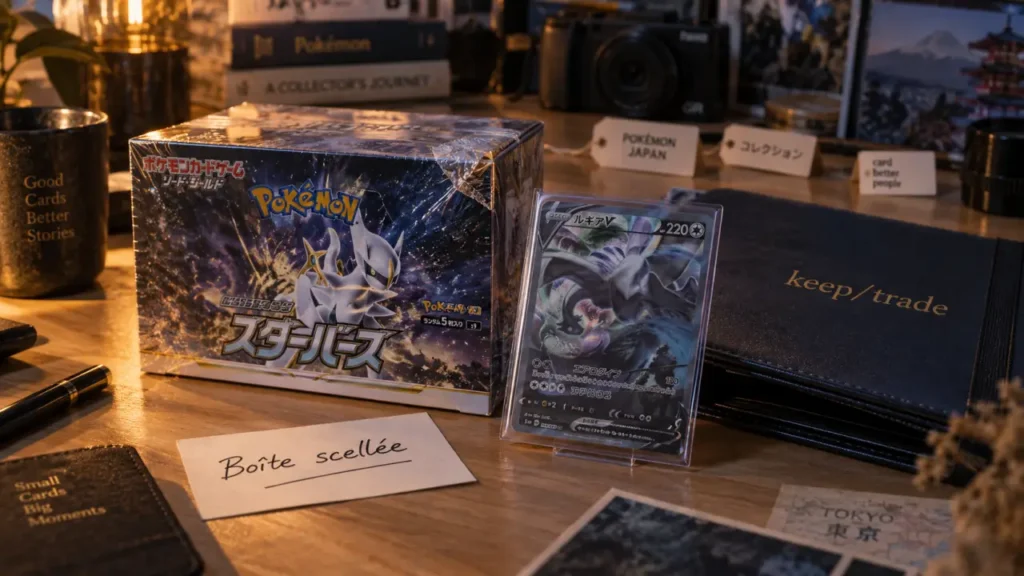
A Japanese booster box contains multiple booster packs and gives an opening session more structure than buying packs one at a time. Its contents remain partly random. Certain rarities or card types may follow box-level expectations for a particular release, but the exact card you want is never guaranteed. Do not treat a box as a reliable way to pull one specific chase card. Compare the box price with the cost of the single before buying.
Buy authentic Japanese Pokémon cards with fewer surprises
Specialist retailers, established card stores, and reputable marketplaces can all be useful places to buy Japanese Pokémon cards. The key question is not simply whether a seller ships from Japan. The listing should give you enough information to assess the exact item, its condition, and the terms of the sale.
Read the listing as carefully as the product name
A reliable listing identifies the product type, set or product name, language, and condition. For sealed products, check that the original outer packaging is intact and look for photos of the actual box when possible. A sealed box has unopened original packaging, with nothing removed. That does not guarantee a particular card inside, and it does not automatically establish long-term value.
- Check that the Japanese product name, set code, and product type are consistent.
- Prefer listings with clear images instead of generic stock photography alone.
- Review shipping charges, taxes or customs treatment, delivery options, and return terms before checkout.
- Be cautious with unusually cheap sealed products, vague descriptions, or sellers who will not show packaging details.
- For loose packs, allow for more uncertainty because their previous handling and origin are harder to verify than those of a sealed box.
International shipping adds another part to the decision. Products sent directly from Japan can provide access to releases that are difficult to find locally, but the total cost includes the item, shipping, and any applicable import charges. Exchange rates can also affect the final price. A slightly more expensive listing from a reliable seller with transparent tracking and returns may be a better purchase than a bargain with unclear terms.
Japanese versus English cards: collectability, language, and play
Japanese and English Pokémon cards belong to different product ecosystems. Releases can have different names, timing, packaging, and set structures. Japanese cards are therefore interesting to collectors, while players need to consider language and deck requirements.
| Consideration | Japanese cards | English cards |
|---|---|---|
| Card text | Japanese-language text may require a translation guide | Accessible to English-language players without translation |
| Card back | Different from English card backs | Different from Japanese card backs |
| Artwork and promos | Can include region-exclusive artwork or promotional products | Has its own releases and product configurations |
| Set matching | A Japanese set may not map one-to-one to an English set | May combine or reorganize cards from Japanese releases |
Use opaque sleeves for mixed-language decks
Japanese and English card backs differ, so mixing unsleeved cards can reveal information from the back of the deck. Use identical opaque sleeves when cards with different backs are played together. You will also need an accurate translation reference for Japanese card text. For organized play, check the current event rules before attending, since language acceptance and deck requirements can vary by organizer and region.
Opening products can create a useful collection cycle. Duplicates become trade material, and trades can help fund the exact singles that packs did not provide. A binder with separate sections for “keep,” “trade,” and “upgrade condition” turns random openings into a more deliberate system. It also keeps duplicate cards from becoming clutter when they may help another collector complete a set.
Identify a Japanese set without relying on packaging alone
Whether you are researching an older card or checking a newly released product, use several identifiers together. A searchable Japanese Pokémon card database is most useful when it lets you filter by era, Japanese name, product code, card count, release date, and product type. One detail can mislead you. Several matching details create a stronger identification trail.
Build a simple set-identification record
Start with the card or product code, then record the Japanese set name and release date. Add the card count and era to distinguish similarly named releases. Useful database categories include booster sets, starter sets, deck build boxes, premium trainer boxes, special deck sets, promotional products, and anniversary products.
Card counts show why the release name matters. Examples include Pokémon Card 151 with 210 cards, VSTAR Universe with 262 cards, Shiny Treasure ex with 359 cards, and Terastal Festival ex with 237 cards. Product codes such as SV8a, SV2a, and S12a provide another practical reference point. Do not assume that a Japanese release has an exact English equivalent. Verify the card list when building a cross-language checklist.
Protect condition from the first day of ownership
Condition matters whether you plan to trade, display, grade, or enjoy your cards years from now. Protection costs less than replacing a scarce promo or a favorite illustration. Sleeve cards before placing them in an album, and choose storage that keeps them stable without compressing them.
- Use clean, properly sized sleeves for cards you want to preserve.
- Store sleeved cards in albums or storage boxes designed for trading cards.
- Keep sealed boxes away from humidity, direct sunlight, and crushing weight.
- Separate trade duplicates from your permanent collection to reduce handling.
- Keep purchase records and product details for significant sealed items or high-value singles.
For a first purchase, choose the format that matches your purpose: a verified single for one card, a sealed booster box for the opening experience, or a starter or special deck product for a more defined entry point. That choice makes Japanese Pokémon cards easier to buy with confidence and easier to enjoy when they arrive.