
Energy cards power attacks in the Pokémon Trading Card Game. Attach them to your Pokémon to meet attack costs, then read the symbols beside each attack name to see which Energy is required. The main distinction is straightforward: colored symbols require matching Energy types, while Colorless symbols require a quantity of Energy that can come from any qualifying type.
Read an attack cost before choosing an Energy card
Every attack shows its Energy requirement to the left of its name. A Pokémon cannot use that attack unless it has enough Energy attached to meet the full cost. Under the standard rule, you may attach one Energy card from your hand per turn to one of your Pokémon. Trainer cards, Abilities, and attack effects can sometimes create additional attachments or move Energy, but those exceptions are stated on the individual cards.
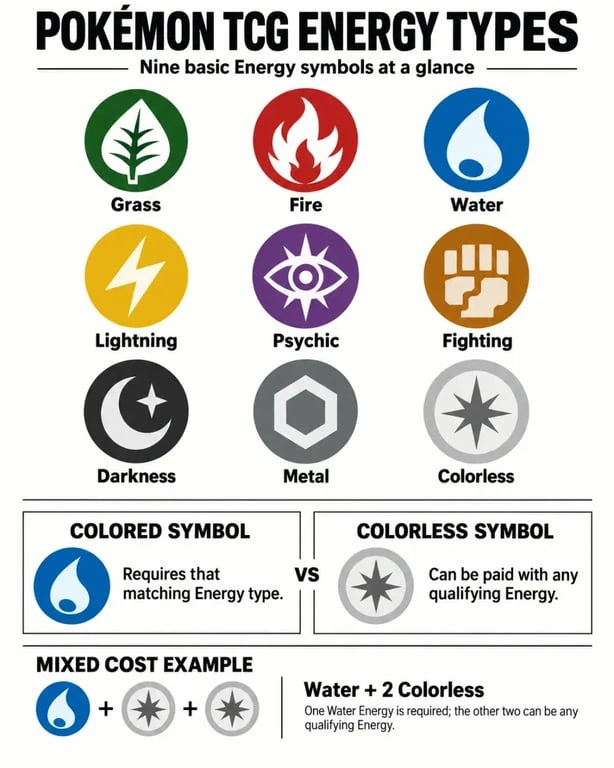
Specific symbols must be matched
A Grass symbol in an attack cost requires Grass Energy. A Fire symbol requires Fire Energy, and the same rule applies to the other colored symbols. If an attack costs one Fire Energy and one Lightning Energy, attaching two Fire Energy does not pay the cost. The Pokémon has two Energy attached, but it still lacks the required Lightning Energy. Your deck’s Energy mix should therefore match the colored symbols on its main attackers, not just the total number of Energy in their attack costs.
Colorless means “any type,” not Colorless Energy
A Colorless symbol represents a quantity requirement. Any Energy that provides Energy can pay it, including Grass, Water, Darkness, a suitable Special Energy, or another type. For example, an attack costing one Water Energy and two Colorless Energy can be paid with three Water Energy, or with one Water Energy plus any two other qualifying Energy. You do not need a Basic “Colorless Energy” card to pay a Colorless cost.
The nine Basic Energy types and what they represent
Basic Energy cards normally provide one unit of the type printed on the card. They have no additional text to interpret, which makes them a dependable way to pay a colored attack cost. Nine Basic Energy types have existed in the Pokémon TCG.
| Basic Energy type | Common use in an attack cost | Important note |
|---|---|---|
| Grass | Pays Grass requirements | Provides one Grass Energy. |
| Fire | Pays Fire requirements | Provides one Fire Energy. |
| Water | Pays Water requirements | Provides one Water Energy. |
| Lightning | Pays Lightning requirements | Provides one Lightning Energy. |
| Psychic | Pays Psychic requirements | Provides one Psychic Energy. |
| Fighting | Pays Fighting requirements | Provides one Fighting Energy. |
| Darkness | Pays Darkness requirements | Provides one Darkness Energy. |
| Metal | Pays Metal requirements | Provides one Metal Energy. |
| Fairy | Pays Fairy requirements | Rotated out of Standard format in 2021. |
Dragon Pokémon and Colorless Pokémon can appear on cards, but that does not mean the game has a matching Basic Dragon Energy or Basic Colorless Energy. Dragon attacks commonly require combinations of other types, while Colorless attack costs accept Energy from any qualifying type. Follow the symbols printed on the attack instead of assuming that a Pokémon’s own type determines the Energy it needs.
Basic Energy and Special Energy solve different deck problems
Both categories can help pay attack costs, but they work differently. Basic Energy is predictable and generally unrestricted in deck quantity. Special Energy has card text that changes what it provides, adds an effect, or limits where it can be attached. A practical deck usually starts with the Basic Energy needed for its main attacks, then adds Special Energy when its effect supports a clear plan.
| Feature | Basic Energy | Special Energy |
|---|---|---|
| What it provides | Usually one unit of its printed type | May provide one or more units, one or several types, or a conditional benefit |
| Card text | Simple and consistent | Controls its effect, restrictions, and exceptions |
| Copies in a deck | More than four copies are allowed | Usually limited to four copies with the same name |
| Reliability | Works the same in normal situations | Can be more flexible, but may depend on conditions |
Why Special Energy needs closer reading
A Special Energy card may provide multiple Energy units, provide more than one type at once, reduce a drawback, or grant another effect while attached. It may also work only on a particular kind of Pokémon. If the attached Pokémon does not meet that condition, the card’s text determines what happens. Some Special Energy cards can be discarded when attached illegally, so treating every Energy card as interchangeable can cost you a turn.
Read the card as a complete effect rather than relying only on its symbols. A Special Energy that can provide two types does not automatically provide two units of Energy. Its text must state that it provides two units if that is how the card works. The same wording determines whether it can satisfy multiple colored requirements at the same time, whether it works only on certain Pokémon, and what happens when an attachment condition is not met.
Use a payment check when an attack has mixed costs
The fastest way to avoid mistakes is to resolve an attack cost in two passes. First, satisfy each colored symbol with Energy that provides that specific type. Then count the remaining attached Energy that can pay the Colorless symbols. This method works with Basic Energy, Special Energy, or a combination of both.
- Identify the colored requirements first, such as Water, Metal, or Psychic.
- Check what each attached Energy currently provides according to its card text.
- Match the required colors.
- Use any remaining qualifying Energy to cover the Colorless portion.
- Confirm that no effect is changing, removing, or preventing the Energy provided.
For instance, a cost of Fighting, Darkness, and Colorless requires both Fighting and Darkness to be covered. A third attached Energy of any qualifying type can cover the Colorless symbol. If a Special Energy provides both Fighting and Darkness simultaneously, its exact wording determines whether it can satisfy both requirements at the same time. Do not infer this from the card’s artwork or name.
Build an Energy line around consistency, not every available type
New players often add many Energy types because their deck contains Pokémon of several types. That can make the deck less consistent, since you may draw Energy that cannot pay for the attack you need. Instead, identify the attacker you expect to use most often, list its colored requirements, and make those types the foundation of your Energy line.
Choose Special Energy for a defined job
Special Energy is most useful when it solves a specific problem. A multitype card can support an attacker with mixed requirements. A card that provides extra Energy can help pay for a high-cost attack, while another may offer a useful effect while attached. In exchange, Special Energy can be vulnerable to effects that target it, and its copy limit makes it less available than Basic Energy. Include it because its text advances your game plan, not simply because it appears more powerful.
Check legality separately from game function
An Energy card can work clearly under the rules and still be illegal in the format you are playing. For official tournament play, check the card’s regulation mark and the current format rules. The official Pokémon TCG card database can help you locate Energy cards and filter Basic and Special Energy categories. For casual play, agree with your opponent on the format and card pool before building around older Energy cards.
Once you separate colored requirements from Colorless requirements, Pokémon card Energy types become easier to understand. Basic Energy provides dependable type matching, while Special Energy adds flexibility and card-specific exceptions. Read the attack symbols, check the full text of every Special Energy card, and build around what your main attackers actually need.