When you buy Pokémon cards, begin by deciding what you actually need: sealed Pokémon TCG products, a specific single card, or a quick local purchase. The best place to shop depends on that choice. Official channels and established retailers suit sealed products, while specialist marketplaces are more practical for targeted cards, deck staples, and Energy cards.
Choose the buying channel that fits your goal
There is no single best store for every Pokémon purchase. A parent buying a gift, a player finishing a deck, and a collector looking for a particular illustration rare have different priorities. Compare the channel first, then assess the individual listing or product.
| Where to shop | Best for | What to check |
|---|---|---|
| Official Pokémon retail channels | New sealed Pokémon TCG products and official merchandise | Availability, purchase limits, shipping terms, and return policy |
| Specialist card marketplaces | Individual cards, graded cards, deck staples, and Energy cards | Seller feedback, card condition, listing photos, and buyer protection |
| Major retailers | Convenient browsing for packs, boxes, decks, and gifts | Whether the retailer sells the item directly, stock status, and returns |
| Local game stores | Immediate pickup, community advice, play events, and sealed products | In-store stock, prices, and whether singles are available in binders or cases |
Start with official and recognized retail routes
For factory-sealed booster packs, Elite Trainer Boxes, decks, and other current products, official Pokémon purchasing channels and recognized retailers provide a sensible starting point. The official Pokémon TCG retailer directory can help you find a legitimate store nearby. It is often more useful than searching a map for generic toy shops, which may not carry Pokémon TCG products consistently.
Large retail categories can make browsing convenient, but they can also become difficult to navigate. For example, the GameStop Pokémon category shows 863 results and pagination extending to page 44. That gives a clear idea of how quickly a broad Pokémon catalog can become difficult to scan without filters. Narrow the results by product type or availability before comparing products. Browsing every page is rarely efficient.
Use marketplaces when the card matters more than the opening
A specialist marketplace is usually more useful when you know the card, set, rarity, or card type you want. This applies to individual Pokémon cards, playable Trainer cards, and basic Energy cards. Marketplace filters can target a card type directly. A dedicated Energy-card filter is helpful when building a deck, since it avoids buying random packs just to find essential cards.
Marketplaces also require more checking. You are often assessing an individual seller rather than relying only on a retailer’s reputation. Read the complete listing, compare condition labels, inspect available photos, and understand the applicable buyer protection before ordering.
Buy sealed products or singles for the result you want
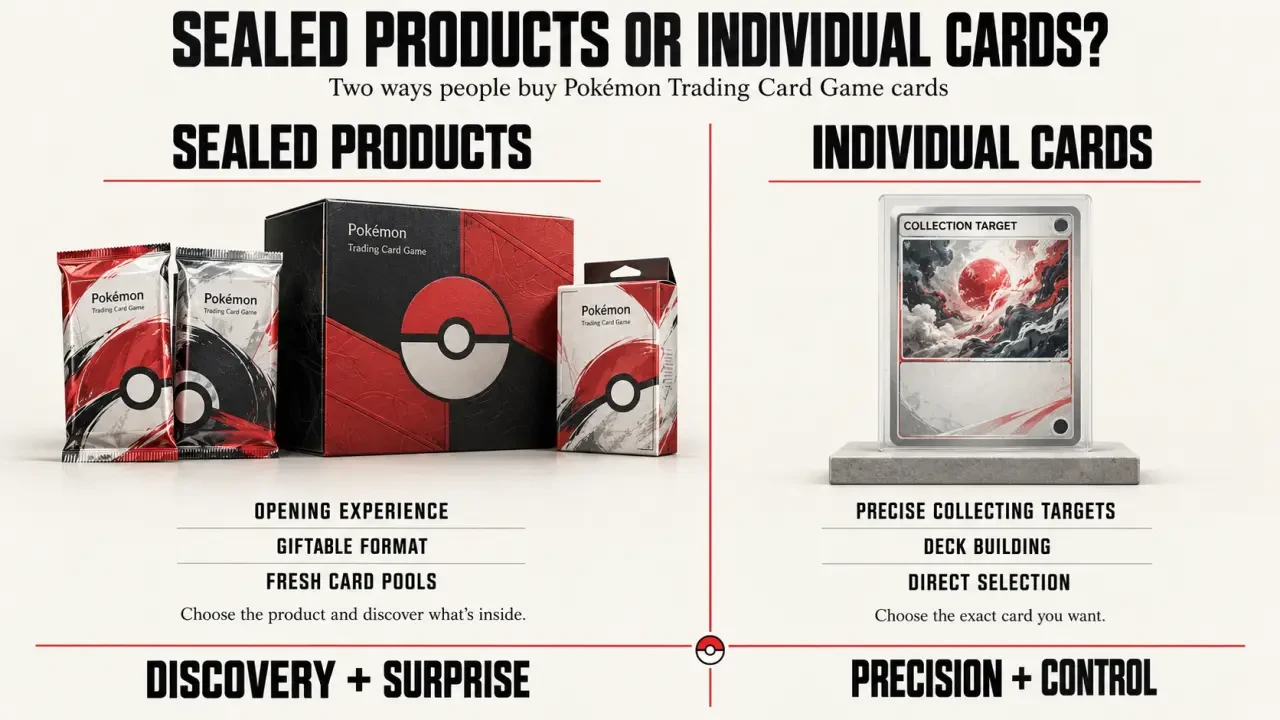
Sealed products and individual cards offer different experiences. Neither is automatically better value. The right choice depends on whether you want the surprise of opening packs, a playable deck, a gift, or one precise collecting target.
Find Official Pokémon TCG Retailers Near You · Discover where to buy Pokémon Trading Card Game products from official retailers, including Walmart, Target, Amazon, and more.
What sealed Pokémon TCG products are for
Booster packs and booster boxes are built around opening packs and discovering cards. They suit gifts, shared opening sessions, players who enjoy building from a fresh card pool, and collectors who want sealed items. An Elite Trainer Box may suit someone who wants packs with game accessories. A starter deck is a more direct option for a new player who wants a playable starting point.
Do not treat a booster as a guaranteed way to obtain a chase card. Pulls are uncertain, and buying more packs can turn a modest goal into an expensive one. If you enjoy the reveal, sealed products make sense. If you want one exact card, they usually do not.
Why singles are better for a focused collection or deck
A single card lets you pay for the card you want instead of paying for a chance to find it. Search by Pokémon name, set name, card number, rarity, language, and condition. For deck building, buy the required Pokémon, Trainer, and Energy cards individually after checking the quantity you need.
For collecting, decide whether you want a raw or graded card and identify the precise version. That may be a reverse holo, full art, illustration rare, or secret rare. The more specific the target, the more useful the set name and card number become.
Sealed products expose you to a broad range of possible pulls, while singles let you move directly toward one card. This distinction helps prevent a common mistake: opening repeated packs to find a low-cost deck card or an identified binder card. Save packs for the opening experience and use singles when precision matters.
Search large inventories with filters, not guesswork
Broad searches for Pokémon trading cards create noise. Plush toys, games, accessories, sealed boxes, singles, and older items may appear together. A few deliberate filters reduce the risk of ordering the wrong format or missing the right listing.
- Product format: choose a booster pack, booster box, Elite Trainer Box, deck, sealed product, single, or graded card.
- Set and card number: use both when looking for a precise print rather than a similarly named card from another set.
- Card type: narrow the search to Pokémon, Trainer, or Energy cards when building a deck.
- Condition: distinguish near mint from moderately played or heavily played, since condition affects appearance and price.
- Language: confirm the language before buying, especially if you want a consistent collection or need cards for tournament use.
- Price and availability: set a spending limit, sort carefully, and confirm that the item is actually in stock.
For a collectible card, compare more than the headline price. A near mint listing may cost more than a heavily played copy because surface wear, edge whitening, creases, and centering affect presentation. “Raw” means ungraded, not necessarily flawless. A graded card is housed and assessed, but you should still read the grade and inspect the listing instead of assuming every slab matches your standard.
Check the seller before you check out
Seller reliability is part of the purchase when you buy Pokémon cards online. A low price is not useful if the listing is misleading, the item is counterfeit, or a return becomes difficult. Take a moment to review the seller and the purchase terms before paying.
Use a practical authenticity and listing checklist
- Confirm whether the listing is for a sealed product, one single card, or a mixed lot.
- Read the set, card number, language, condition, and quantity instead of relying only on the thumbnail.
- Review the seller’s reputation and recent buyer comments when the marketplace provides them.
- Check clear photos for valuable singles. Stock images reveal little about the condition of a specific card.
- Compare the price with similar listings in the same condition before calling it a bargain.
- Read the shipping cost, estimated dispatch details, return rules, and buyer-protection terms.
Be cautious when an unusually low price appears alongside a vague description, missing condition details, or poor-quality images. Counterfeit cards and misleading listings can imitate popular products, so established sellers are generally the safer choice. For sealed items, look for packaging that is described clearly and avoid offers that do not explain exactly what is included.
For singles, an exact card number and a clear condition description are more useful than a generic claim that the card is “rare.” Check that the images match the listed card and version. If important details are missing, ask the seller before ordering or choose another listing.
Find Pokémon cards near you without wasting a trip
Local game stores combine buying with hands-on inspection, immediate pickup, and advice from people familiar with the Pokémon TCG. Many also host casual play or events, which can help a new player understand which products are useful beyond the packaging. Start with the official retailer directory, then contact the store before travelling to ask about current stock.
Ask specific questions. Do they have sealed products from the set you want? Do they sell singles? Is there a binder or display case for Energy cards and deck staples? Can they hold an item briefly? Local stock changes quickly, particularly around new releases and restocks, so a short call can be more reliable than an old social post or a generic search result.
For a gift, a nearby recognized retailer lets you check the box size, age guidance, and product format in person. For a collector seeking one exact card, a local store may still be useful if it carries singles. Call with the Pokémon name, set, and card number ready. That preparation makes the purchase faster and increases the chance that the item matches what you intended to buy.