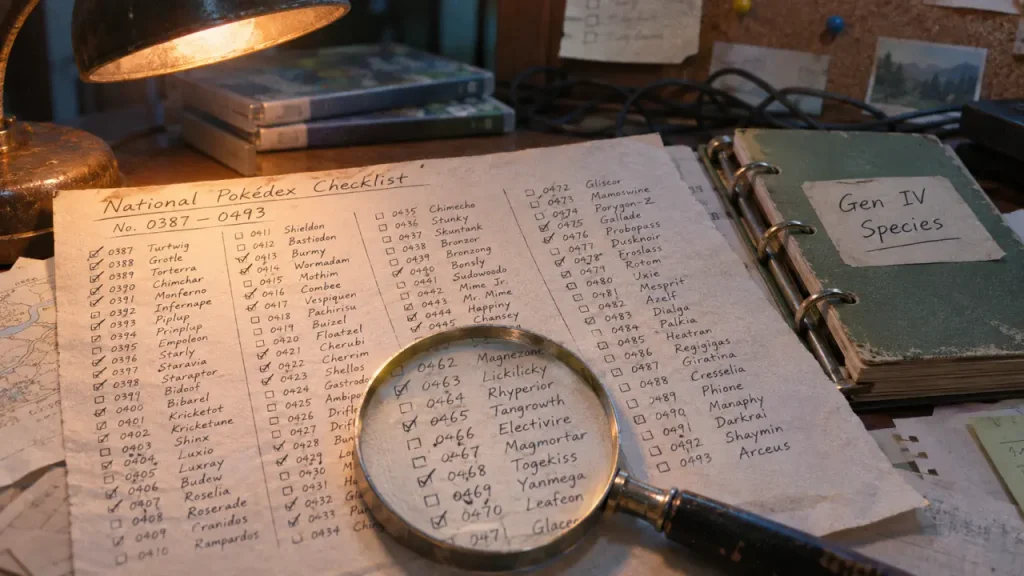
Generation IV introduced 107 Pokémon species, running from Turtwig (#0387) to Arceus (#0493) in the National Pokédex. They debuted with Pokémon Diamond and Pearl. The numbered list below includes every species, followed by the distinctions that matter when checking types, evolution families, alternate forms, and stats.
The complete Gen 4 Pokémon list in National Pokédex order
This is a species list, not a list of every form. Each National Pokédex number appears once. Use your browser’s Find function to locate a name or number quickly; on desktop, press Ctrl+F or Command+F.
Pokémon List by National Pokédex Number · Browse Pokémon in the official National Pokédex order for quick reference.
| Number | Pokémon | Number | Pokémon |
|---|---|---|---|
| #0387 | Turtwig | #0388 | Grotle |
| #0389 | Torterra | #0390 | Chimchar |
| #0391 | Monferno | #0392 | Infernape |
| #0393 | Piplup | #0394 | Prinplup |
| #0395 | Empoleon | #0396 | Starly |
| #0397 | Staravia | #0398 | Staraptor |
| #0399 | Bidoof | #0400 | Bibarel |
| #0401 | Kricketot | #0402 | Kricketune |
| #0403 | Shinx | #0404 | Luxio |
| #0405 | Luxray | #0406 | Budew |
| #0407 | Roserade | #0408 | Cranidos |
| #0409 | Rampardos | #0410 | Shieldon |
| #0411 | Bastiodon | #0412 | Burmy |
| #0413 | Wormadam | #0414 | Mothim |
| #0415 | Combee | #0416 | Vespiquen |
| #0417 | Pachirisu | #0418 | Buizel |
| #0419 | Floatzel | #0420 | Cherubi |
| #0421 | Cherrim | #0422 | Shellos |
| #0423 | Gastrodon | #0424 | Ambipom |
| #0425 | Drifloon | #0426 | Drifblim |
| #0427 | Buneary | #0428 | Lopunny |
| #0429 | Mismagius | #0430 | Honchkrow |
| #0431 | Glameow | #0432 | Purugly |
| #0433 | Chingling | #0434 | Stunky |
| #0435 | Skuntank | #0436 | Bronzor |
| #0437 | Bronzong | #0438 | Bonsly |
| #0439 | Mime Jr. | #0440 | Happiny |
| #0441 | Chatot | #0442 | Spiritomb |
| #0443 | Gible | #0444 | Gabite |
| #0445 | Garchomp | #0446 | Munchlax |
| #0447 | Riolu | #0448 | Lucario |
| #0449 | Hippopotas | #0450 | Hippowdon |
| #0451 | Skorupi | #0452 | Drapion |
| #0453 | Croagunk | #0454 | Toxicroak |
| #0455 | Carnivine | #0456 | Finneon |
| #0457 | Lumineon | #0458 | Mantyke |
| #0459 | Snover | #0460 | Abomasnow |
| #0461 | Weavile | #0462 | Magnezone |
| #0463 | Lickilicky | #0464 | Rhyperior |
| #0465 | Tangrowth | #0466 | Electivire |
| #0467 | Magmortar | #0468 | Togekiss |
| #0469 | Yanmega | #0470 | Leafeon |
| #0471 | Glaceon | #0472 | Gliscor |
| #0473 | Mamoswine | #0474 | Porygon-Z |
| #0475 | Gallade | #0476 | Probopass |
| #0477 | Dusknoir | #0478 | Froslass |
| #0479 | Rotom | #0480 | Uxie |
| #0481 | Mesprit | #0482 | Azelf |
| #0483 | Dialga | #0484 | Palkia |
| #0485 | Heatran | #0486 | Regigigas |
| #0487 | Giratina | #0488 | Cresselia |
| #0489 | Phione | #0490 | Manaphy |
| #0491 | Darkrai | #0492 | Shaymin |
| #0493 | Arceus |
Which games belong to Generation IV?
Pokémon Diamond and Pearl introduced Generation IV in 2006, with Sinnoh as their setting. Pokémon Platinum belongs to the same generation, as do Pokémon HeartGold and SoulSilver, the Johto remakes. A generation describes an era of the games, rather than a single region or one regional Pokédex.
That distinction matters when making a checklist. “Introduced in Gen 4” means the 107 species above. “Appears in a Gen 4 game” is a broader category that includes Pokémon from earlier generations. Likewise, a Sinnoh regional Pokédex is not interchangeable with the National Pokédex interval #0387–#0493.
Early appearances can also cause confusion: Bonsly, Mime Jr., and Munchlax appeared in anime adaptations in 2005 and 2006 before Diamond and Pearl. Those appearances do not move them into an earlier game generation.
Types and forms: check the game before comparing
For a quick type reference, the starter lines finish as Torterra, Grass/Ground; Infernape, Fire/Fighting; and Empoleon, Water/Steel. Other distinctive combinations include Lucario’s Fighting/Steel, Garchomp’s Dragon/Ground, and Spiritomb’s Ghost/Dark. Dual typing means both types apply, not that the Pokémon switches between them.
Historical typing needs special care. Mime Jr. was pure Psychic in Generation IV, but modern listings show Psychic/Fairy. Togekiss was Normal/Flying before Pokémon X and Y and is Fairy/Flying in later games. A current Pokédex page can therefore be correct without describing the original Diamond, Pearl, or Platinum rules.
Forms introduce another layer of variation:
- Burmy and Wormadam: Plant, Sandy, and Trash Cloaks; Wormadam’s cloak affects its secondary type.
- Rotom: its appliance forms require game-specific checks, particularly when comparing historical and modern typing.
- Giratina: Altered Forme and Origin Forme share one species number.
- Shaymin: Land Forme is Grass, while Sky Forme is Grass/Flying.
These variations do not increase the generation’s 107-species count. A database may display additional rows to describe forms, but extra rows are not necessarily extra Pokémon species.
Evolution families and the legendary end of the list
The opening entries make several evolution lines easy to spot: Turtwig evolves into Grotle and then Torterra; Chimchar into Monferno and Infernape; Piplup into Prinplup and Empoleon. Shinx, Luxio, and Luxray form another three-stage family, as do Gible, Gabite, and Garchomp.
Other families cross generation boundaries. Budew and Roserade connect to Roselia, while Munchlax connects to Snorlax. Leafeon and Glaceon are Eevee evolutions, and species such as Weavile, Magnezone, and Rhyperior extend older evolution lines. National Pokédex order records when species were introduced; it does not keep every family together.
Think of an evolution family as a plant growing from a seed: the branch you see in this list may have roots in an earlier generation. For a collection checklist, keep two separate records—one for species introduced in Gen 4 and another for their complete families. This prevents an earlier Pokémon such as Eevee from being mistakenly counted among the 107 while still showing why you need it to obtain Leafeon or Glaceon.
The legendary Pokémon introduced here include Uxie, Mesprit, Azelf, Dialga, Palkia, Heatran, Regigigas, Giratina, and Cresselia. The mythical entries are Phione, Manaphy, Darkrai, Shaymin, and Arceus. Being near the end of the list does not imply that these Pokémon share evolution methods or availability.
Reading base stats and abilities without misleading comparisons
Base stats describe six categories: HP, Attack, Defense, Special Attack, Special Defense, and Speed. A base-stat total adds those six values together. It is useful for a broad comparison, but it does not tell you whether a Pokémon is a physical attacker, special attacker, defensive supporter, or fast but fragile option.
For example, comparing Attack alone can overlook whether a Pokémon primarily uses special moves. Comparing totals alone can hide a low Speed stat or an uneven defensive spread. Actual in-game stats also depend on factors beyond species base stats, including level and training.
Abilities should be checked separately from typing and stats. They can change how a Pokémon functions without changing its listed type. When consulting a detailed reference, match the species, form, and game generation before comparing numbers or ability options. That three-part check is especially important for alternate forms and for modern database entries used alongside older games.