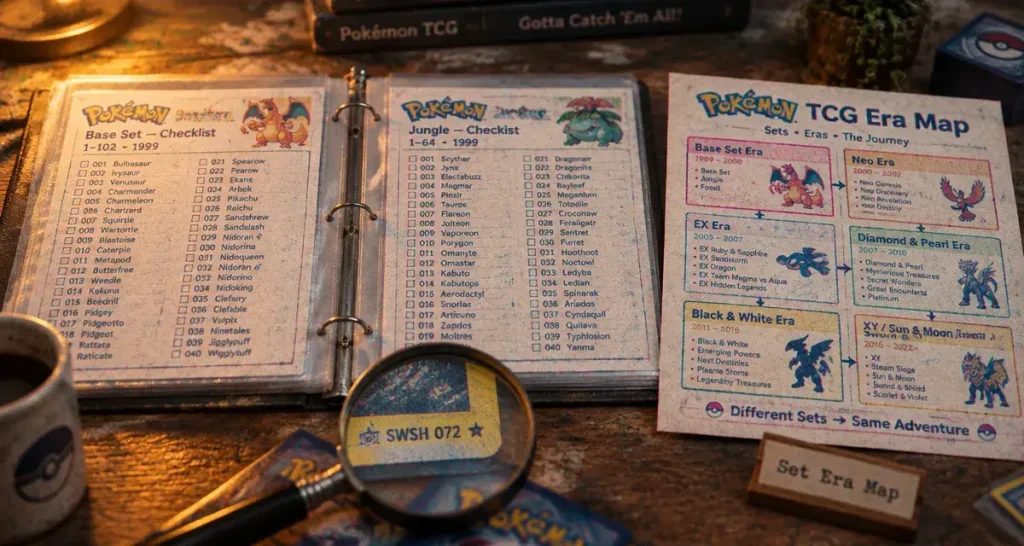
Looking for all Pokémon sets starts with choosing the right catalog: English expansions, Japanese releases, and promotional cards do not share one identical checklist. For official expansion browsing, use Pokémon’s all-expansions index; for visual card checklists, explore a specialist directory such as Pokellector. The era map below helps you narrow your search before identifying a particular set or building a collection tracker.
Where to Browse All Pokémon Sets
A set directory is more useful than a static list when you need individual card images, release information, or collection checkboxes. However, “all sets” only means something when the catalog’s scope is clear. A directory may separate English and Japanese releases, place promotional cards in their own section, or list subsets beneath their parent expansions.
Browse Every English & Japanese Pokémon TCG Set · Explore 205 Pokémon TCG sets with release dates and complete card lists, covering 23,739 cards.
| Resource | Best starting point for | What to check |
|---|---|---|
| Official Pokémon expansion index | Official expansion names and release information | Language, regional coverage, and historical depth |
| Pokellector | Visual set browsing and card checklists | Selected language and treatment of promos or subsets |
| Pokedata | Set research alongside collecting and market information | Whether you are viewing cards, sets, or sealed products |
| TCGplayer’s set-order article | Reading through expansion chronology | Article update date and inclusion of special releases |
Start with the official index to confirm an expansion’s identity, then use a collector database for card-level browsing. Neither an expansion landing page nor a marketplace product listing automatically gives you a complete checklist of every printing.
For the newest set, check current release information rather than assuming the first entry in a directory is already available. Announced, upcoming, and released expansions are different statuses, and catalogs may display them together.
Pokémon Set Eras in Oldest-to-Newest Order
The table below is an era navigation map, not an exhaustive expansion checklist. It gives you recognizable set names to search within a directory. English and Japanese release histories should be browsed separately because names, contents, and release sequences do not map perfectly.
| English-language series or grouping | Example sets to search |
|---|---|
| Original and Gym releases | Base Set, Jungle, Fossil, Base Set 2, Team Rocket, Gym Heroes, Gym Challenge |
| Neo | Neo Genesis, Neo Discovery, Neo Revelation, Neo Destiny |
| Legendary Collection | Legendary Collection |
| e-Card | Expedition Base Set, Aquapolis, Skyridge |
| EX | EX Ruby & Sapphire, EX Team Rocket Returns, EX Dragon Frontiers, EX Power Keepers |
| Diamond & Pearl | Diamond & Pearl, Mysterious Treasures, Stormfront |
| Platinum | Platinum, Rising Rivals, Supreme Victors, Arceus |
| HeartGold & SoulSilver | HeartGold & SoulSilver, Unleashed, Undaunted, Triumphant |
| Call of Legends | Call of Legends |
| Black & White | Black & White, Dark Explorers, Boundaries Crossed, Legendary Treasures |
| XY | XY, Flashfire, Ancient Origins, Evolutions |
| Sun & Moon | Sun & Moon, Lost Thunder, Team Up, Cosmic Eclipse |
| Sword & Shield | Sword & Shield, Evolving Skies, Brilliant Stars, Silver Tempest |
| Scarlet & Violet | Scarlet & Violet, Paldea Evolved, Paradox Rift, Temporal Forces |
| Mega Evolution | Mega Evolution, Phantasmal Flames |
Use oldest-to-newest sorting when studying the game’s history or arranging binders. Use newest-to-oldest sorting when checking recent releases. Within either view, keep special expansions visible: filtering only for regular releases can hide sets you intended to collect.
The original Japanese Pokémon Trading Card Game launched in 1996, while the English-language Base Set arrived in 1999. That distinction matters when a search for the “first Pokémon set” returns apparently conflicting answers.
Separate Expansions, Special Sets, Subsets, and Promos
Not every product name is a set name
A booster box, collection box, tin, or Elite Trainer Box is a product format. Its packaging may reference an expansion, feature a Pokémon, or contain packs from several expansions. Search the actual expansion name printed on the packs rather than treating every retail product as a separate set.
Special expansions, including examples such as Hidden Fates, Celebrations, and Crown Zenith, still belong in a collector’s set directory. Their product distribution can differ from regular expansions, so the absence of a conventional booster box does not mean they are merely promotional collections.
Subsets and promotional series need their own labels
A subset is a distinct card group associated with a broader release. Trainer Gallery and Galarian Gallery cards, for example, should remain connected to their parent expansions even when a database gives them separate checklist views. Otherwise, you may count the same collecting target twice.
Promotional cards require another category. Black Star Promo series, event distributions, and other promotional releases do not fit neatly into the regular expansion timeline. A useful master index records them separately while preserving their identifiers and release details.
For Japanese cards, use a Japanese-specific catalog rather than translating an English expansion name and assuming the checklist matches. An English expansion can draw cards from multiple Japanese releases, making direct set-to-set comparisons misleading.
Identify a Card’s Set Before Adding It to a Checklist
The Pokémon’s name is rarely enough to identify a card. The same character can appear across many expansions, sometimes with similar artwork. Start with the information near the bottom of the card, then compare it against a visual checklist.
- Check the language. This determines which catalog to search first.
- Find the expansion symbol or set code. Its format and location depend on the card’s era.
- Read the collector number. Copy the complete identifier, including any letter prefix.
- Compare the artwork and finish. Confirm whether the card is a regular, reverse-holo, or another printing.
- Check stamps and edition details. These can distinguish variants within the same set.
A number above the printed denominator can indicate a secret-numbered card; it does not automatically mean the card is fake. Likewise, the denominator alone may not describe every collectible variant. Use the set’s actual checklist rather than calculating completion from that number.
If an older card has no obvious expansion symbol, do not identify it by absence alone. English Base Set cards lack a set symbol, but artwork, numbering, copyright text, and printing details still need to agree.
Turn the Set Directory Into a Useful Collection Tracker
Before checking off cards, define what “complete” means for your collection. A numbered set, a collection including reverse holos, and a master set with additional variants are different projects. Write down your inclusion rules so your progress remains meaningful when you change databases or discover another printing.
Think of collecting as a spiral rather than a straight checklist: you return to the same expansion with increasingly precise knowledge. First you identify missing card numbers, then finishes, then stamped or product-exclusive variants. Keep those layers in separate tracking columns. This prevents a newly discovered variant from making a previously completed numbered set appear unfinished.
A practical spreadsheet or collection app should record the set name, language, collector number, variant, owned quantity, condition, and storage location. Keep duplicate counts separate from ownership status: owning several copies of one card does not move you closer to completing the remaining checklist.
When comparing purchases, filter your missing cards by expansion and variant before looking at prices. Confirm that the listing matches the exact card you need, including language and condition. For players, check current format legality separately; expansion chronology alone does not establish whether an individual card is legal.
The most reliable workflow is simple: choose the correct language catalog, locate the expansion, verify the card identifier, and track the exact printing. That turns a large set index into a collection you can actually navigate.