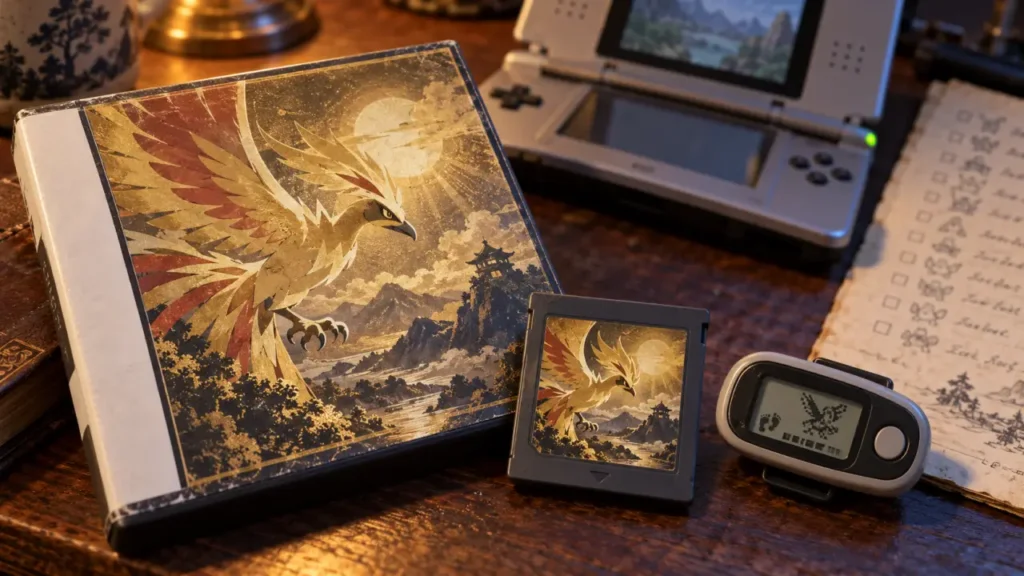
Pokémon HeartGold is a Nintendo DS role-playing game that remakes Pokémon Gold, pairing the Johto adventure with a substantial return to Kanto. Released in Japan in 2009 and internationally in March 2010, it combines classic Pokémon collecting with updated battles, a Pokémon that follows you, and the optional PokéWalker accessory. For anyone buying a copy today, understanding the game is only half the decision: authenticity, packaging, and accessory condition also matter.
A familiar adventure rebuilt beyond the original Gold
Developed by Game Freak, HeartGold launched alongside Pokémon SoulSilver on September 12, 2009, in Japan, marking the original games’ 10th anniversary. HeartGold specifically remakes Gold, while SoulSilver remakes Silver. Both also incorporate elements from Pokémon Crystal, including the expanded attention given to Suicune and its pursuer, Eusine.
You begin as a new Trainer in Johto, choose a starter Pokémon, and build a team through exploration, catching, and turn-based battles. Gym Leaders provide the main progression milestones, while Team Rocket’s attempted comeback supplies the central conflict. Learning type advantages and keeping a balanced team matters more than simply training one powerful Pokémon.
The remake uses fourth-generation battle mechanics, including the distinction between physical and special attacks on a move-by-move basis. Returning players therefore get familiar towns and routes without being restricted to the original Game Boy Color battle system.
Kanto makes the credits a milestone, not the finish line
Defeating the Elite Four and Champion opens the way to Kanto, where another set of Gym Leaders extends the journey. This is not a second standalone campaign of equal scope, but it gives your established team meaningful places to go. Later challenges, additional catches, and the eventual battle against Red make continued training worthwhile.
The paired remakes sold a reported 12.72 million copies combined as of March 2014. That figure belongs to HeartGold and SoulSilver together, rather than HeartGold alone.
The features that change the rhythm of playing
HeartGold’s appeal is not just its map size. Small interactions and optional activities break up the cycle of catching Pokémon and challenging Gyms, giving the journey a more companionable pace.
Your lead Pokémon becomes a travelling companion
The first eligible Pokémon in your party follows you outside its Poké Ball, rather than limiting the feature to one mascot. You can turn around and interact with it, making even ordinary routes feel more personal. Changing your party order also changes your visible companion, so the feature remains relevant as your team develops.
Think of that companion as the germ of a different team-building habit: a Pokémon you enjoy seeing beside you may earn a place before its battle usefulness is obvious. Try rotating an overlooked catch into the lead during exploration, then testing its moves against suitable wild opponents. The walking animation becomes a reminder to experiment, rather than letting every new capture disappear permanently into storage.
PokéWalker and Pokéathlon offer different kinds of progress
The PokéWalker is a small pedometer accessory that communicates with the cartridge through infrared. You can send a Pokémon to it, walk to accumulate activity, and use its features to encounter Pokémon and find items. A transferred Pokémon can gain one level per outing, but this is a supplement to training, not an automatic replacement for battles. The main game works without the accessory.
The Pokéathlon instead uses teams of three Pokémon in touchscreen sporting events. Its performance attributes create a different reason to consider your collection: a useful athlete is not necessarily your strongest battler. The Safari Zone adds another optional collecting activity when you want a break from the main route.
HeartGold or SoulSilver: choose by encounters, not map size
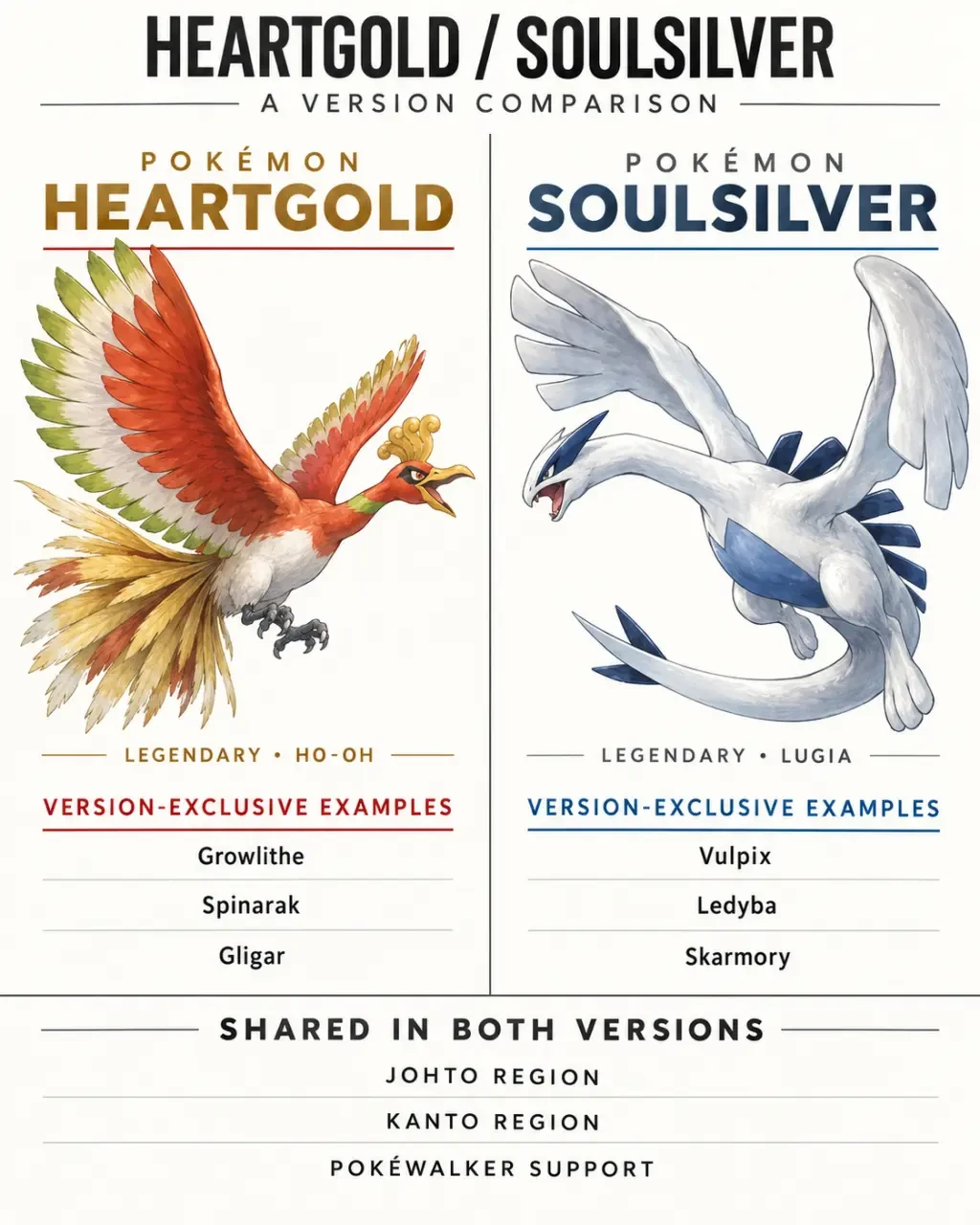
Neither version offers a fundamentally larger adventure. Both contain Johto, Kanto, following Pokémon, the Pokéathlon, and PokéWalker support. The practical differences concern wild encounters and the timing of certain legendary battles.
Official Pokéwalker Instruction Manual · Learn how to connect, use, and manage the Pokéwalker accessory with Pokémon HeartGold or SoulSilver.
| Feature | HeartGold | SoulSilver |
|---|---|---|
| Main legendary focus | Ho-Oh encountered earlier in progression | Lugia encountered earlier in progression |
| Other cover legendary | Lugia available later | Ho-Oh available later |
| Examples of exclusive wild Pokémon | Mankey, Growlithe, Spinarak | Vulpix, Meowth, Ledyba |
| Late-game weather legendary | Kyogre | Groudon |
| Core regions and activities | Johto, Kanto, Pokéathlon | Johto, Kanto, Pokéathlon |
Ho-Oh and Lugia are not strictly version-exclusive. Both can be caught in either game, but their place in the adventure differs. Other legendary encounters include the roaming Raikou and Entei, plus the Crystal-influenced Suicune sequence.
If your favourite Pokémon is exclusive to one version, that is a sensible deciding factor. Otherwise, choose the authentic copy in better condition rather than paying extra under the impression that HeartGold contains an additional region. Trading can fill many version gaps, provided you have compatible games and hardware.
Trading still matters, but old events need careful expectations
Local wireless trading and battling remain useful features. HeartGold and SoulSilver can connect with compatible fourth-generation games, including Diamond, Pearl, and Platinum, subject to the relevant in-game requirements. Nearby play does not depend on the discontinued official Nintendo Wi-Fi Connection service.
Original internet trading and battling services are no longer officially available. A listing that advertises “Wi-Fi features” may simply repeat the original packaging, not describe a currently supported online service. For local trades, plan on two compatible systems and two games.
Special events require similar caution. Encounters associated with places such as the Sinjoh Ruins or the Ilex Forest event depend on particular event Pokémon or conditions; they are not all unlocked by normal story progression. Historical distributions should not be treated as available downloads today.
If a seller promotes a cartridge containing rare event Pokémon, remember that a save file does not establish how those Pokémon were obtained. Buy for the physical game’s verified condition, not an unverified promise of a “complete” collection.
Buying an original copy without confusing price and completeness
There is no single useful price for HeartGold without specifying the edition and contents. A loose cartridge, a boxed game, and an original outer-box package with a PokéWalker are different purchases. Region, language, cosmetic condition, and seller protections also affect comparisons.
Recorded PriceCharting completed-sale examples include $177.50, $190.50, $199.99, $205.64, $230.00, and $298.80. A GameStop game-only pre-owned listing showed $94.99, alongside a displayed regular price of $99.99. These are listing and sale examples, not a current valuation or evidence that all copies have equivalent contents.
- Game only: expect the cartridge, with no assumption of a case, manual, or PokéWalker.
- Case and cartridge: check whether the manual and inserts are actually included.
- Complete in box: ask for an itemised inventory; sellers may use “CIB” differently, especially regarding the outer box and accessory.
Request clear photographs of the actual cartridge’s front and back, packaging, and included accessories. Compare label printing, product codes, and shell details against a verified example from the same region. No single visual clue guarantees authenticity, and a reproduction cartridge can still boot successfully.
Ask whether saving and reloading have been tested, whether the cartridge is recognised reliably, and whether an included PokéWalker powers on and connects. Confirm the return policy before paying. For playing, an authentic tested cartridge may be enough; for collecting, completeness should be demonstrated in photographs rather than implied by the title.