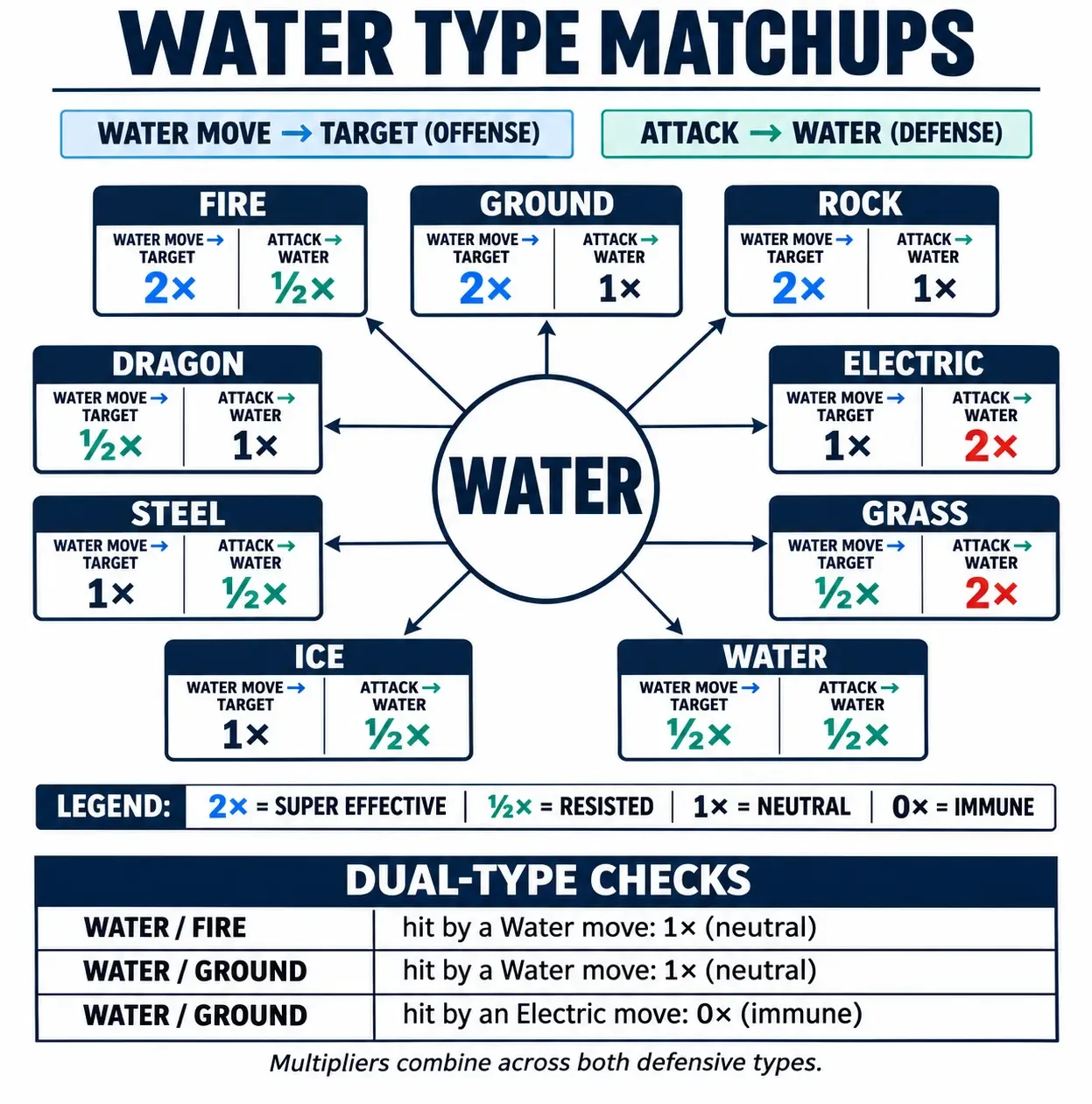
Water Pokémon are weak to Electric and Grass attacks, while their Water-type moves hit Fire, Ground, and Rock super effectively. That makes Water a useful starting point for understanding battles—but a second type, an ability, or the weather can change the outcome. The key is to separate a Pokémon’s defensive typing from the move it is using.
Water-type matchups: attacking and defending are different
Water is one of the three familiar starter elements alongside Fire and Grass. The basic triangle is easy to remember: Water beats Fire, Fire beats Grass, and Grass beats Water. Actual battles extend beyond that triangle, with separate rules for outgoing and incoming attacks.
Water Pokémon Type Matchup Quiz
Answer all six questions. Check each answer for immediate feedback, then submit for your final score.
| Situation | Types involved | Type-effectiveness multiplier |
|---|---|---|
| Using a Water move | Fire, Ground, Rock | 2× |
| Using a Water move | Water, Grass, Dragon | 0.5× |
| Pure Water Pokémon receiving an attack | Electric, Grass | 2× |
| Pure Water Pokémon receiving an attack | Fire, Water, Ice, Steel | 0.5× |
These multipliers describe type effectiveness, not the entire damage calculation. Move power, attacking and defensive stats, abilities, weather, and other effects still matter. A Water Pokémon can also use moves of other types; those attacks follow their own type matchups.
Multiply both types before choosing an attack
Against a dual-type target, apply the attacking move’s effectiveness against each defensive type, then multiply the results. A Water move against Fire/Rock gets 2 × 2, producing 4× effectiveness. Against Water/Ground, it gets 0.5 × 2, producing neutral 1× effectiveness.
The same logic changes a Water Pokémon’s weaknesses. Water/Ground is immune to Electric attacks through its Ground typing, but takes 4× damage from Grass. Water/Flying takes 4× damage from Electric. “Water is weak to Electric” is a starting rule, not a substitute for checking both types.
Finding Water Pokémon without confusing species and forms
Published totals do not always count the same things. PokémonDB reports 180 Water-type Pokémon: 81 single-type and 99 dual-type. DittoBase reports 192, including alternate forms. These are reference-specific totals, not interchangeable counts of unique species; their coverage and treatment of forms are not fully reconciled.
When checking a Water Pokémon list, look for three details: whether alternate forms have separate entries, which games or generations are covered, and whether the listed form actually has Water typing. A species name alone may not identify the battle form you need.
This short selection illustrates common type combinations rather than attempting a complete Pokédex:
| Pokémon | Typing | Matchup worth remembering |
|---|---|---|
| Blastoise | Water | The standard Electric and Grass weaknesses apply. |
| Gyarados | Water/Flying | Electric attacks are 4× effective. |
| Swampert | Water/Ground | Electric immunity, but a 4× Grass weakness. |
| Ludicolo | Water/Grass | Grass typing changes the usual Water defensive profile. |
| Empoleon | Water/Steel | Steel adds resistances while introducing other vulnerabilities. |
Water’s variety is not new: PokémonDB notes that it had been paired with every other type by Generation VI. That breadth is why Water Pokémon cannot be reduced to one speed tier, defensive role, or attacking style.
Choose Water moves around the job you need done
A move list is more useful when organized by purpose than by name alone. PokémonDB lists 53 Water-type moves in its reference coverage. Availability and individual move properties should still be checked for the game you are playing.
Pokémon Type Chart: Strengths and Weaknesses · Quickly check how effective every Pokémon type is against each opponent type.
- Basic and direct attacks: Water Gun, Surf, Hydro Pump, and Waterfall offer familiar ways to deal Water damage.
- Priority: Aqua Jet can act before ordinary-priority attacks, making it useful for finishing a weakened opponent.
- Positioning: Flip Turn deals damage and switches the user out, helping bring in another teammate.
- Damage with disruption: Scald can burn its target; Chilling Water lowers the target’s Attack.
- Battlefield or typing changes: Rain Dance establishes rain, while Soak changes the target to pure Water.
Build a moveset like a scaffold: every slot should support a distinct part of the battle plan. A reliable Water attack supplies the platform; priority provides emergency access; a switching move creates an exit route. Filling several slots with similar Water attacks can leave the structure without bracing against resistant opponents. Ask what each move enables that the others cannot.
Historical rules also matter. In Generations I–III, all Water-type moves were Special, according to PokémonDB. Do not assume that a move’s modern physical or special category applies when playing those older games.
Weather, abilities, and items can overturn the type chart
Check weather and abilities before attacking
Rain increases Water-type attack power by 50%, while harsh sunlight decreases it by 50%. Extremely harsh sunlight created by Desolate Land prevents damaging Water moves from working. These effects can make the same attack perform very differently without changing either Pokémon’s typing.
Torrent boosts Water-move power by 50% below one-third HP, and Water Bubble doubles the user’s Water-type attack power. Defensive abilities demand equal attention: Water Absorb and Dry Skin restore one-quarter of maximum HP when struck by a Water move instead of taking damage.
Storm Drain can redirect single-target Water moves, grants immunity to them, and raises Special Attack by one stage when activated. Water Compaction sharply raises Defense after a Water hit, while Steam Engine drastically raises Speed. Liquid Voice changes sound-based moves to Water type.
Remember items and exceptions
PokémonDB lists Splash Plate, Mystic Water, Sea Incense, and Wave Incense as boosting Water-move power by 20%; Water Gem provides a 30% boost before being consumed. Item availability and mechanics vary between games, so check the relevant version before planning a set.
Absorb Bulb raises Special Attack after a Water hit, while Luminous Moss raises Special Defense. Outside ordinary damage matchups, Net Ball improves catching effectiveness against Water Pokémon. Two move exceptions are particularly useful: Freeze-Dry is an Ice move that hits Water super effectively, and Salt Cure causes increased end-of-turn damage to Water targets.
Stats, specialists, and Water’s history
Type-wide averages describe a collection, not an individual Pokémon’s strengths. PokémonDB reports the following averages and rankings; they should be read within that reference’s coverage rather than as universal rankings across every possible form or game.
| Stat | Average | Rank |
|---|---|---|
| HP | 71.1 | 11 |
| Attack | 77.6 | 13 |
| Defense | 75.3 | 10 |
| Special Attack | 76.4 | 8 |
| Special Defense | 72.1 | 14 |
| Speed | 69.2 | 13 |
Water specialists include Gym Leaders Misty, Wallace, Juan, Crasher Wake, Cress, Marlon, Nessa, and Kofu, alongside Elite Four member Siebold and trial captain Lana. Their teams illustrate how one type can support different battle approaches.
Bulbapedia’s generation comparison records 32 Water Pokémon introduced in Generation I and 9 in Generation VI, its highest and lowest totals respectively. Its move comparison records 12 Water moves introduced in Generation VIII, versus 3 each in Generations II and VI. For practical team building, however, start with the individual Pokémon: check both types, its stats, its ability, and its available moves before assigning it a role.