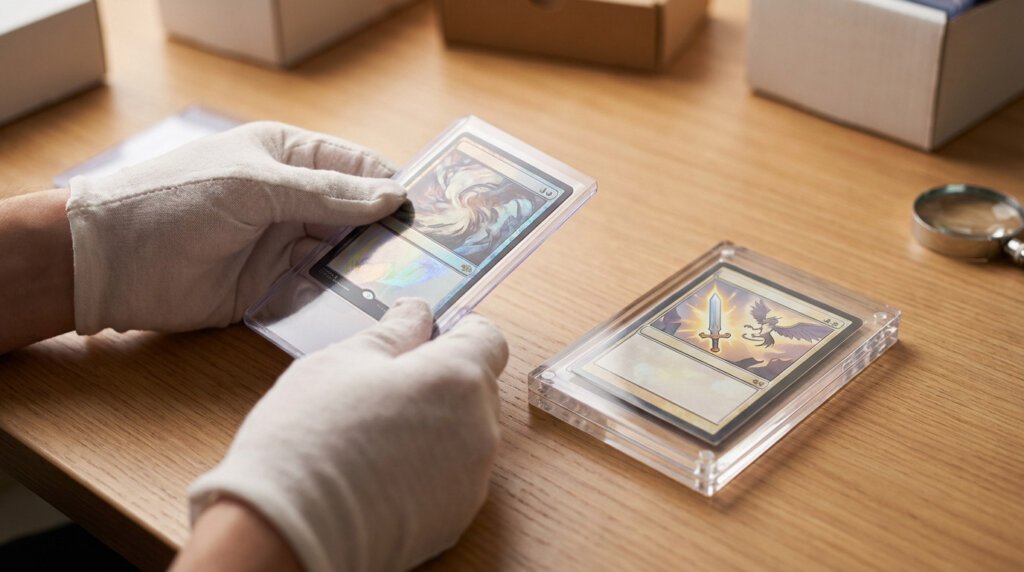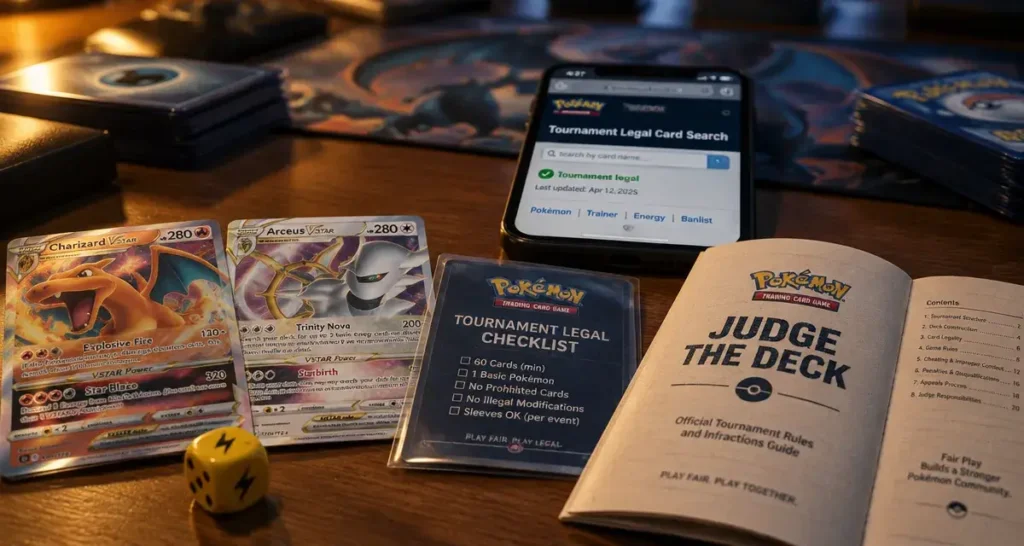
Good Pokémon cards help you execute a plan reliably—not just put a large damage number on the table. Charizard VSTAR can deliver a powerful knockout, while Arceus VSTAR can find the cards that make your next turn work. For collecting, neither effect tells you what a card should cost. Start by separating gameplay strength, tournament legality, and collectible appeal.
Judge a card by the job it does
A strong attacker, a dependable draw engine, and a defensive Pokémon solve different problems. Comparing them solely by damage is like comparing a goalkeeper with a striker by goals scored. The useful question is whether the card improves your deck’s route to winning.
- Damage efficiency: Can the attack take relevant knockouts for a manageable Energy cost?
- Consistency: Does the card help you find Pokémon, Energy, or other resources when needed?
- Tempo: Does it get your board ready sooner or force your opponent to spend extra turns recovering?
- Durability: Can its HP, healing, or defensive effects realistically keep it in play?
- Opportunity cost: What Bench space, setup steps, and deck slots does it require?
HP means hit points; Energy pays attack costs; and the Bench holds Pokémon outside the Active position. These details interact. An attacker with excellent HP can still struggle if it takes too long to power up, while a fragile support Pokémon may justify its place by fixing an otherwise unusable hand.
Prize liability also matters. Some Pokémon give up multiple Prize cards when Knocked Out. Read the card’s rule box rather than assuming that a bigger Pokémon is automatically a safer investment.
Recognizable cards show different kinds of strength
The following examples span different eras and mechanics. They illustrate useful strategic roles, not a current tournament ranking. Check the exact printing and applicable format before building around one.
Official 2026 Pokémon TCG Standard Rotation Guide · Check which regulation marks remain legal in the 2026 Pokémon TCG Standard format.
Attackers: compare conditions, not just maximum damage
Charizard VSTAR’s Star Blaze deals 320 damage, but it is a once-per-game VSTAR Power. That makes it a decisive resource rather than an attack you can repeat every turn. Its Explosive Fire can reach 230 damage when Charizard has damage counters on it; a Magma Basin interaction can help enable that condition. Plan both the ordinary attacking turns and the big finishing turn.
Mega Mewtwo-EX with Psychic Infinity takes a different approach: its attack deals 10 damage plus 30 for each Energy attached to both Active Pokémon. Its ceiling depends on the board. Snorlax VMAX’s G-Max Fall instead deals 60 plus 30 for each of your Benched Pokémon, reaching 210 with five on your Bench. Rayquaza C LV.X’s Final Blowup offers a historical 200-damage example, but its Level-Up requirements and supporting card text must be considered too.
Utility cards: make the rest of the deck function
Shaymin-EX with Set Up draws until you have six cards in hand when you play it from your hand onto your Bench. That is not “draw six”: the benefit depends on how many cards remain in your hand. It illustrates why sequencing—playing useful cards before drawing—can matter as much as choosing a powerful attacker.
Arceus VSTAR’s Starbirth searches for two cards, giving precision rather than random draw. Its Trinity Nova also combines damage with Energy acceleration to Pokémon V. Remember that Starbirth and Charizard VSTAR’s Star Blaze compete for your single VSTAR Power use during a game; putting both in a deck does not let you use both powers.
Durability and disruption: win without the biggest hit
Copperajah VMAX pairs 340 HP with a 240-damage G-Max Hammer, while Mega Venusaur ex provides a 380-HP durability example. Those numbers are starting points, not verdicts: attack costs, Weakness, and the opponent’s damage output determine whether that bulk actually buys another turn.
Blastoise & Piplup-GX’s Splash Maker deals 150 damage and can attach up to three Water Energy from your hand to your Pokémon, healing 50 damage from each Pokémon for each Energy attached to it this way. That can total 150 healing across the attachments. Charizard-GX with Raging Out GX instead discards the top ten cards of the opponent’s deck, while M Gengar-EX’s Phantom Gate copies an opponent’s Pokémon’s attack. These effects reward timing and matchup knowledge rather than raw damage alone.
Check legality before treating a card as a recommendation
A spectacular card is not necessarily a playable tournament card. Shadow Lugia is the clearest example: the promotional jumbo card has 300 HP and a Shadow Storm attack dealing 1,000 damage, but it is not legal in official competitive play. Its oversized presentation and extreme statistics make it a novelty, not a shortcut to a stronger legal deck.
Older cards also need individual checks. Standard rotation, Expanded restrictions, and event-specific rules are different considerations. An older card is not automatically permitted simply because a tournament uses a broader format, and a recognizable Pokémon name does not establish which version you own.
- Identify the exact card using its set, collector number, and printed name.
- Check the organizer’s format and the official Pokémon TCG legality information.
- Check applicable bans, reprint permissions, and current card rulings.
- For casual games, agree on the permitted card pool before building decks.
For example, the Shaymin-EX discussed above means the version with Set Up, not every card bearing that Pokémon’s name. Matching the Ability or attack is essential when researching or buying a specific card.
Choose cards that connect, then test the weak links
Start with a repeatable winning plan: attack early, build toward a larger attacker, survive through healing, or disrupt the opponent’s resources. Then identify what stops that plan. If you repeatedly miss Energy attachments, adding another expensive attacker is unlikely to solve the problem.
Think of your deck as a mesh of connections rather than a stack of individually impressive cards. Search connects you to an attacker; draw connects you to Energy; acceleration connects that Energy to an attack. A card with several useful connections strengthens the whole network. A powerful card that requires an unsupported Energy type becomes an isolated node—impressive in your hand, but disconnected from your next playable turn.
| What goes wrong? | What to investigate |
|---|---|
| Your attacker is ready too late | Setup requirements and Energy acceleration |
| Your hand repeatedly stalls | Draw, search, and sequencing |
| You narrowly miss knockouts | Damage thresholds and attack conditions |
| Your bulky Pokémon still loses quickly | Weakness, healing access, and Prize trade |
Change a small part of the deck at a time and record why games are lost. Distinguish a card that is genuinely unhelpful from one you simply did not draw. For beginners, a coherent deck with understandable interactions is usually a better learning tool than a pile of unrelated headline cards.
Keep collectible appeal separate from playing value
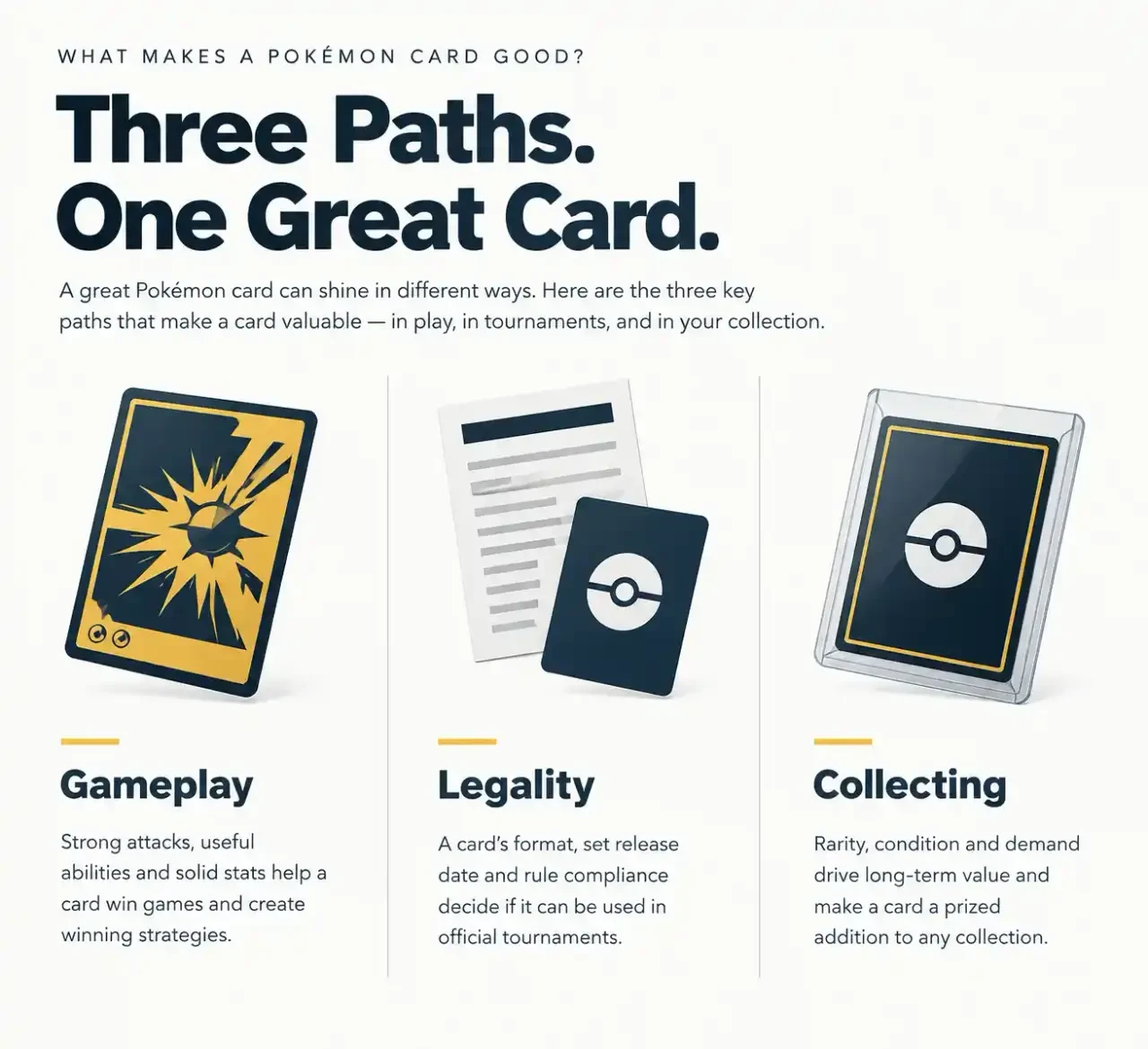
A card can be desirable because of its artwork, Pokémon, rarity, condition, or personal significance without being useful in a deck. Conversely, an effective gameplay card does not need to be the most visually elaborate printing. Attack damage is not a pricing method.
Before buying, confirm the exact set, collector number, language, finish, and condition. Compare completed sales for matching versions rather than relying only on asking prices. If a card is graded, verify the certification and examine what the grade actually describes; a high grade does not guarantee future demand.
For play, prioritize the correct legal card and readable, usable condition. For collecting, decide whether artwork, a favorite Pokémon, or completing a set matters most. The best purchase is one that serves your actual goal—not one promoted as universally “strongest.”