To sell Pokémon cards, choose between a local buyer for an in-person offer, an online buylist for a store-led transaction, or a marketplace where you list cards for buyers. The right route depends on whether you want a straightforward sale, control over pricing, or a way to move an entire collection. Before accepting an offer, identify what you have and compare what you will actually receive after costs.
Choose the selling route that matches your priorities
A business that sells Pokémon products does not necessarily buy collections. Look for an explicit buying service, buylist, or seller account rather than assuming a retail storefront accepts trade-ins.
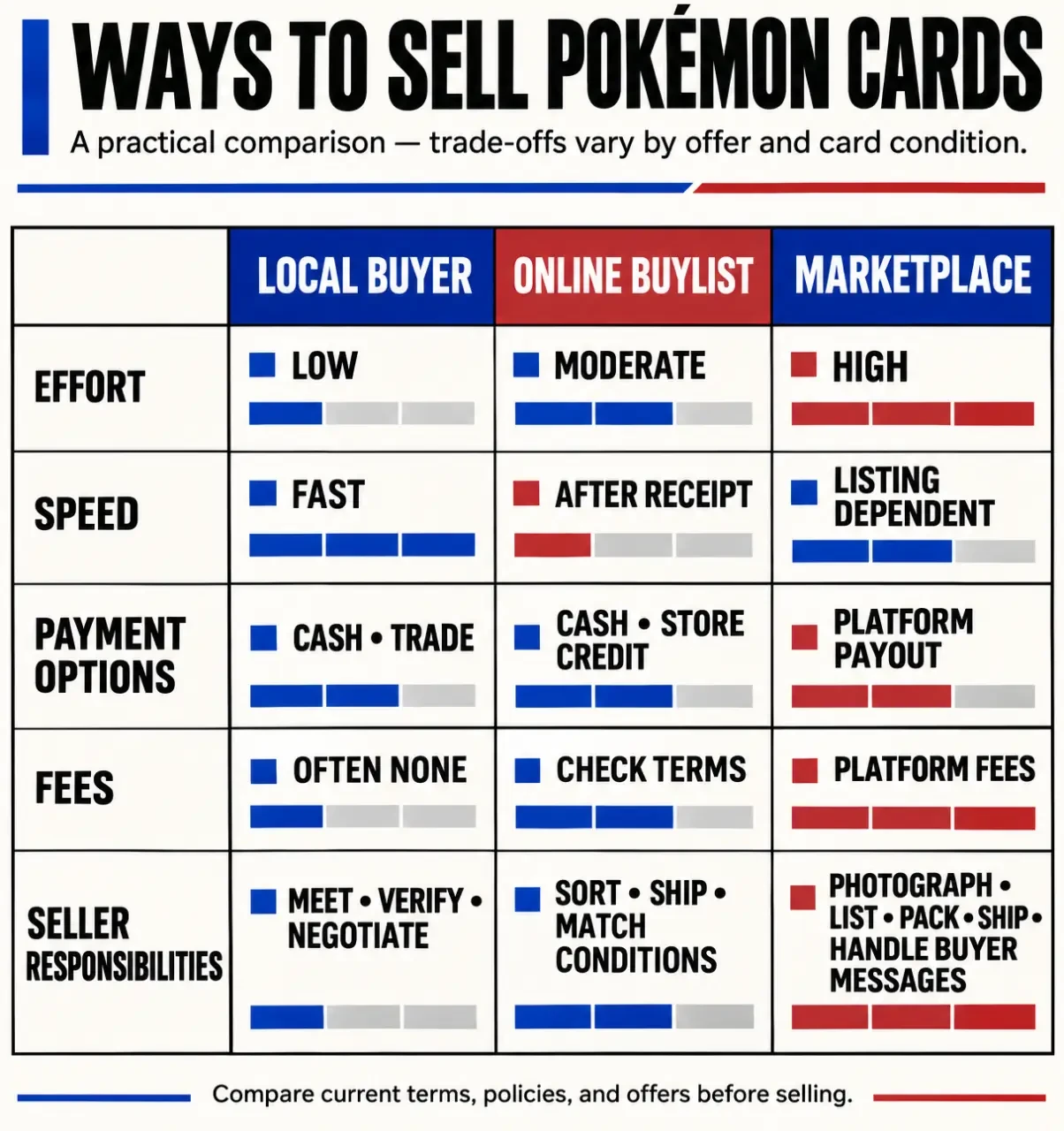
| Selling route | Best fit | Effort and timing | Payment and costs |
|---|---|---|---|
| Local buyer | In-person evaluation and a direct offer | Bring cards to the store; confirm availability for large collections | Cash where offered; ask about deductions and payment timing |
| Online buylist | Cards a store is actively buying | Match inventory, submit quantities, and follow shipping instructions | Service-specific payment options; check shipping and adjustment terms |
| Marketplace | Sellers willing to manage listings and orders | Prepare listings and wait for purchases; sale timing is uncertain | Check fees, postage, payment processing, and payout rules |
PayMore offers in-store evaluation and cash buying. CCG Castle describes an online buylist workflow with PayPal or store credit options. TCGplayer is a marketplace route, not simply a store making an immediate offer for your collection.
TCGplayer also promotes inventory scanning and importing, pricing tools, fulfillment, verification, and customer-service support. These may matter to regular sellers, but check availability and eligibility before assuming a particular service is included with your account.
Separate valuable singles, bulk, and sealed products
You do not need a professionally graded collection to find a buyer. However, acceptance varies by business, current demand, condition, and inventory needs. Ask about your specific items before transporting boxes or paying for shipping.
Official TCGplayer Marketplace Seller Agreement · Review the official terms, fees, and seller obligations for listing items on TCGplayer’s Marketplace.
Raw, graded, Japanese, and damaged cards
Raw cards are cards that have not been professionally graded and encapsulated. PayMore says it considers graded cards from PSA, BGS, and CGC in their original slabs, with the grade and certification number visible. Keep those holders intact rather than removing cards for inspection.
PayMore also considers Japanese Pokémon cards, Japanese-exclusive sets, and Pokémon Center Japan releases. It says damaged and heavily played cards may still have value, particularly rare or vintage examples. That is not a promise that every scratched, creased, or foreign-language card will receive an offer.
Bulk, complete collections, and unopened products
Bulk generally means grouped quantities of lower-value cards. Separate holographic rares, reverse holos, playable trainers, and energy from ordinary commons before requesting a quote. PayMore describes considering these categories, while common bulk acceptance may depend on quantity, popularity, or WOTC-era cards—cards associated with the Wizards of the Coast period.
Keep complete sets together. PayMore advises that presenting a full set may produce a better offer than separating it. For sealed inventory, its listed categories include booster boxes, booster packs, Elite Trainer Boxes, Ultra Premium Collections, collection boxes, tins, theme decks, promo boxes, and anniversary products. Preserve the original seal and confirm acceptance for each product.
Establish value before judging an offer
A cash offer and a potential retail selling price are different figures. A buyer purchasing your cards must account for resale work and risk. A marketplace listing leaves more of that work with you, and its asking price is not proof that a buyer will pay it.
Identify each potentially valuable card by name, set, collector number, language, and finish. Similar-looking cards can belong to different releases or variants. Then assess the front and back for scratches, edge wear, whitening, dents, and creases. Do not describe a card as near mint simply because it has been kept in a binder.
Rarity, vintage status, set, language, condition, grading, and collector demand all influence value. Professional grading can make condition easier to communicate, but it does not guarantee a higher net return. Before grading a raw card solely to sell it, weigh the grading expense against a realistic difference in proceeds.
Repeated prices can create an echo rather than independent evidence: several sellers may copy the same optimistic asking price. When researching comparable sales, check that the exact variant and condition match, and distinguish completed transactions from unsold listings. Ten repeated asking prices do not establish what your card will actually sell for.
Compare offers on a net basis: expected proceeds minus selling fees, shipping, packaging, and any other applicable charges. Treat store credit separately from cash. Credit is useful if you already intend to buy from that store, but it is not interchangeable with money you can spend elsewhere.
Prepare and submit cards without creating avoidable problems
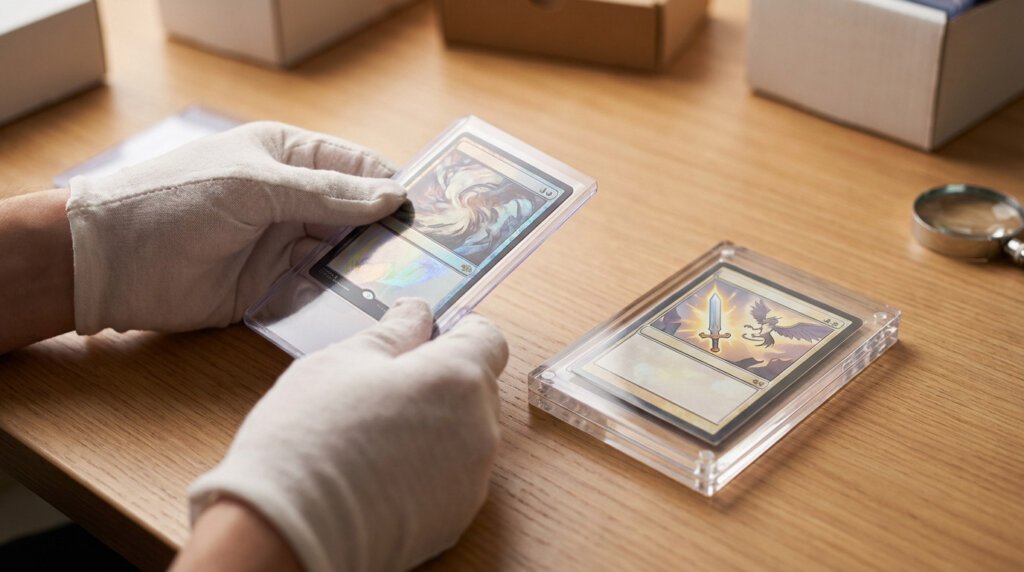
Protecting and organizing a collection makes evaluation easier and reduces misunderstandings. Do not clean, polish, or otherwise alter cards to improve their appearance. Keep valuable singles protected, graded cards in their original slabs, and unopened products sealed.
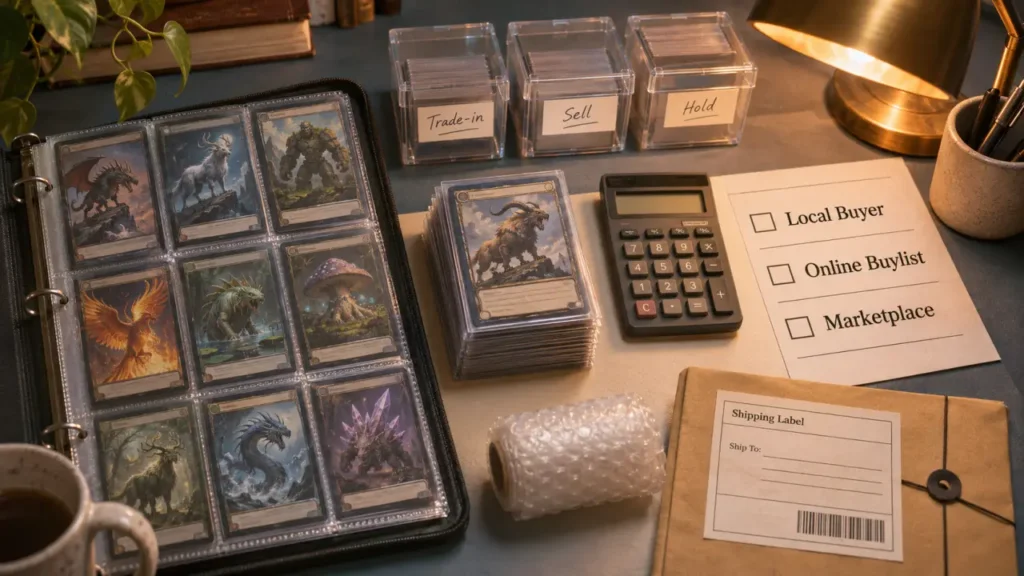
- Make a simple inventory. Record notable singles, graded cards, sealed products, complete sets, and approximate bulk quantities.
- Sort by set and rarity. Keep complete sets together and distinguish languages and finishes.
- Document condition. Photograph valuable cards front and back, including visible defects and slab labels.
- Confirm the buying terms. Ask what is accepted, how condition is assessed, and what happens if an offer changes.
- Retain transaction records. Keep submission details, correspondence, shipping receipts, and payment confirmation.
Taking cards to a local store
Call ahead for a large collection and describe its contents. Ask whether an appointment is needed and whether the store can assess your inventory during the visit. PayMore states that sellers must be 18 or older and present a valid physical state- or government-issued photo ID. These are PayMore’s requirements; verify other buyers’ rules separately.
Submitting an online buylist
CCG Castle describes searching for a card, choosing the quantity and sell option where the store is buying, and reviewing the payout total in a buylist cart. Its process then involves creating an account, providing return-address and order details, and selecting PayPal or store credit. Check current instructions before submitting, especially condition standards, shipping deadlines, and revised-offer procedures.
Confirm payment and protection before handing cards over
Before a local sale, establish whether the offer covers the whole collection or selected items. Ask for clarification if valuable singles and bulk are combined into one total. You can decline an offer without committing to a different selling route immediately.
Before shipping, confirm the recipient’s address through the service’s official instructions. Use protective packaging that prevents movement and bending, follow the buyer’s packing requirements, and consider tracking and appropriate insurance for valuable shipments. Understand who bears transit risk and what happens to rejected cards, including any return charges.
For marketplace sales, read the seller rules covering condition descriptions, dispatch, payment, and disputes. Keep communications and payments within the platform’s permitted process. Do not assume a payment screenshot means funds have cleared or that every transaction carries identical protection.
Start with a manageable comparison: obtain a local offer or buylist quote for your identified cards, then estimate marketplace proceeds after costs. Choose the route whose return, workload, and uncertainty you are comfortable accepting—not simply the one displaying the highest headline number.