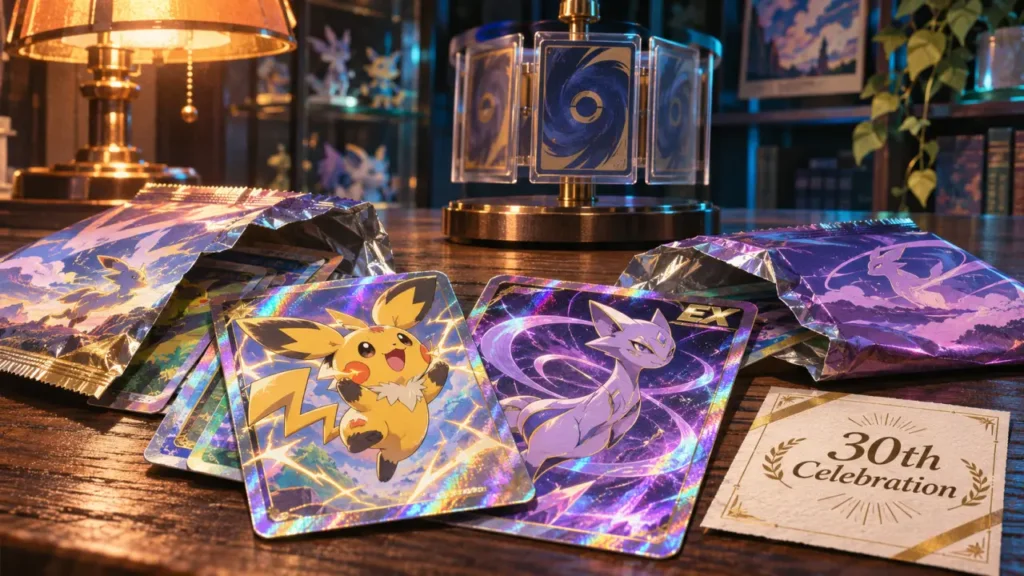
The new Pokémon cards featured in Pokémon TCG: 30th Celebration bring together 30 different Pikachu rare cards, futuristic artwork, and selected classics with a new foil treatment. The official expansion page says “Available now!”—but that statement is not a guarantee of stock in every country or store. For collectors, the immediate draw is the artwork; for players, the celebration also offers a look at how card mechanics have evolved.
What 30th Celebration actually offers
The expansion’s central idea is to connect 30 years of the Pokémon Trading Card Game through new designs and familiar cards. Pikachu takes a prominent role, while Mew, Mewtwo, and Mew ex also feature in the presentation. Rather than treating every card as the same kind of collectible, it helps to separate new artwork, special visual treatments, and historical gameplay examples.
Explore the Official Pokémon TCG 30th Celebration Expansion · Discover new cards, build powerful decks, and battle with the official 30th Celebration expansion.
30th Celebration is the expansion discussed here, not a complete catalogue of every current Pokémon TCG release. Its official presentation confirms several highlights, but it does not establish a full product lineup, exact launch date, regional stock, prices, or pull rates.
| Featured element | Confirmed detail | What not to assume |
|---|---|---|
| Pikachu rare cards | 30 different cards and 30 art styles | Equal chances of finding each card |
| Selected classic cards | A new foil treatment | Every historical card shown is included |
| Futuristic rare cards | Bold colors and illustrations by YOSHIROTTEN | A specific pull rate or market value |
| Basic Energy | One card in each booster pack, designed by YOSHIROTTEN | A complete booster-pack configuration |
If you are choosing something to buy, confirm the exact product name and language before comparing listings. An expansion name identifies the card release; it does not, by itself, tell you how many packs a particular sealed product contains.
The artwork worth examining first
Pikachu’s 30-card visual collection
The 30 different Pikachu rare cards span 30 art styles. That makes this a particularly interesting release to browse visually before deciding what to collect. Instead of focusing only on your favorite Pokémon, compare composition, color, mood, and the way each illustration presents the same recognizable character.
A useful collecting approach is to treat your wishlist like a ladder: begin with one illustration you genuinely love, move up to a small group connected by palette or composition, and only then consider completing all 30. Each rung should have its own satisfying stopping point. This gives a collection a clear visual identity without making an unfinished full set feel like a failure.
YOSHIROTTEN, Mew, and Mewtwo
The Futuristic rare cards are associated with bold colors and illustrations by YOSHIROTTEN. Mew and Mewtwo are among the featured Pokémon to examine, alongside the highlighted Mew ex. When browsing previews, distinguish the Pokémon’s name from the card’s treatment: recognizing a character does not tell you which version or rarity you are viewing.
The Basic Energy card in each booster pack is also described as a YOSHIROTTEN design. That detail makes Energy worth a closer look rather than simply setting it aside. For an art-focused collection, a supporting card can help connect pages through a shared aesthetic, even when it is not the headline collectible.
“Futuristic rare” and “Illustration rare” should not be treated as interchangeable labels. The former is the term used for the highlighted futuristic treatment; Illustration rare is a separate rarity category described as debuting in Scarlet & Violet. Neither label alone establishes a card’s financial value.
Classic cards put the new designs in perspective
Selected classic Pokémon cards receive a new foil treatment, linking familiar designs with the anniversary presentation. Foil is the reflective finish, not a gameplay mechanic. When comparing an older card with a newly presented version, examine the illustration, printed text, and finish separately rather than assuming they are identical.
The historical examples below provide a useful route through the game’s changing artwork and card designs. This timeline is not a confirmed checklist of cards obtainable in the expansion.
| Year | Card and original expansion | Reason to revisit it |
|---|---|---|
| 1999 | Charizard — Base Set | An early reference point for classic Pokémon cards |
| 2000 | Erika’s Jigglypuff — Gym Challenge | A historical example connecting a Pokémon with a named Trainer |
| 2005 | Scizor ex — EX Unseen Forces | An example of the EX Series card type, which debuted in 2003 |
| 2011 | N — Black & White—Noble Victories | The featured version is described as the first-ever full-art Supporter card |
| 2016 | Greninja BREAK — XY—BREAKpoint | A distinctive evolution mechanic |
| 2019 | Pikachu & Zekrom-GX — Sun & Moon—Team Up | A TAG TEAM Pokémon-GX example |
| 2023 | Magikarp — Scarlet & Violet—Paldea Evolved | An artwork highlight illustrated by Shinji Kanda |
| 2026 | Mew ex — 30th Celebration | The anniversary endpoint of the featured timeline |
For a meaningful comparison, ask what attracts you to each era: familiar illustration, expansive artwork, unusual layouts, or mechanical novelty. Nostalgia and visual preference can overlap, but they do not have to lead to the same wishlist.
Read the mechanics separately from the rarity
A card’s rarity or finish describes a different aspect of it from its rules. Pokémon ex, Pokémon-GX, and Pokémon BREAK refer to gameplay categories or mechanics, while full-art describes a visual treatment. A Supporter is a type of Trainer card; an Ability is an effect distinct from an attack. Reading these terms separately makes previews much easier to understand.
Evolution and inherited effects
The historical Scizor ex example is described as able to evolve from Scyther or Scyther ex. Greninja BREAK, meanwhile, retains the attacks and Abilities of the Pokémon it evolved from. Its Giant Water Shuriken Ability and Greninja’s Shadow Stitching attack illustrate why the underlying evolution matters: the upper card does not tell the whole gameplay story.
Prize cards and TAG TEAM risk
Prize cards are cards players take during a game, including when opposing Pokémon are Knocked Out. The featured TAG TEAM Pokémon-GX give up three Prize cards when Knocked Out. The historical description also highlights taking six Prize cards in one turn with Tag Bolt-GX. That is a described gameplay possibility, not an automatic result whenever the attack is used; the full card text and game situation matter.
These examples explain historical significance, not current tournament eligibility. A striking card or powerful historical interaction should not be taken as proof that it belongs in a present-day competitive deck.
Explore the cards before committing to packs
Start with the official Pokémon TCG 30th Celebration expansion page for its card previews and collection carousels. The official Pokémon trading-card expansions directory and all-expansions page are useful destinations for checking which release you are viewing. Keep the expansion name visible while browsing so that anniversary highlights do not become confused with unrelated products.
- For artwork: compare the Pikachu styles, artist credits, and special treatments.
- For collecting: identify the exact card version rather than relying only on a Pokémon’s name.
- For purchases: verify price, language, contents, and local stock on the specific listing.
- For play: read the complete card text and check the rules for your intended format.
Pokémon TCG Live is also presented as a way to collect digital cards, build decks, and battle. It offers another route into the game, but the expansion presentation does not confirm that every featured physical card has a corresponding playable digital version. Browse first, choose whether artwork or gameplay matters most to you, and let that choice guide your next step.