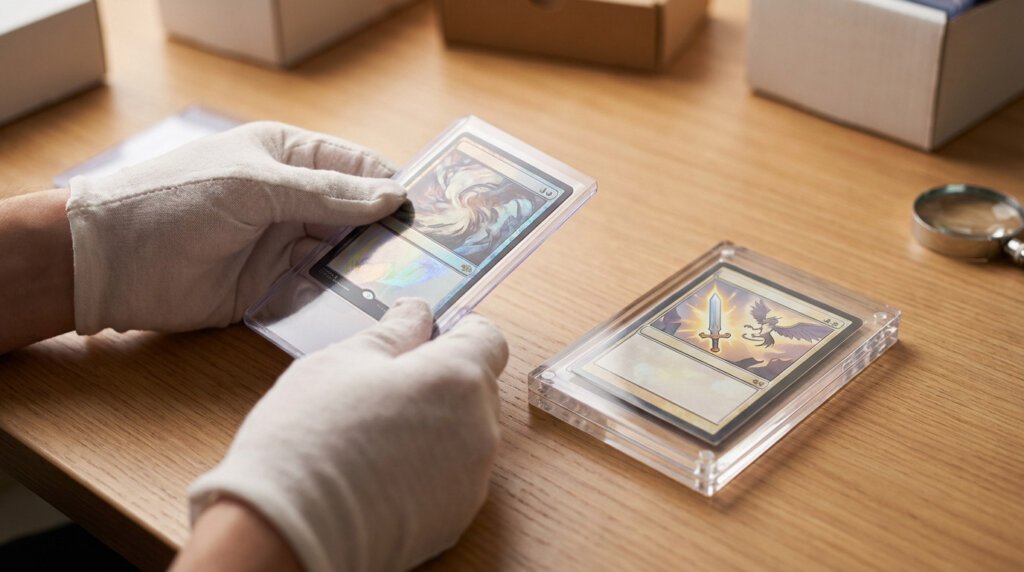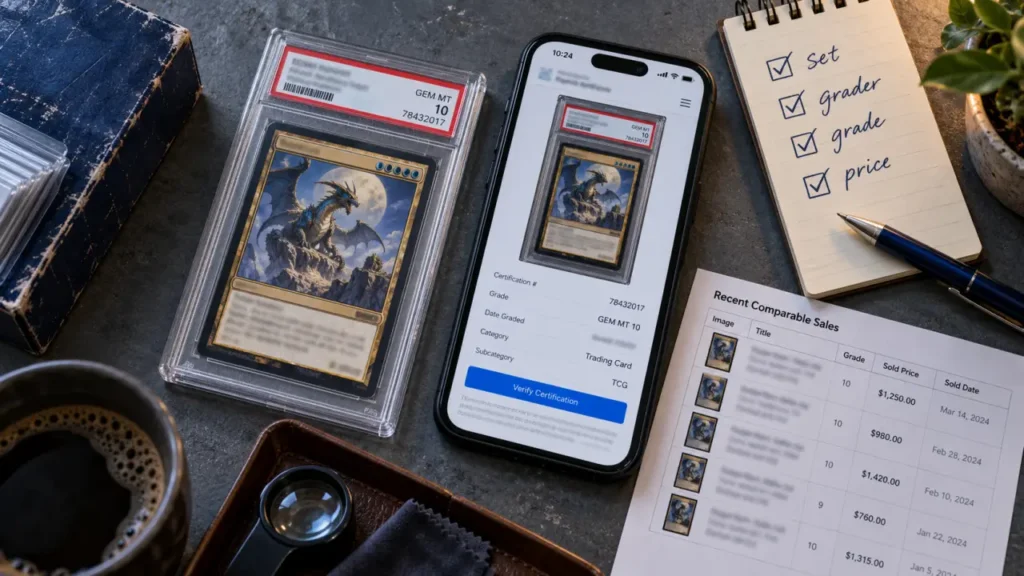
When buying graded Pokémon cards, narrow your search by the exact card, grading company, condition grade, and total budget. Then check the certification, photographs, and comparable sales before paying a premium. A high number on a label is useful information, but it does not establish authenticity, fair pricing, or suitability for your collection on its own.
Build a shortlist before comparing prices
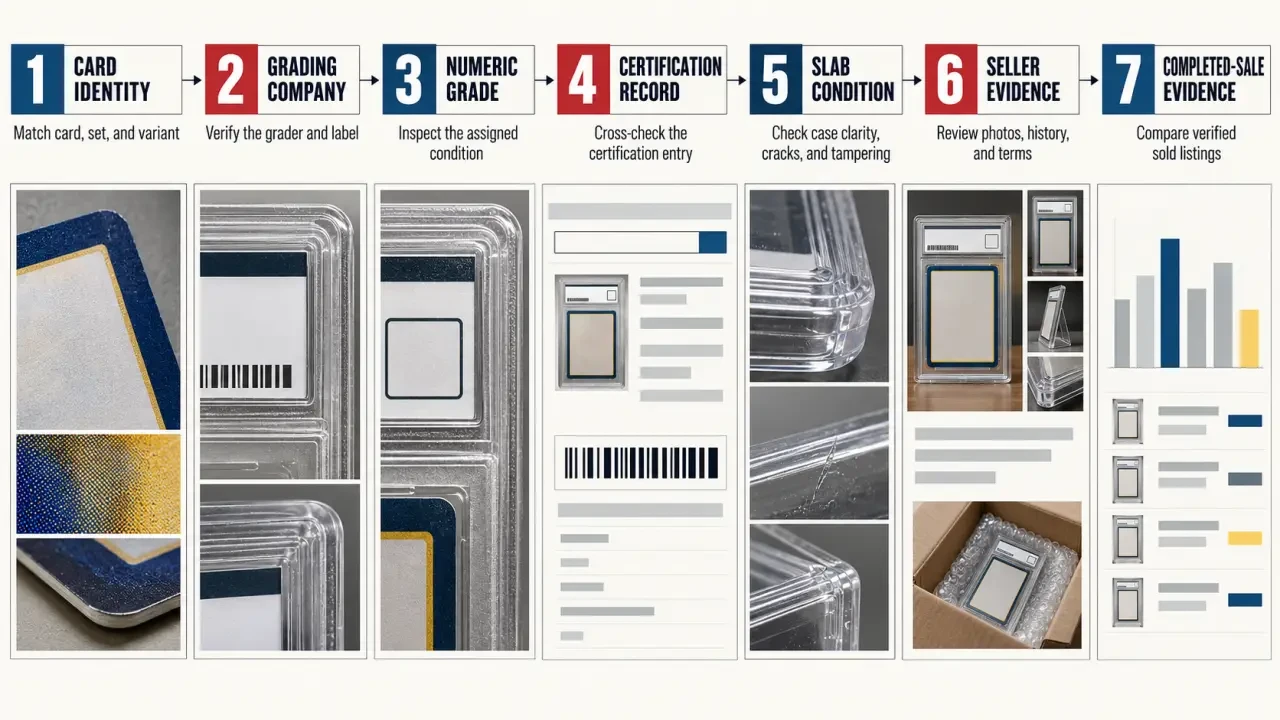
Start with the card you actually want: Pokémon, set, card number, language, and edition. Similar artwork can appear across different releases, so a character name alone is not enough. Once the identity is clear, use retailer or marketplace filters to separate relevant slabs from attractive but unrelated listings.
- Set and edition: distinguish releases, first editions, and promotional cards.
- Grading company: compare like-for-like listings before broadening your search.
- Grade: choose a realistic range rather than automatically restricting results to 10.
- Price: leave room for shipping, taxes, and any import charges.
- Availability: confirm that the pictured card is the item currently for sale.
For a display collection, a lower-grade example with artwork you love may be more satisfying than an expensive top-grade card chosen only for its label. For resale-focused buying, the grading company and evidence of actual buyer demand deserve greater weight.
Compare completed sales, not just asking prices. Match the card, language, edition, grader, and grade as closely as possible. If comparable sales are scarce, acknowledge that uncertainty rather than treating the highest advertised price as a valuation.
Think of one well-documented comparable sale as a navigation beacon: it gives your search a reference point. Record the exact card identity, grader, grade, sale date, and delivered price. When another listing looks unusually cheap or expensive, check which coordinate changed. This simple reference record helps distinguish a genuine opportunity from a different edition, a damaged case, or an unsupported asking price.
Read the slab as a record, not a guarantee
A graded card has been assessed by a third party and placed in a rigid, sealed case called a slab, with an identification label and condition grade. The case reduces handling and friction while allowing the card to be displayed. It does not make the collectible immune to damage or remove the need for careful storage.
Official PSA Collectibles Authentication & Grading · Verify certifications or submit sports cards, autographs, and memorabilia for trusted PSA authentication and grading.
Authentication, grading, and certification have different jobs
Authentication concerns whether the card is genuine and whether alteration is detected. Grading assesses condition. Certification documents the identification and assessment associated with the encapsulated card. These functions are often bundled into one service, but buyers should check the provider’s terms rather than assume every service offers identical checks.
CCC’s guide describes a 1–10 scale, with 1 described as poor and 10 as perfect. Grader-specific definitions matter: the same numerical grade from different companies should not automatically be treated as equivalent. Look at the card itself, including centering, corners, edges, and surface, rather than relying exclusively on the headline number.
Check the actual item before paying
- Request clear photographs of the front, back, label, and case edges.
- Match the label’s set, card number, language, and edition to the card.
- Use the grading company’s certification lookup where available; compare the record and any images with the listing.
- Inspect for cracks, unusual seams, label inconsistencies, and visible card defects.
- Check seller history, return terms, delivery protection, and the full purchase cost.
A matching certification number is a useful check, not conclusive proof that the physical slab is genuine. If the photographs or seller’s answers leave important doubts unresolved, request better evidence or choose another listing.
Compare PSA, BGS, and CCC on what matters to you
The right grading company depends on your intended audience and collection goals. Reputation can influence buyer confidence, while label design and case appearance affect display appeal. Neither an attractive slab nor a familiar brand guarantees a future selling price.
| Company | Relevant distinction | What to examine |
|---|---|---|
| PSA | Appears in graded Pokémon retail listings and grade filters. | Sales evidence for the exact card and grade, certification details, and applicable grading standards. |
| BGS | Associated with a four-subgrade approach. | The assessments shown on the individual label and the definitions behind its overall grade. |
| CCC | Advertises four subgrades, GradeReport, and HD scans. | Example reports, image detail, slab design, current service terms, and buyer demand. |
For submissions, compare grading expertise, consistency, customer support, declared-value rules, fees, and processing estimates. For purchases, prioritize the documentation available for that particular slab. A detailed report can help explain an assessment, but it does not replace inspection of the listing.
CCC advertises processing of 3–25 working days, depending on service type. Treat this as a company-specific claim and confirm current terms, including when processing begins and whether shipping is additional.
Population reports can add perspective by showing recorded numbers at particular grades. However, graded population is not total surviving supply, and a low count does not prove strong demand. Use population information alongside sales evidence, not as a standalone reason to pay more.
Decide whether to buy a slab or submit your own card
Buying an already graded card gives you a known grade and purchase price. Submitting your own adds uncertainty: the result may be lower than expected, costs can accumulate, and the card will be unavailable during processing. Submission makes most sense when its purpose is clear.
Separate collection value from financial value
Collection goals might include completing a matching graded set. Aesthetic goals may center on alternate artwork or a favorite promo. Emotional goals could justify encapsulating a childhood card despite visible wear. Financial goals require a stricter comparison between the ungraded card’s value, likely graded outcomes, and total submission costs.
Examples such as Umbreon VMAX 215/203 or Pikachu Stamp Box Japan Post S-P Promo 227 illustrate why collectors may value specific artwork and releases. Their names alone do not establish that every copy is worth grading. Condition, personal attachment, and market demand still need separate consideration.
CCC says alternate-art cards from the Sword & Shield and Scarlet & Violet eras account for almost 60% of its Pokémon submissions. That describes its submission mix, not a guarantee of rarity or profitable resale. Likewise, a community survey cited by CCC reports graded-card ownership among 53% of occasional collectors and 94% of confirmed collectors; without published methodology, those figures should not drive a purchase.
Prepare a submission without adding avoidable risk
- Inspect and document: photograph each card and note visible defects. Do not attempt surface repairs or alterations.
- Check acceptance rules: confirm eligibility for the card’s language, format, and release.
- Complete the submission: enter accurate card details, select the service, and follow declared-value instructions.
- Protect each card: use a new sleeve and the holder specified by the grader, such as a Card Saver or accepted toploader.
- Pack and record: follow the required order, prevent movement, retain paperwork, and choose appropriate tracked shipping and cover.
Before sending, total the grading fee, outbound and return shipping, insurance, and applicable charges. Compare that amount with the cost of buying an equivalent finished slab. Grading can improve confidence and presentation, but it does not guarantee a higher sale price. The strongest purchase or submission decision remains one you can justify without assuming a perfect grade or future price rise.