Flip any Pokémon card over to its front and look at the bottom corner: a small circle, diamond or star sits next to the set number. That tiny symbol is the starting point for understanding Pokémon trading cards rarity. It tells you how hard a card is meant to be to find in its expansion, but it does not tell you the whole story, and it certainly does not set a price on its own.
Reading the Rarity Symbol and the Set Number
The rarity symbol is printed at the bottom left or bottom right of the card, right beside the set number. Always look at both together, because the pair answers two questions at once: how the card is classified, and where it sits in the expansion.
The three foundation symbols
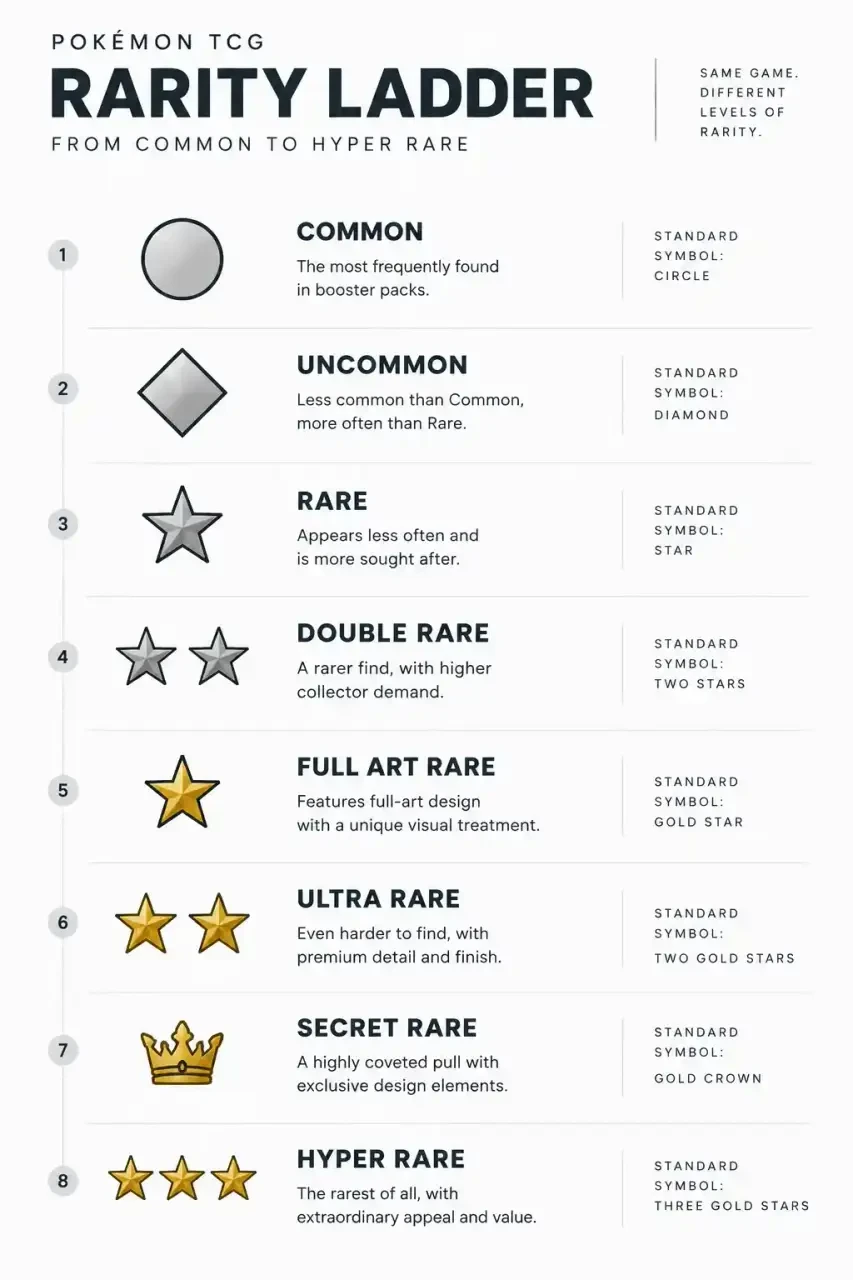
In the traditional English system, a circle means Common, a diamond means Uncommon and a star means Rare. Cards marked PROMO are different: they are not normally pulled from standard booster packs and are distributed through other channels. Basic Energy cards generally carry no rarity at all, so do not be surprised by a blank spot.
What the set number reveals
A set number such as 045/198 means the card is number 45 in a set printed as 198 cards. When the first number is higher than the second, as with 101/100 or 224/198, you are looking at a Secret Rare. The card exists beyond the official checklist, which is exactly why it feels like a bonus find. This is the fastest check you can run without any database.
The Rarity Ladder, from Common to Hyper Rare
Booster packs historically contain at least one Rare, generally three Uncommon cards, and the rest are mostly Common, typically four to five in English packs. Since Scarlet & Violet, the premium end of the ladder has become much more visual. The official Pokémon guide describes the current categories this way:
| Rarity | Symbol | What to look for |
|---|---|---|
| Common | Circle | Standard card, bulk of every pack |
| Uncommon | Diamond | Roughly three per English pack |
| Rare | Black star | Included Rares are Holofoil Rares in Scarlet & Violet packs |
| Double Rare | Two solid black stars | Pokémon ex cards |
| Ultra Rare | Two foil stars | Full-art style treatment |
| Illustration Rare | One gold star | Artwork extends across the card |
| Special Illustration Rare | Two gold stars | Scene-style artwork telling a small story |
| Hyper Rare | Three gold stars | Gold finish |
The Mega Evolution era adds Mega Attack Rare, described as full-art Mega Evolution Pokémon ex cards with pink and green stars, and Mega Hyper Rare, a gold-finished class. CGC cites a Mega Hyper Rare pull rate as low as 1 in 1,260 packs, which shows how steep the top of the ladder can be.
Holo, Reverse Holo and Full Art: Same Rarity, Different Look
Rarity, foil treatment, card mechanic and artwork style are four separate ideas, and mixing them up causes most identification mistakes. A card can look spectacular and still sit at a modest rarity, or look plain and be a sought-after variant.
International Scarlet & Violet Pokémon Card Rarities List · Mar 30, 2023 — This guide provides the latest official Card Rarity list for the international Scarlet & Violet TCG, according to The Pokémon Company …Read more
Holofoil versus Reverse Holofoil
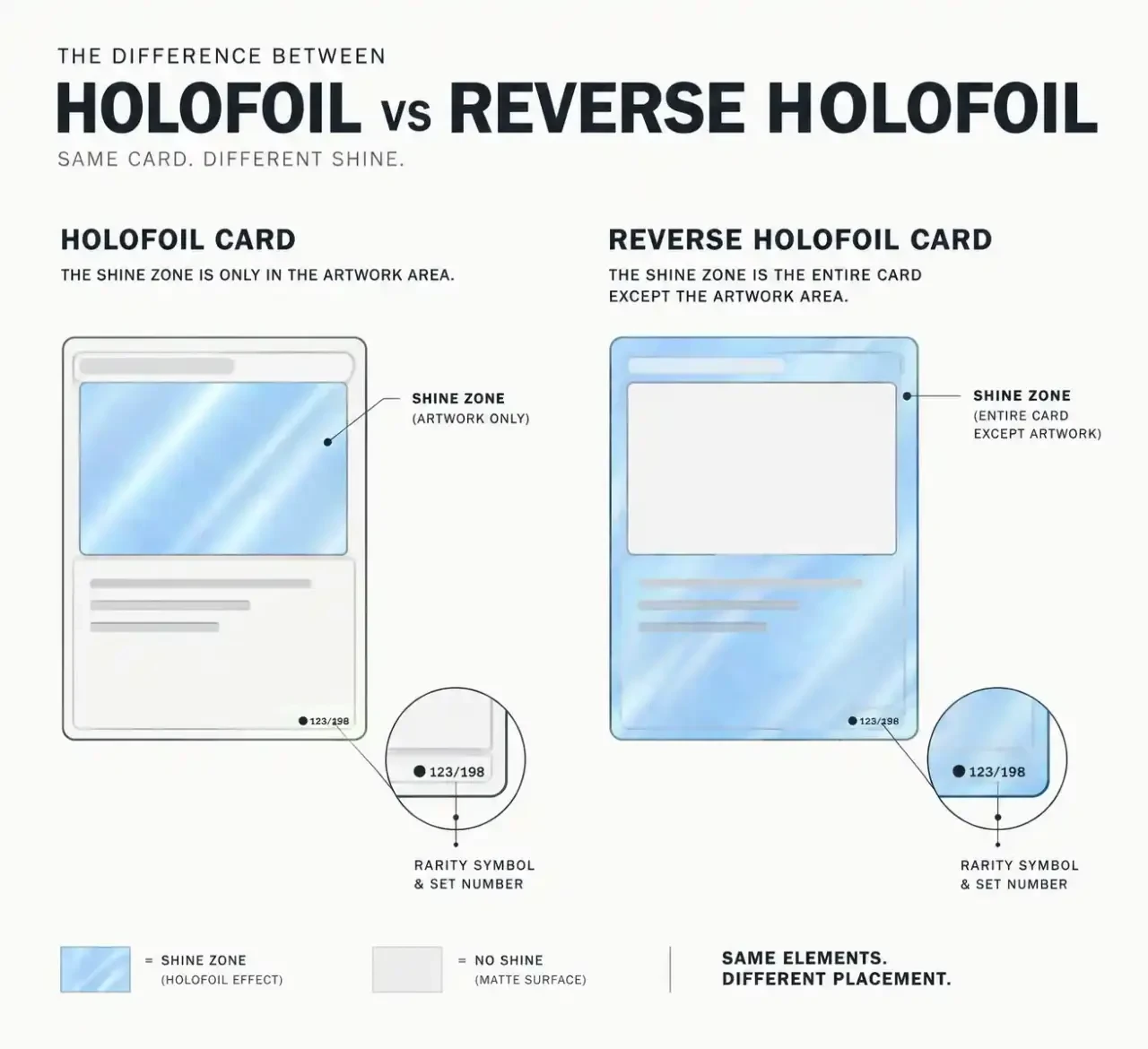
The test is simple: where is the shine? On a regular Holofoil, the foil sits in the artwork area. On a Reverse Holofoil, the foil covers the whole card except the artwork. Starting with the Legendary Collection expansion, packs include one Reverse Holofoil card, so a reverse version of a Common is a normal pack find and not a premium pull. The same Pokémon with the same set number can exist in both forms.
Full art is a treatment, not a guarantee
Full-art cards extend the artwork across the entire card and are commonly tied to premium rarities such as Ultra Rare. But the look alone does not prove the class. Always confirm with the symbol: two foil stars point to Ultra Rare, while gold stars point to the illustration classes. Shiny Rare cards, introduced with Shining Fates and seen again in Paldean Fates, add yet another family with their alternate-colored Pokémon.
A Four-Step Method to Identify an Unknown Card
Think of it as a compass for the card in your hand: four readings, taken in order, will point you to the right classification even if you have never seen the set before.
- Find the symbol. Circle, diamond, star, or a gold or foil variant, bottom corner.
- Read the set number. A number above the set size signals a Secret Rare.
- Check the foil. Shine in the artwork means Holofoil; shine around it means Reverse Holofoil.
- Check the language and era. Japanese releases may use bolded letters instead of the same symbols, and the same card can be classified differently in Japanese and English.
Era matters too. Older cards follow historical systems with many specialized foil patterns, such as Cracked Ice or Cosmos Holofoil, so a modern chart will not always apply to a card from the early 2000s. When a card does not fit the table above, identify its expansion first, then look up that expansion’s own rarity scheme.
Does Rarity Determine Value?
Not by itself. Rarity describes how difficult a card is to obtain within an expansion, and official rarity may not always match how frequently a card actually turns up. Two cards of the same class can sit at very different prices.
The factors that move the price
Card condition, the age of the set, playability, collector demand, special-set status and the specific Pokémon all weigh in. Centering, whitening on the edges and scratches affect what a buyer will pay, whatever the symbol says. A well-kept Rare of a beloved Pokémon can outperform a poorly kept Ultra Rare of a minor one.
A sensible next step before selling or grading
Once you have identified the rarity, expansion, language and variant, compare recent completed sales of that exact version rather than asking prices. If the card is in excellent shape and looks valuable, grading may be worth considering, since a grading company such as CGC, which has certified nearly 10 million Pokémon cards, can verify condition and authenticity. Treat rarity as the first filter, never as a price tag.