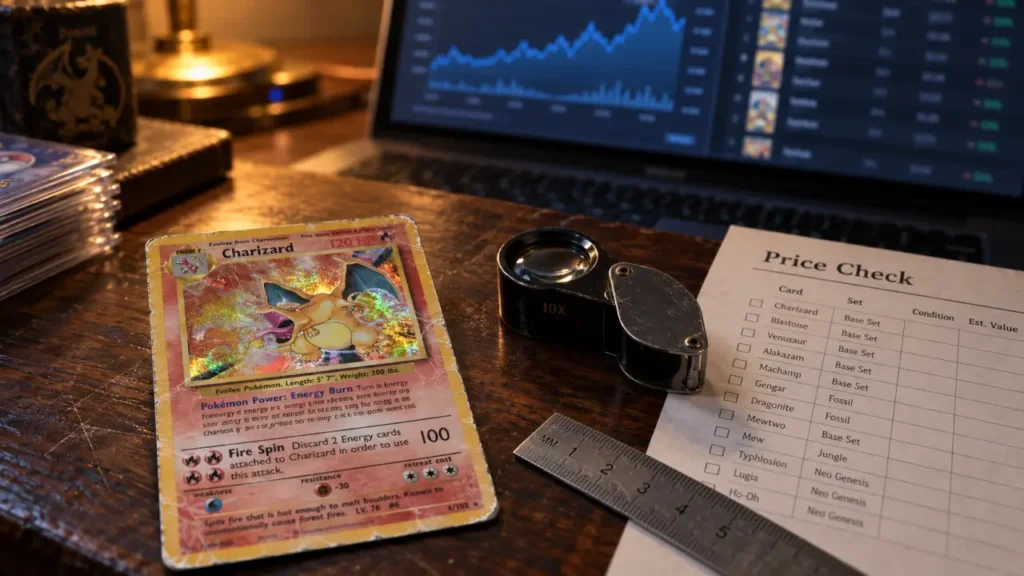
To run a Pokemon TCG price check, you need three things: the card’s exact name, its number in the set, and its condition. Type something like “Charizard #4” into a price database, pick the right set, then read the figure for your card’s condition, not the headline number. Most wrong valuations come from skipping one of those steps.
The three-step price check
Step 1: Search by name and number, or by photo
Tools such as PriceCharting accept a card name, a number, or both, for example “Charizard #4” or simply “Bulbasaur”. Adding the number matters because popular Pokemon appear in dozens of sets, and the name alone will return every version. Several tools also let you search with a photo, which helps when you are staring at a card in a language you cannot read or cannot find the number.
Step 2: Open the right set page
Set pages list the full checklist with a value beside each card. If you only know part of a set name, most databases offer a quick-jump field that autocompletes it. Opening the set page is also a good sanity check: if your card’s number and artwork match the checklist entry, you are looking at the right version.
Step 3: Read the right condition column
A price page usually shows several figures: ungraded, then graded tiers. Match your card to the correct row. A card with whitened edges is not priced like a pack-fresh one, and a professionally graded card sits in a different column from a raw one. Check both the current value and the price history, so you know whether you are looking at a stable number or a spike.
Identify the card before you price it
Where to find the number, symbol and rarity
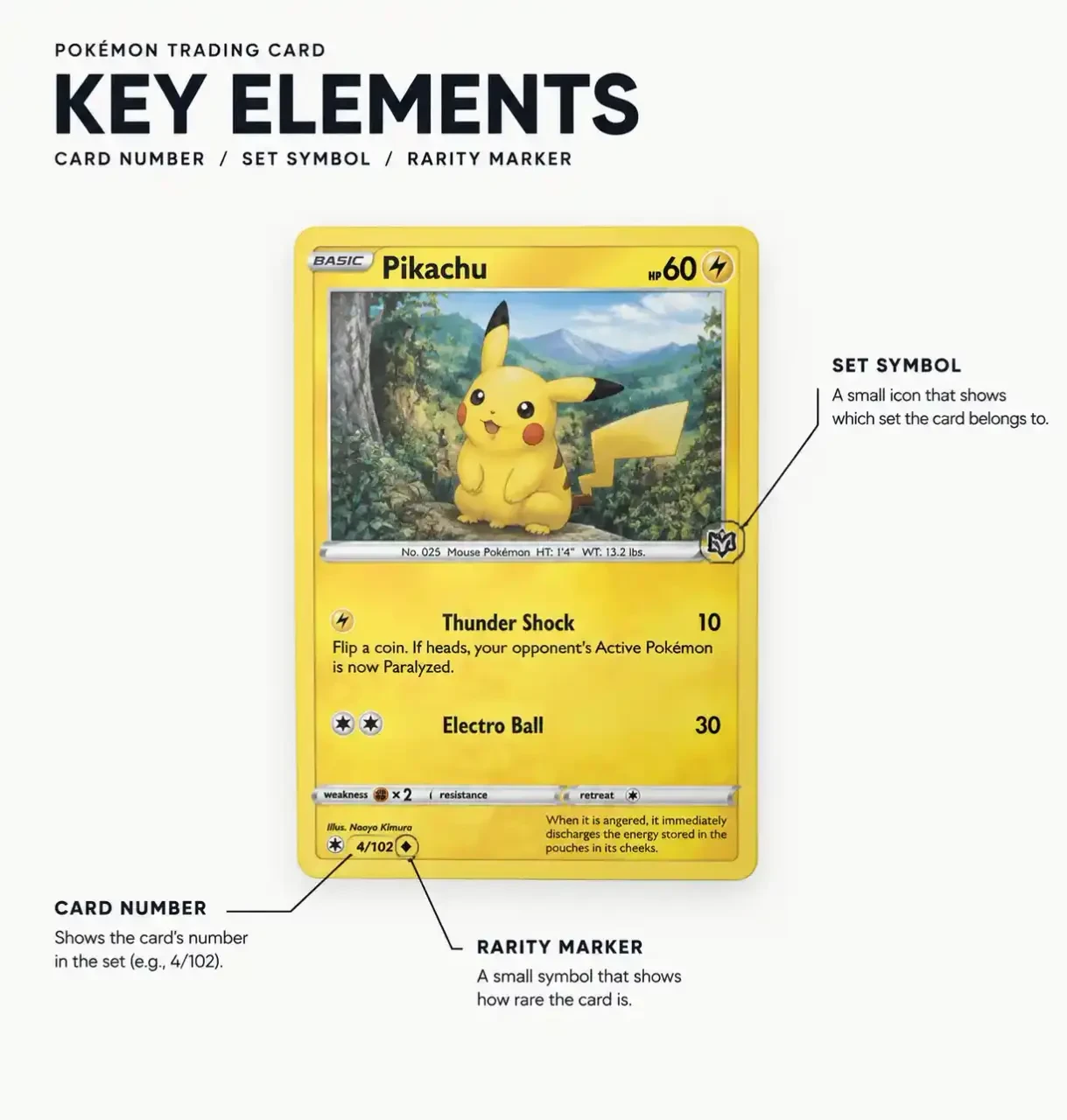
The card number sits at the bottom of the card, usually written as a fraction such as 4/102. The small set symbol is next to the artwork or near the bottom corner, and a rarity marker (circle, diamond, star) sits near the number. Together, these three details pin down the card far more reliably than the name. If your lookup returns a price that seems wildly off, recheck these before assuming the market is strange.
Variants that change the price dramatically
Base Set launched in 1999 in the US, and its versions are a classic trap. A 1st Edition or Shadowless copy commands a large premium over the standard Unlimited print, even though the artwork looks nearly identical. The same goes for holo versus reverse holo versus non-holo. Language matters too: English and Japanese versions of the same card trade at different values, so confirm which one you hold.
Watch for fakes
If a card looks too glossy, has odd fonts, or feels wrong in weight or texture, verify its authenticity before trusting any price. A price guide values a genuine card; it cannot tell you yours is real. Comparing against a known genuine copy is a sensible first step before you consider selling or grading.
Why the same card shows different prices
Market price, listed price and sold price
These three numbers answer different questions. A listed price is what sellers are asking, and can be optimistic. A sold price is what a buyer actually paid. A market price is typically an average calculated from recent sales on that platform. For a quick valuation, recent sales are the most honest signal, and the lowest listing is the least reliable one, especially on thin markets.
Why tools disagree
Each tool draws on its own data. TCGplayer reflects its own marketplace, PriceCharting tracks current and historic values, and European collectors often look to Cardmarket, which is priced in euros. Different sources, currencies and update frequencies mean small gaps are normal. Treat two or three sources as a range rather than hunting for a single true number.
Think of price as a pendulum
A card’s price rarely moves in a straight line. It behaves like a pendulum: a reprint, a hyped set release or a tournament shift swings it hard in one direction, then it drifts back toward a calmer middle. That is why reading the price history chart matters more than the number on the day. If the current value sits far above its long-run range, the swing may already be near its peak, and a card that just dropped after a reprint may simply be on the way back. Before you sell in a rush, check where the card is in its swing.
Raw versus graded prices
Condition tiers for raw cards
Raw cards are usually sorted into Near Mint, Lightly Played, Moderately Played, Heavily Played and Damaged. Each step down lowers the value, sometimes sharply for older, sought-after cards. Be honest about centering, edges, corners and surface scratches, because buyers will be.
PSA, BGS and CGC slabs
Graded cards are sealed in a slab with a numeric grade from PSA, BGS (Beckett) or CGC. A gem-mint grade such as PSA 10 can multiply a card’s value compared with the raw price, but only for cards that truly earn it. Always compare like with like: a PSA 9 price is not a PSA 10 price, and a different grading company can trade at a different level. Population reports, which show how many copies exist at each grade, help you judge how scarce a top grade really is.
Choosing a price-check tool
| Tool | Strength | Best for |
|---|---|---|
| TCGplayer | Prices tied to a large marketplace | Buying and selling in the US market |
| PriceCharting | Current and historic values, photo search, collection add | Quick lookups and price history |
| PokeData | Dedicated Pokemon data platform | Data-focused collectors |
| CardHedger | AI-based price guide with real-time values, Base Set to modern | Instant valuations |
What to do after the check
Once you have a reliable range, decide on the next move. Hold if the price is in a dip, sell if it is near the top of its history, and consider grading only if the card is a strong candidate and the graded premium justifies the cost. If you own many cards, add them to a collection tracker so you can watch the total value over time instead of checking each card by hand.
Mistakes that skew a valuation
- Using asking prices instead of recent sold prices.
- Ignoring condition and reading the near-mint figure for a worn card.
- Mixing up editions, such as 1st Edition, Shadowless and Unlimited.
- Trusting one source when two or three would show the real range.
- Relying on stale data after a reprint or new set release has moved the market.
Avoid these and a price check becomes a reliable starting point rather than a guess.