To find Pokémon card sets, start with what you already know: an expansion name, a card’s printed number, or the era you remember collecting. Official Pokémon expansion pages and card galleries are useful starting points, while independent indexes can help you browse historical releases, promotional cards, and printing variants.
The important distinction is that a catalogue entry is not always a separate expansion. A name may identify an entire series, a promotional grouping, or a particular printing of an older set. Knowing which you are looking at makes card identification and collection planning much easier.
Browse Pokémon card sets by name or era
If you remember a set name, search for that exact name before adding broader terms. “Neo Genesis” is more useful than “old Pokémon cards,” for example. If you only remember the general period, use the groupings below to narrow your search.
Official Pokémon TCG Card Database · Find any Pokémon TCG card with filters for type, Energy, format, expansion, and more.
This is a selective browsing map, not an exhaustive release list or a calendar. It brings together recognizable historical sets and later series labels without treating every entry as the same type of release.
| Browsing group | Names to look for | What to check next |
|---|---|---|
| Early releases | Base Set, Jungle, Fossil | The expansion, then any edition or printing distinction |
| Gym and Neo releases | Gym Heroes, Gym Challenge, Neo Genesis, Neo Discovery, Neo Revelation | The full expansion name rather than only “Gym” or “Neo” |
| e-Card period | e-Card | The individual expansion within this broader grouping |
| Diamond & Pearl through XY | Diamond & Pearl, Black & White, XY | Whether the name refers to a series or its opening expansion |
| Later series | Sun & Moon, Sword & Shield, Scarlet & Violet | The specific expansion and its associated checklist |
| Promotional and supplementary entries | Black Star Promo, Pop Series 1–9, Radiant Collection | The catalogue’s category and numbering conventions |
An era name is a starting point, not necessarily a complete set name. Searching for Sword & Shield, for instance, can lead you to both a broader series and an expansion carrying that name. Open the individual entry and check its description before using its card list.
Separate expansions, promos, collections, and printings
An expansion is not the same as a boxed collection
An expansion is a named release with an associated group of cards. A retail collection is a packaged product, which may combine booster packs, promotional cards, and other items. The name on a box therefore does not necessarily identify the expansion of every card inside it. When identifying loose cards, prioritize their printed identifiers over the packaging they came from.
“Special collection” also needs care: retailers and databases may use collection-related wording differently. Read the entry description rather than assuming that every product title represents an independent checklist.
Promotional groupings follow a different logic
Promotional cards may be organized by a shared numbering system, distribution programme, or campaign rather than a conventional expansion. Black Star Promo entries and Pop Series 1–9 are useful search terms when a card does not fit the expansion you expected. A promo catalogue can cover cards distributed through different products or occasions, so its scope needs checking.
A printing variant does not automatically mean another expansion
Base Set 1st Edition, Base Set Shadowless, and Base Set Unlimited are distinct catalogue labels you may encounter. They help collectors separate printings within Base Set rather than identify three unrelated expansions. Similar edition labels appear alongside other historical set names. Confirm the expansion first, then investigate the printing. Otherwise, a correct card identification can still lead to the wrong collection entry.
Identify a set from a card you already own
A Pokémon’s name alone rarely identifies its set: the same character can appear across many releases. Start with the small identifying details printed on the card, then use the artwork as a cross-check.
- Copy the collector number exactly. Keep any letters, prefixes, and denominator rather than recording only the first number.
- Look for a set symbol or code. Its position and format vary between releases; some older cards require additional clues.
- Note the language. Do not assume cards in different languages use identical set organization or numbering.
- Compare the full card image. Match artwork, card name, number, and identifying marks together.
- Check the variant separately. Holographic treatment, stamps, or edition markings may distinguish versions of the same card.
Think of identification like a rope made from several strands: a name, number, symbol, language, and artwork each adds strength. One strand can mislead you—a familiar illustration may appear again—but several matching identifiers make the conclusion much more dependable. In a collection spreadsheet, keep those strands in separate columns instead of compressing everything into a single card name.
If a search produces several plausible matches, do not choose the first thumbnail. Open each candidate’s checklist or individual card entry and compare the printed details. A gallery is particularly helpful for artwork; a text checklist is often easier for checking numbering and spotting missing cards.
Choose between official galleries and independent indexes
For first-party information, look for Pokémon’s official Pokémon TCG expansions destination and its Pokémon Trading Card Game gallery pages. These are sensible places to begin when confirming an expansion name or looking for an official visual reference. Check which releases a page covers rather than assuming a gallery includes every historical card.
Pokellector and Pokedata are independent reference destinations, not official Pokémon properties. Their set indexes offer another route into the catalogue. Pokedata’s listed names span early releases, later series, promotional groupings, and collections, making category awareness especially important when browsing.
- For a known expansion: begin with its exact name and look for an official expansion page or gallery.
- For an older or uncertain release: use an independent set index to narrow the possibilities, then verify the card details.
- For promos or unusual labels: check how the database defines the grouping before treating it as a conventional expansion.
- For newly announced releases: distinguish an announcement or preview gallery from a finalized checklist.
No single page should be assumed complete simply because its list is long. Look for a stated scope, language, release region, and update information where available. A catalogue that separates confirmed entries from previews is easier to interpret than one that presents both without explanation.
Define “complete” before building a set
Once you have found the right expansion, decide what you actually want to collect. A numbered checklist, every artwork, and every printing variant are different projects. Without a clear boundary, a nearly finished binder can keep expanding as you discover reverse-holo versions, stamped cards, or related promotional releases.
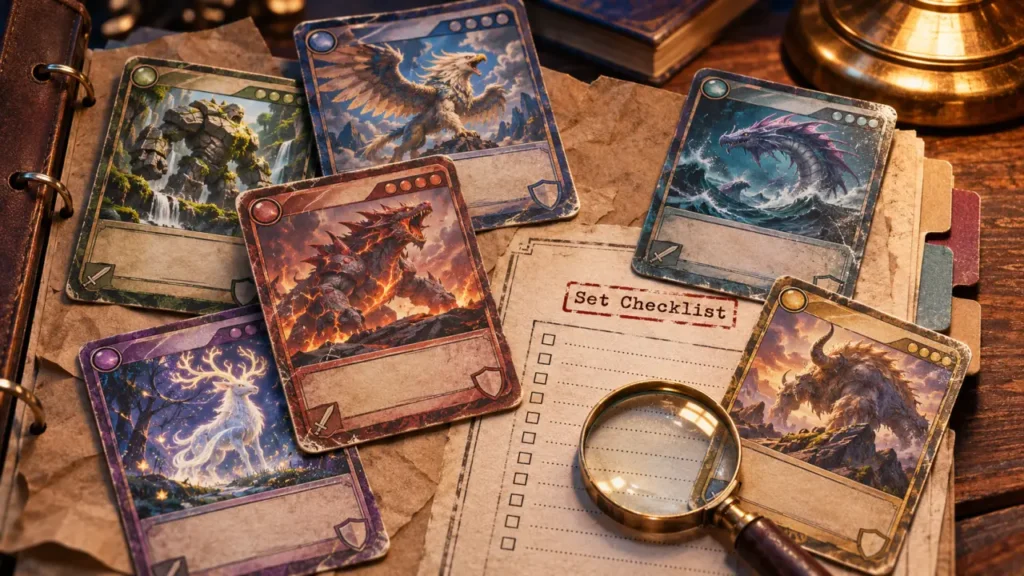
Create a checklist with separate fields for the set name, collector number, card name, language, variant, and ownership status. Keep related promos in a separate section unless you deliberately include them in your goal. This preserves the difference between completing an expansion and collecting everything associated with its release.
When comparing checklist totals, read the inclusion rules before assuming one list is wrong. A database may count variants separately, while another presents one entry per numbered card. The useful question is not simply “How many cards are in this set?” but “Which cards and versions does this checklist include?”
Start with a clearly identified expansion and a checklist whose scope matches your goal. That gives you a reliable path from browsing Pokémon card sets to knowing exactly what belongs in your collection—and what is still missing.