To find out what a Pokémon card is worth, start with the exact card, not just the Pokémon character. A Charizard or Pikachu can appear in many sets, rarities, languages, and print variations, with very different levels of market interest. A reliable estimate comes from identifying the card, assessing its condition, and comparing it with relevant market prices instead of trusting the first number you see.
Why “Pokémon TCG worth” depends on more than the card name
A Pokémon card’s value is the price a suitable buyer may realistically pay for that specific version in its actual condition. The name on the card is only one identifying detail. The set and card number, rarity treatment, language, edition, foil pattern, and grading status can all change the result.
Official Pokémon TCG Card Database · Find any Pokémon card quickly by type, Energy, format, expansion, and more.
Popular characters often cause the biggest valuation errors because collectors search broadly. A search for “Charizard card price” may return cards from the Base Set, newer releases, promotional cards, alternate-art versions, and graded copies. These are not interchangeable. Before treating any price as relevant, check that the listing matches your card in every important field.
| Value factor | What to check | Why it matters |
|---|---|---|
| Set and card number | The printed number, including any number after a slash | It distinguishes cards with the same character name. |
| Condition | Surface, corners, edges, centering, bends, dents, and scratches | A clean copy and a played copy should not use the same comparison price. |
| Version | Holo, reverse holo, promo, special print, or regular version | Different treatments can have different levels of collector demand. |
| Language and edition | English, Japanese, or another language; edition details where applicable | Supply and buyer demand vary between versions. |
| Grading | Raw card or professionally graded card | A graded price applies to the labeled grade, not automatically to an ungraded copy. |
Identify the card before you look up a price
Use the card number and set details first
The fastest route to a reliable Pokémon TCG value is usually the card number. Look near the bottom of the card for a number formatted as part of a set total. Record the Pokémon name, the number, the set symbol or set name, and whether the card is foil. A searchable card database can then narrow the result to the correct checklist entry instead of showing every card featuring that Pokémon.
If the card number is hard to read, compare its artwork, HP, attack names, illustrator line, and rarity marker with full card lists for the likely set. New releases and older sets can both include visually similar designs, so artwork alone is not enough. The more identifying details you confirm, the less likely you are to compare your card with a related version.
Use photo identification as a starting point, not a verdict
Photo-based search is useful when you have inherited a binder, cannot identify the set, or own cards in a language you do not read. Take a sharp image of the full front in even light. If possible, photograph the back as well. The goal is to capture the card number, foil effect, borders, and symbols that distinguish one printing from another.
A photo match still needs manual verification. Glare can hide holofoil, cropped images can omit the card number, and a visual match may point to a related version rather than the exact printing. Treat image recognition as a shortcut to identification, then confirm the checklist details yourself.
Compare sold prices, current listings, and price history correctly
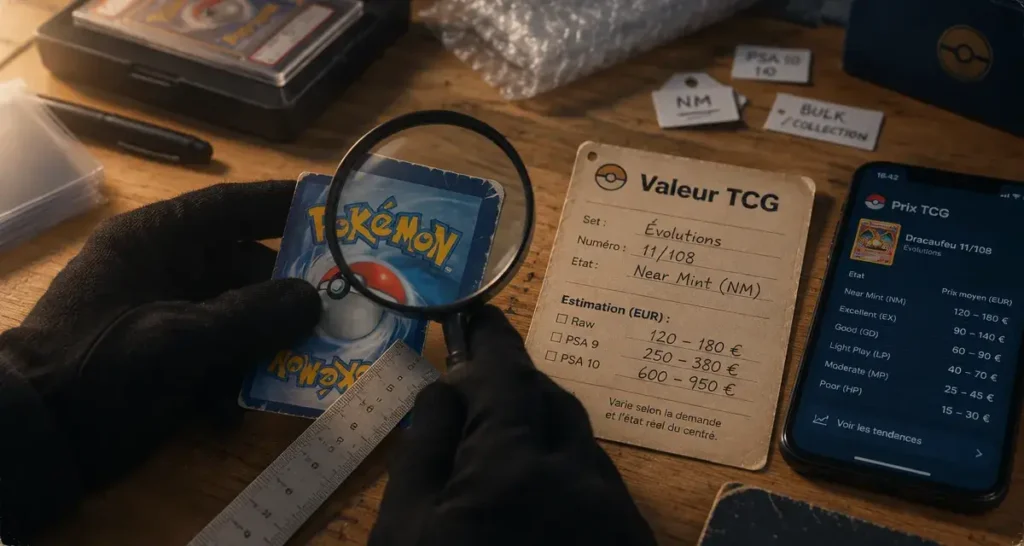
The most common mistake is using an asking price as proof of value. A listing shows what a seller hopes to receive; it does not confirm what buyers have paid. When a price guide provides current market information, use it alongside recent completed sales that match your card’s version and condition. This gives you a more grounded estimate of fair market value.
Historical prices add context, but they should not replace current research. A previous high point may reflect a temporary surge in attention, while an old low price may predate renewed interest in a set. Look for a pattern over time: stable movement, repeated sales in a narrow range, sudden spikes, or a lack of recent activity. Thin sales data calls for more caution, not a more confident number.
There is also a useful valuation threshold: the point at which a tiny physical flaw changes the buyer category for the card. A faint scratch may be negligible on a low-demand modern card, yet decisive on a scarce foil where collectors expect a display-quality surface. Instead of asking only, “Is this damaged?”, ask, “Would the next buyer still describe it as the same condition as the comparison copy?” That shift makes condition assessment more practical and helps prevent you from borrowing premium prices for an imperfect card.
Match condition before matching price
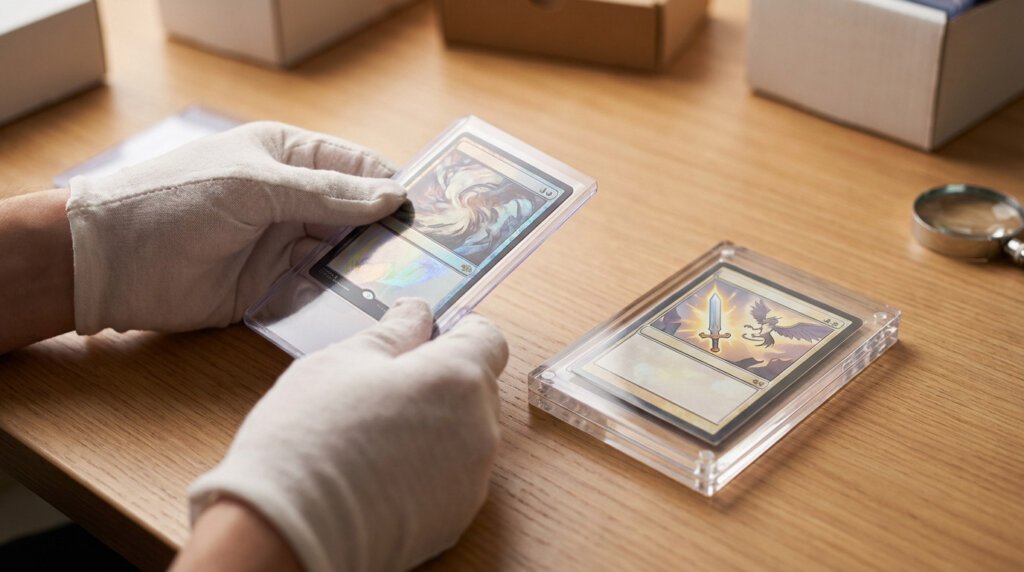
Inspect the card outside its sleeve under indirect light. Check the front and back for whitening, edge wear, scratches, pressure marks, creases, stains, and warping. Centering and print quality can matter as well, especially when comparing raw cards with copies that were graded.
Do not compare a raw card to a graded one without adjusting your expectations. A graded card has a stated assessment and a sealed holder; an ungraded card carries uncertainty for the buyer. Likewise, a card described as near mint should not be valued using damaged, heavily played, or mint-condition examples. Keep notes on the flaws you find so your estimate remains repeatable.
Research a set, not just a single card
Set-based browsing helps when you have multiple cards or are unsure whether a standout card belongs to a popular release. A full checklist reveals the set size, neighboring card numbers, variants, and other cards that share a visual style. This is especially helpful for older collections, where set identity may be more informative than the Pokémon name.
Popular sets and new releases are useful entry points, but they should not dictate your valuation. A card can be inexpensive in a well-known set, while an overlooked promotional or limited-print card may require more careful research. Browse from the set page to the individual card page, then confirm the precise version before recording a value.
Track collection value without mistaking it for cash value
A collection tracker or portfolio tool can make a large binder manageable. Add each card with its set, card number, version, condition, and grading status. When current card prices change, the tracker can show how the estimated total has moved. Price alerts can also help you monitor cards with meaningful price swings instead of checking every item manually.
For a useful portfolio, separate cards by condition and avoid assigning one generic price to every copy. Review entries after a new set release, a notable market movement, or a condition reassessment. Keep your own purchase price in a separate field from the current estimate: what you paid, what a price guide displays, and what a buyer will offer are three different figures.
The best answer to “What is my Pokémon TCG worth?” is therefore a range supported by matching evidence. Identify the card precisely, use comparable sales and current market data, account for condition, and revisit the estimate when the market changes. That process is slower than copying a headline price, but it is far more useful for collectors, buyers, and sellers.