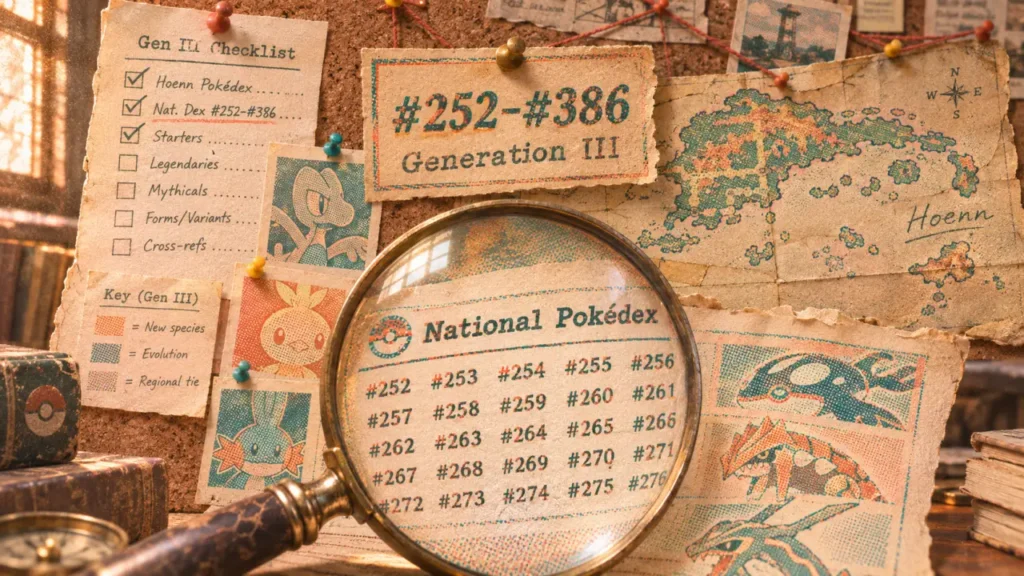
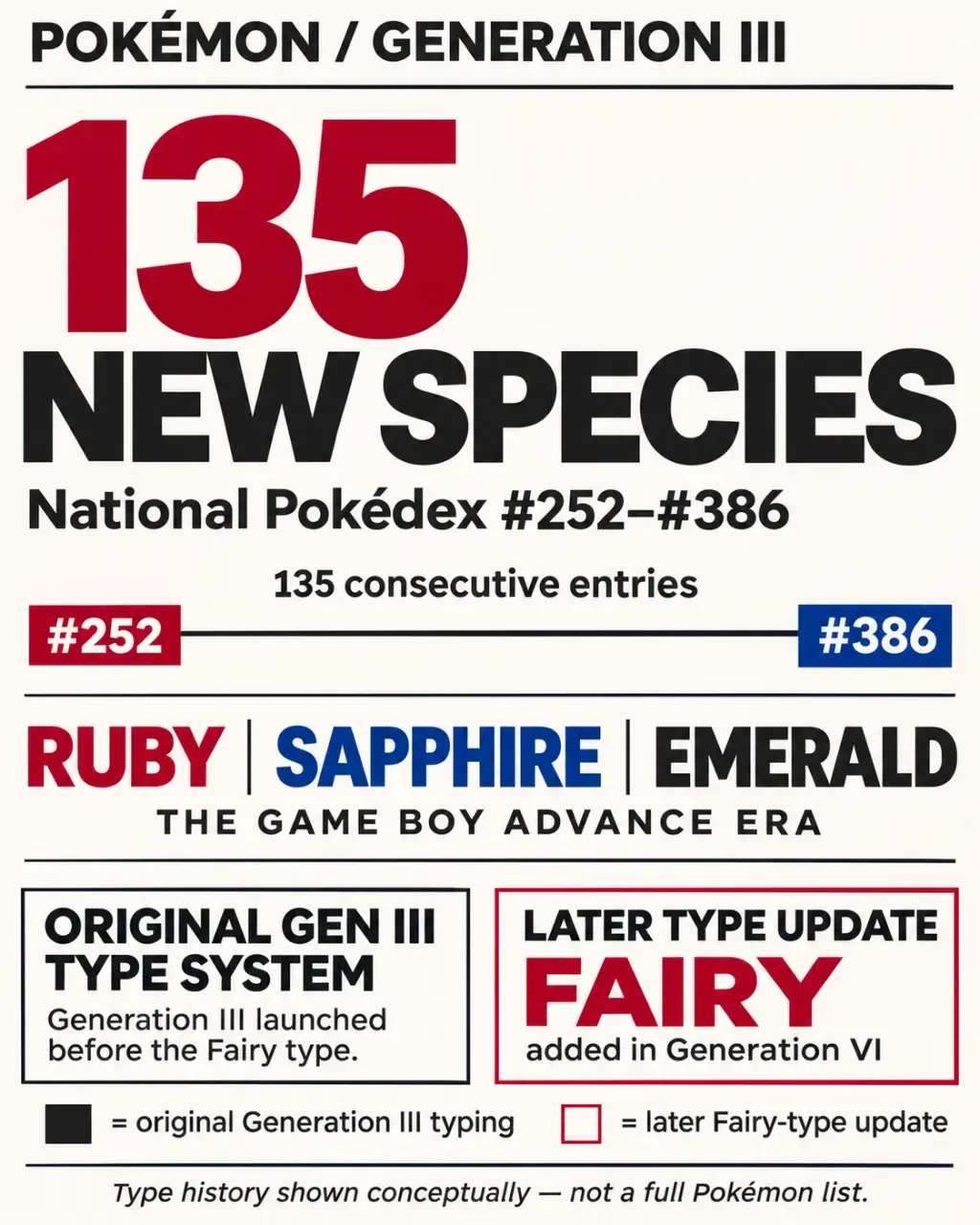
Generation III introduced 135 Pokémon, numbered #252–#386 in the National Pokédex. The roster starts with Treecko and ends with Deoxys, and is associated with Pokémon Ruby, Sapphire, and Emerald. Below is the full numbered list, followed by the distinctions that matter when checking types, abilities, stats, and later forms.
The complete Generation III roster in National Pokédex order
These are the newly introduced species, not every Pokémon obtainable in a Generation III game. Numbers follow the National Pokédex rather than the regional Hoenn Pokédex. Use your browser’s find function to locate a name or number quickly.
| National numbers | Pokémon in order, with individual numbers |
|---|---|
| 252–260 | 252 Treecko; 253 Grovyle; 254 Sceptile; 255 Torchic; 256 Combusken; 257 Blaziken; 258 Mudkip; 259 Marshtomp; 260 Swampert |
| 261–269 | 261 Poochyena; 262 Mightyena; 263 Zigzagoon; 264 Linoone; 265 Wurmple; 266 Silcoon; 267 Beautifly; 268 Cascoon; 269 Dustox |
| 270–278 | 270 Lotad; 271 Lombre; 272 Ludicolo; 273 Seedot; 274 Nuzleaf; 275 Shiftry; 276 Taillow; 277 Swellow; 278 Wingull |
| 279–287 | 279 Pelipper; 280 Ralts; 281 Kirlia; 282 Gardevoir; 283 Surskit; 284 Masquerain; 285 Shroomish; 286 Breloom; 287 Slakoth |
| 288–296 | 288 Vigoroth; 289 Slaking; 290 Nincada; 291 Ninjask; 292 Shedinja; 293 Whismur; 294 Loudred; 295 Exploud; 296 Makuhita |
| 297–305 | 297 Hariyama; 298 Azurill; 299 Nosepass; 300 Skitty; 301 Delcatty; 302 Sableye; 303 Mawile; 304 Aron; 305 Lairon |
| 306–314 | 306 Aggron; 307 Meditite; 308 Medicham; 309 Electrike; 310 Manectric; 311 Plusle; 312 Minun; 313 Volbeat; 314 Illumise |
| 315–323 | 315 Roselia; 316 Gulpin; 317 Swalot; 318 Carvanha; 319 Sharpedo; 320 Wailmer; 321 Wailord; 322 Numel; 323 Camerupt |
| 324–332 | 324 Torkoal; 325 Spoink; 326 Grumpig; 327 Spinda; 328 Trapinch; 329 Vibrava; 330 Flygon; 331 Cacnea; 332 Cacturne |
| 333–341 | 333 Swablu; 334 Altaria; 335 Zangoose; 336 Seviper; 337 Lunatone; 338 Solrock; 339 Barboach; 340 Whiscash; 341 Corphish |
| 342–350 | 342 Crawdaunt; 343 Baltoy; 344 Claydol; 345 Lileep; 346 Cradily; 347 Anorith; 348 Armaldo; 349 Feebas; 350 Milotic |
| 351–359 | 351 Castform; 352 Kecleon; 353 Shuppet; 354 Banette; 355 Duskull; 356 Dusclops; 357 Tropius; 358 Chimecho; 359 Absol |
| 360–368 | 360 Wynaut; 361 Snorunt; 362 Glalie; 363 Spheal; 364 Sealeo; 365 Walrein; 366 Clamperl; 367 Huntail; 368 Gorebyss |
| 369–377 | 369 Relicanth; 370 Luvdisc; 371 Bagon; 372 Shelgon; 373 Salamence; 374 Beldum; 375 Metang; 376 Metagross; 377 Regirock |
| 378–386 | 378 Regice; 379 Registeel; 380 Latias; 381 Latios; 382 Kyogre; 383 Groudon; 384 Rayquaza; 385 Jirachi; 386 Deoxys |
The count is inclusive: 386 − 252 + 1 = 135. The final number does not mean this generation introduced 386 species; it means the National Pokédex had reached that total.
Which games define Generation III?
Pokémon Ruby and Sapphire introduced this generation in Japan in 2002, with Pokémon Emerald following there in 2004. Their Hoenn adventures established the new roster, including the Grass-type Treecko, Fire-type Torchic, and Water-type Mudkip starter families.
Complete Generation III Pokémon Reference · Explore Pokémon #252–386, from Treecko to Deoxys, including alternate forms with type changes.
A game generation and a species’ debut generation are different labels. FireRed and LeafGreen also belong to the Generation III game era, but their returning Kanto Pokémon do not become newly introduced Generation III species. Likewise, a Hoenn Pokémon appearing in a later game retains its original debut classification.
Ruby and Sapphire could not receive transfers from the earlier Game Boy games. That break limited access to older Pokémon; FireRed and LeafGreen subsequently helped restore access to many returning species within the newer game ecosystem. They did not reopen direct transfers from those older cartridges.
Compared with earlier generations, this roster expanded the presence of Dark and Steel types and offered many dual-type combinations. Most new species were not related to existing Pokémon, with Azurill and Wynaut notable exceptions connecting to earlier evolution families.
Types: distinguish original typings from modern listings
A Pokémon’s debut generation stays fixed, but its reference information can change. Fairy did not exist as a type in Ruby, Sapphire, or Emerald. It was introduced in Pokémon X and Y, when several Generation III species received updated typings.
| Pokémon | Original Generation III type | Type from X and Y onward |
|---|---|---|
| Ralts, Kirlia, Gardevoir | Psychic | Psychic/Fairy |
| Azurill | Normal | Normal/Fairy |
| Mawile | Steel | Steel/Fairy |
Dual typing means both types apply, rather than the Pokémon switching freely between them. For example, Swampert is Water/Ground, while Metagross is Steel/Psychic. Those combinations affect weaknesses, resistances, and the same-type attack bonus, so checking both labels matters more than judging a Pokémon by its appearance.
Treat the game version as a reference lock: before comparing entries, fix the ruleset you are using. Pairing Emerald-era moves with a modern Fairy typing produces a Pokémon that cannot exist under Emerald’s rules. Recording the game beside your notes keeps types, abilities, forms, and battle calculations aligned—a small habit that prevents misleading team comparisons.
Reading abilities and base stats without mixing rulesets
For a deeper lookup, Serebii’s Pokémon reference tables provide abilities and six base-stat fields. Select the relevant game generation before using those values for team planning. A modern species profile is not automatically a historical record of everything that species could do in Emerald.
- HP: the base attribute contributing to how much damage a Pokémon can withstand.
- Attack and Defense: the attributes used for physical damage calculations.
- Special Attack and Special Defense: the corresponding attributes for special damage.
- Speed: helps determine action order when other factors, such as move priority, are equal.
Base stats are species-level starting points, not the exact numbers shown on an individual Pokémon’s summary screen. Level, nature, individual values, and effort values also influence actual stats. A base-stat total is useful for a broad comparison, but it can hide whether a Pokémon’s strengths suit its intended role.
Abilities are separate from types and moves. Their effects can change how a Pokémon performs, so compare the ability alongside its stat spread rather than treating the total as a complete ranking. For original Generation III battles, also remember that physical or special damage categories depended on move type, rather than being assigned individually to each move as in later games.
Legendary, Mythical, and alternate forms: count them correctly
The Legendary Pokémon introduced in this generation are Regirock, Regice, Registeel, Latias, Latios, Kyogre, Groudon, and Rayquaza. They occupy #377–#384, making the end of the roster a convenient place to find them together.
Jirachi (#385) and Deoxys (#386) are Mythical Pokémon, a separate classification. Their inclusion in the species roster does not imply ordinary wild availability in every associated game. When checking availability, distinguish a Pokémon’s debut from the version, event, or distribution needed to obtain it.
Alternate forms do not automatically add species to the total. Primal Kyogre remains #382 and Primal Groudon remains #383; their transformations were introduced later and are not extra entries among the original 135. The same principle keeps Mega Evolutions and regional forms from inflating this roster.
For a reliable lookup, start with the National Pokédex number, then confirm the form and game. Those three identifiers separate the enduring species entry from the battle details that may change between releases.