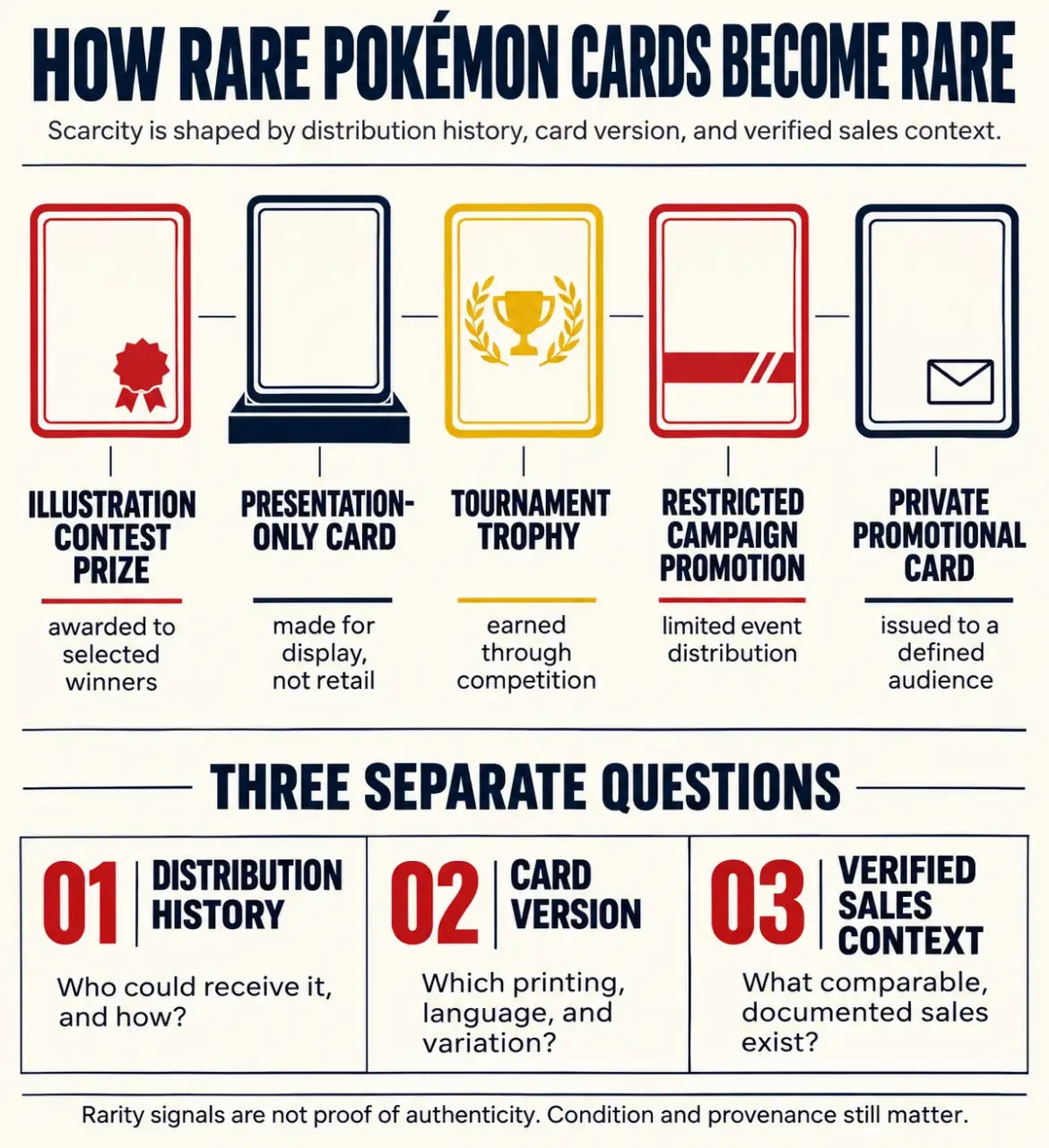
Pikachu Illustrator, tournament trophies, and presentation-only Blastoise cards are rare for different reasons. Some never appeared in booster packs; others reached only a small circle of recipients. To judge rare Pokémon cards properly, separate how a card was distributed, which version you have, and what buyers actually pay for comparable copies.
A shiny finish or an impressive asking price cannot establish scarcity. The most useful starting point is the card’s identity and history—not its price tag.
Five rare Pokémon cards with very different histories
These collectibles illustrate why restricted distribution matters. Their historical sale figures are reference points, not current valuations or prices that every copy could achieve.
| Card | Date | Reason for scarcity | Reported historical sale |
|---|---|---|---|
| Pikachu Illustrator | 1998 | Illustration-contest prize; 39 copies reportedly distributed | $5.275 million, PSA 10, July 2021 |
| Blastoise WOTC Presentation Galaxy Holo | 1998 | Presentation card rather than a regular pack release | $360,000, reported as PSA 10, 2021 |
| No. 1 Trainer Trophy Cards | 1997–2001 | Tournament awards with year-specific versions | Reported PSA 10 range of $90,000–$200,000; no single sale date specified |
| Tamamushi University Magikarp | 1998 | Restricted promotional campaign distribution | $66,000, 2021 |
| Ishihara GX Promo | 2017 | Private promotional distribution; around 30 copies reported | $50,000, 2020 |
Pikachu Illustrator and presentation Blastoise
Pikachu Illustrator is associated with the 1997–1998 CoroCoro Comic Illustration Contest. Designed by Atsuko Nishida, it carries “Illustrator” where collectors would ordinarily expect a Trainer heading. The reported distribution of 39 copies describes the original awards, not a verified count of all surviving examples today.
The Blastoise WOTC Presentation Galaxy Holo belongs to the development history of the English-language game. Associated with Wizards of the Coast and artwork by Ken Sugimori, it is a presentation piece rather than an ordinary expansion card. Two English-back copies are reported as known. An estimate of fewer than 10 produced remains uncertain and should not be treated as a confirmed print run.
Trophies, campaign prizes, and private promos
No. 1 Trainer Trophy Cards reward tournament achievement, so the event, year, and version are essential identifiers. Tamamushi University Magikarp comes from a 1998 campaign associated with Shogakukan. Ishihara GX is a 2017 promotional curiosity featuring Tsunekazu Ishihara and an unusual 350 HP. These cards share restricted access, but their audiences and histories differ; comparing them solely by price misses much of their appeal.
Scarcity is not the same as a printed rarity category
Rarity classification describes a card’s place within its release. Scarcity concerns how many relevant copies exist or are available. Demand describes how many people want them. Market value emerges from those factors together, not from one label.
Official Pokémon TCG Card Database · Find any Pokémon TCG card with filters for type, Energy, format, expansion, and more.
A promo may have broad distribution, while a tournament trophy may have reached very few recipients. A prototype can be scarce because it was never intended for public release. An error requires extra care: damage, altered printing, and an authentic production mistake are not interchangeable.
- Holo rare: a rare card with a holographic treatment; the exact appearance varies by release.
- Secret rare: commonly used for cards numbered beyond an expansion’s main set total.
- Rainbow rare: a collector term associated with rainbow-colored treatments in particular releases.
- Hyper rare: a designation whose meaning should be checked against the specific expansion and language.
- Illustration rare and special illustration rare: artwork-focused classifications, not proof of a tiny surviving population.
Think of a collection as a palette rather than a ladder of prices. A trophy contributes competitive history, an illustration card contributes visual storytelling, and a familiar holo contributes nostalgia. Choosing which “color” you want before shopping helps you compare meaningful alternatives: you may want a striking binder page rather than a scarce tournament artifact. That distinction can prevent an expensive purchase that does not actually suit your collection.
Identify the exact card before judging its value
A Pokémon’s name alone is not enough. Different expansions, languages, finishes, and promotional versions can share that name while having very different availability. Build an identity record before searching for prices.
- Copy the printed details: name, collector number, set symbol or code, language, and copyright information.
- Record distinguishing features: promotional stamps, edition markings, holographic treatment, and unusual numbering.
- Search the official Pokémon TCG card database: narrow by expansion, rarity, and card type rather than relying only on the character name.
- Compare the complete design: artwork, attacks, HP, and numbering should agree with the version you are checking.
- Escalate unusual finds: seek specialist assessment for suspected prototypes, errors, trophies, or valuable variants.
The official database also offers gameplay filters, including retreat cost, attack cost, weakness, resistance, and energy type. These can help distinguish similar cards. However, a matching database image does not authenticate a physical copy, and a missing result does not automatically prove a historical promo is counterfeit.
For a potentially valuable card, keep clear photographs of both sides and any documentation showing its ownership or distribution history. Provenance is particularly useful when the claim depends on an event or restricted promotion rather than an ordinary set release.
Read condition, grading, and sale prices together
Two genuine copies of the same card can attract different offers because of surface scratches, whitening, creases, centering, or other condition differences. Inspect the front and back under good lighting, and request close-ups rather than judging only from a distant listing photograph.
A label such as PSA 10 refers to a grading assessment of a particular copy. It is not a promise that an ungraded card will receive that grade. When buying a graded card, check the certification details and make sure they correspond to the card and holder shown.
Historical prices need equally careful reading. The $5.275 million Pikachu Illustrator figure concerns a reported PSA 10 transaction in July 2021. It does not establish the value of a lower-grade copy, another Pikachu promo, or a card offered today.
- Compare completed transactions, not just asking prices.
- Match the language, edition, variant, grading company, and grade.
- Check the transaction date and whether the total includes buyer’s fees.
- Treat isolated record sales cautiously when comparable sales are scarce.
A grading population report also measures submissions recorded by that service—not the complete original print run or every surviving card. Scarcity claims should say exactly what is being counted.
Choose singles for a target, packs for the experience
If you want one specific rare card, buying a single is the more direct route. Opening packs gives you uncertain contents, and historical trophies or presentation cards were never ordinary booster pulls. Out-of-print cards are usually sought through the secondary market rather than newly released packs.
Packs still make sense when opening them is part of the enjoyment. Set a spending limit and treat the contents as uncertain, not as a reliable way to recover the purchase cost. For singles, compare established specialist retailers, card shops, and marketplace sellers with documented trading histories.
Before paying, confirm the exact version, condition description, photographs, return terms, and payment protection. For expensive cards, request provenance where relevant and independent authentication when appropriate. Buy the card you have verified—not the rarity story attached to it.