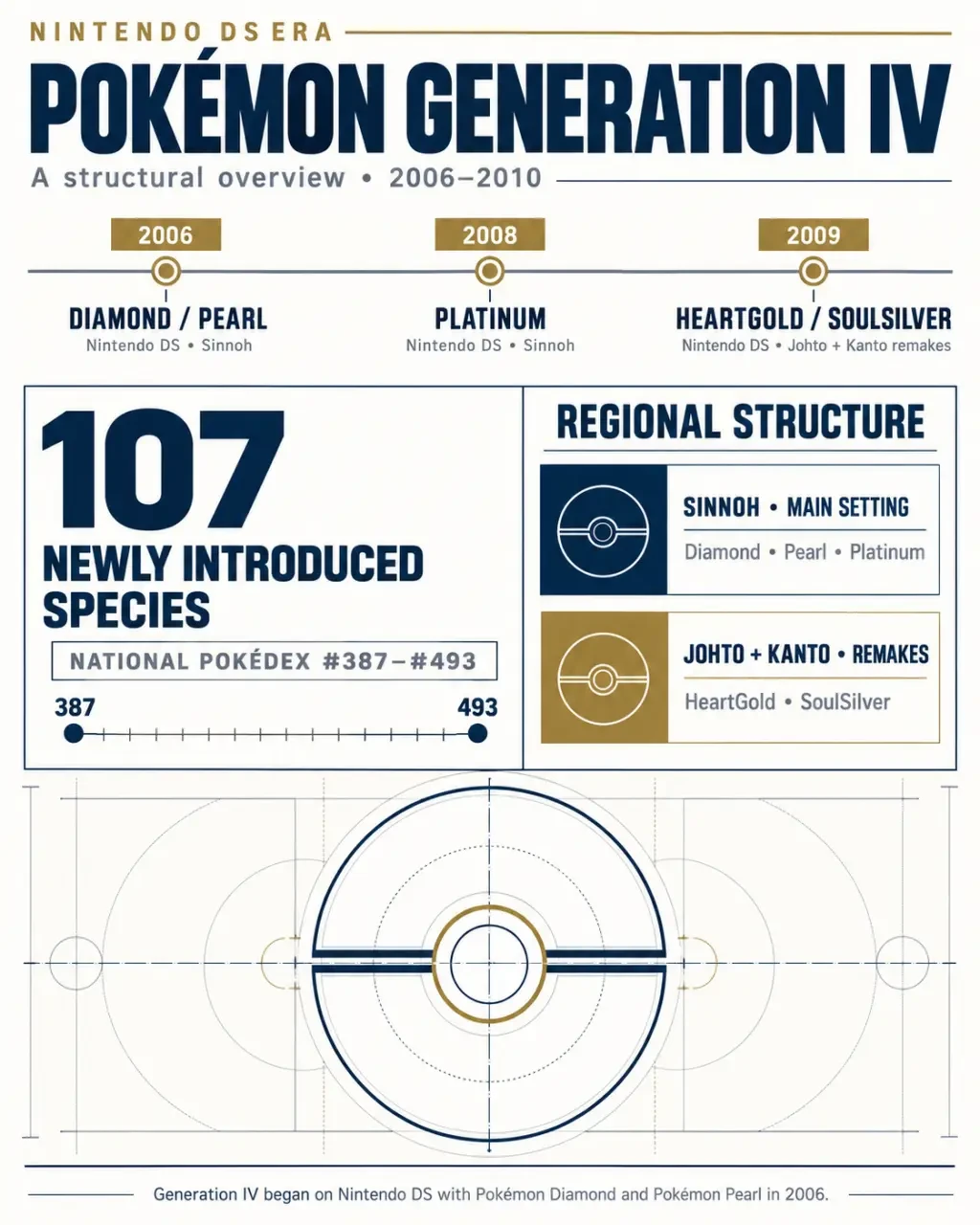
Pokémon Generation IV began with Pokémon Diamond and Pearl on Nintendo DS in 2006. It introduced Sinnoh, added 107 species numbered #387–#493 in the National Pokédex, and changed how attacks work. Its five core games also include Platinum, HeartGold, and SoulSilver: the last two revisit Johto rather than Sinnoh.
Five core games, two regional adventures
A Pokémon generation is a shared era of games and mechanics, not simply a region. That distinction explains why HeartGold and SoulSilver belong to Generation IV even though their setting and original stories come from Generation II.
| Game | Main setting | Role in Generation IV |
|---|---|---|
| Diamond | Sinnoh | Original paired release; Dialga is the cover Legendary |
| Pearl | Sinnoh | Original paired release; Palkia is the cover Legendary |
| Platinum | Sinnoh | Expanded third version featuring Giratina and the Distortion World |
| HeartGold | Johto and Kanto | Remake of Pokémon Gold |
| SoulSilver | Johto and Kanto | Remake of Pokémon Silver |
Platinum is the most expanded Sinnoh adventure of this generation, with a revised regional Pokédex and a Battle Frontier. HeartGold and SoulSilver offer a different journey, including Pokémon following the player and travel through both Johto and Kanto.
The five titles above are the core role-playing releases, not every Pokémon game of the era. Bulbapedia counts 17 games across Generation IV when the broader lineup is included. Keeping those scopes separate prevents confusion between “Generation IV games” and “Generation IV core games.”
The complete Generation IV Pokémon list, #387–#493
The National Pokédex records species across the franchise; a regional Pokédex only covers a particular adventure’s selection. Consequently, a Pokémon introduced in Generation IV is not necessarily available during every Sinnoh storyline. The following list includes all 107 newly introduced species, in National Pokédex order.
| National numbers | Pokémon, in order |
|---|---|
| #387–#395 | Turtwig, Grotle, Torterra, Chimchar, Monferno, Infernape, Piplup, Prinplup, Empoleon |
| #396–#405 | Starly, Staravia, Staraptor, Bidoof, Bibarel, Kricketot, Kricketune, Shinx, Luxio, Luxray |
| #406–#414 | Budew, Roserade, Cranidos, Rampardos, Shieldon, Bastiodon, Burmy, Wormadam, Mothim |
| #415–#423 | Combee, Vespiquen, Pachirisu, Buizel, Floatzel, Cherubi, Cherrim, Shellos, Gastrodon |
| #424–#432 | Ambipom, Drifloon, Drifblim, Buneary, Lopunny, Mismagius, Honchkrow, Glameow, Purugly |
| #433–#442 | Chingling, Stunky, Skuntank, Bronzor, Bronzong, Bonsly, Mime Jr., Happiny, Chatot, Spiritomb |
| #443–#452 | Gible, Gabite, Garchomp, Munchlax, Riolu, Lucario, Hippopotas, Hippowdon, Skorupi, Drapion |
| #453–#462 | Croagunk, Toxicroak, Carnivine, Finneon, Lumineon, Mantyke, Snover, Abomasnow, Weavile, Magnezone |
| #463–#471 | Lickilicky, Rhyperior, Tangrowth, Electivire, Magmortar, Togekiss, Yanmega, Leafeon, Glaceon |
| #472–#479 | Gliscor, Mamoswine, Porygon-Z, Gallade, Probopass, Dusknoir, Froslass, Rotom |
| #480–#486 | Uxie, Mesprit, Azelf, Dialga, Palkia, Heatran, Regigigas |
| #487–#493 | Giratina, Cresselia, Phione, Manaphy, Darkrai, Shaymin, Arceus |
Starters and connections to older species
The Sinnoh starters are Turtwig, Chimchar, and Piplup. Their final evolutions have distinct combinations: Torterra is Grass/Ground, Infernape is Fire/Fighting, and Empoleon is Water/Steel. All three starter species can learn Stealth Rock through TM compatibility, an unusually useful shared option for otherwise different evolutionary lines.
Generation IV also introduced 29 evolutions for Pokémon from previous generations, its largest such expansion. Examples include Weavile for Sneasel, Magnezone for Magneton, and Leafeon and Glaceon for Eevee. Evolution requirements vary: some depend on a held item and trade, others on a move, location, stone, or time of day. Do not assume modern evolution methods apply unchanged to the DS games.
Legendary and Mythical Pokémon: which belong to which group?
Dialga, Palkia, and Giratina anchor Sinnoh’s mythology, representing time, space, and antimatter respectively. Their original types are Steel/Dragon, Water/Dragon, and Ghost/Dragon. Giratina’s Altered and Origin Formes are forms of one species, not separate Pokédex entries.
- Lake guardians: Uxie #480, Mesprit #481, and Azelf #482.
- Other Legendary Pokémon: Dialga #483, Palkia #484, Heatran #485, Regigigas #486, Giratina #487, and Cresselia #488.
- Mythical Pokémon: Phione #489, Manaphy #490, Darkrai #491, Shaymin #492, and Arceus #493.
“Mythical” is a classification, not merely another word for powerful. Historically, these Pokémon were generally associated with special distributions or unusual acquisition methods rather than ordinary encounters. Phione is an important exception in practice: it can be obtained by breeding Manaphy or Phione with Ditto, but Phione does not evolve into Manaphy.
For an original-cartridge collection, separate species identity from present-day availability. An event described in an old walkthrough is not necessarily still accessible officially. Likewise, owning Diamond, Pearl, or Platinum does not by itself provide every Mythical Pokémon.
The mechanical changes that distinguish Generation IV
Physical and special attacks became move-specific
In Generation III, a damaging move’s type determined whether it used physical or special stats. Generation IV changed that: each move has its own damage category. Waterfall is physical, while Surf is special, despite both being Water-type moves. This lets players match attacks more closely to a Pokémon’s Attack or Special Attack rather than relying on type alone.
Team switching also works like a pressure valve: a well-chosen defensive switch releases an opponent’s offensive momentum, but entry hazards charge a cost each time that valve opens. Stealth Rock makes this especially important because its damage depends on the incoming Pokémon’s Rock weakness. When building a team, consider not just whether a Pokémon survives one attack, but whether it can afford repeated entries into battle.
Transfers connected eras without making them interchangeable
Generation IV can receive Pokémon from compatible Generation III cartridges through Pal Park, including eligible held items. Pokémon can subsequently move from Generation IV to Generation V through Poké Transfer, but these are one-way transfers, not ordinary backward-compatible trades. The later transfer does not carry held items. Hardware requirements and game progress also matter.
This era introduced legitimate level 1 Pokémon through breeding, replacing the earlier level 5 hatch standard. Its Nintendo DS connectivity also supported online trading and battling, although the original Nintendo Wi-Fi Connection service is no longer operating. Historical online features should therefore not be mistaken for currently available official services.
Reading types, abilities, and base stats without mixing generations
A modern Pokédex entry may not describe the original DS rules. For example, Togekiss is Normal/Flying in Generation IV, not Fairy/Flying; Fairy did not yet exist. Hidden Abilities also arrived later, so a modern ability listing can include options unavailable in these games.
Base stats are listed in this order: HP, Attack, Defense, Special Attack, Special Defense, Speed. They describe a species’ underlying strengths, not an individual Pokémon’s exact displayed stats, which also depend on level, nature, individual values, and effort values.
| Pokémon | Generation IV type | Ability | Base stats in that order |
|---|---|---|---|
| Turtwig #387 | Grass | Overgrow | 55 / 68 / 64 / 45 / 55 / 31 |
| Chimchar #390 | Fire | Blaze | 44 / 58 / 44 / 58 / 44 / 61 |
| Piplup #393 | Water | Torrent | 53 / 51 / 53 / 61 / 56 / 40 |
| Garchomp #445 | Dragon/Ground | Sand Veil | 108 / 130 / 95 / 80 / 85 / 102 |
| Arceus #493 | Normal; changes with Plates | Multitype | 120 / 120 / 120 / 120 / 120 / 120 |
For practical lookup, start with the National Pokédex number, then check the game-specific type, ability, moves, and evolution method. That sequence avoids the most common mistake: applying a correct modern fact to a Generation IV cartridge where it does not yet apply.