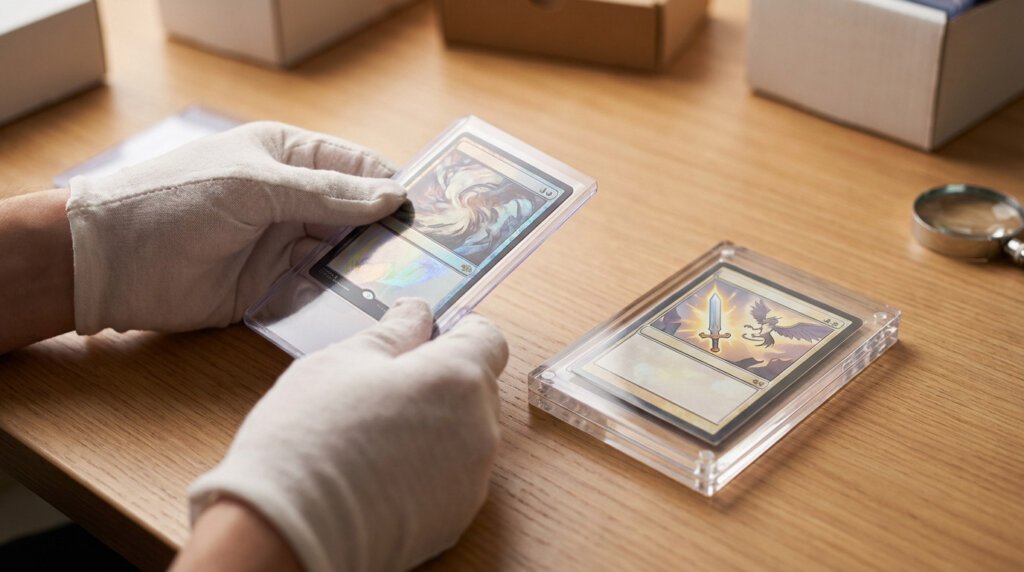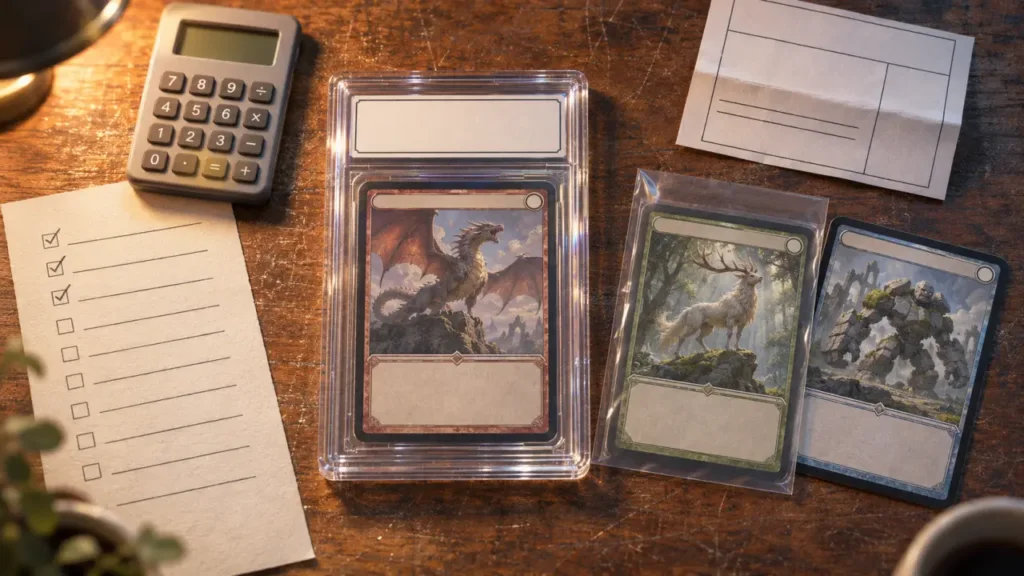
Pokémon card grading combines authentication, condition assessment, and a protective holder. The right service depends on your card’s likely value, the detail you want from its grading report, and whether you prefer direct submission or retail drop-off. Before paying, compare the full cost—not just the advertised grading fee—and allow for a result below your hoped-for grade.
Decide whether your card deserves the grading fee
Start with your purpose. A childhood favorite may be worth grading for preservation and display even if the financial return is modest. A card intended for resale needs a stricter calculation: its likely selling price after grading must justify submission costs and selling expenses.
Pokémon Card Grading Cost Calculator
Estimate submission costs using your own details and rates. All entered rates and values are estimates.
Submission details
Estimated costs
Optional sale estimate
Estimated results
Total cost = (number of cards × grading fee per card) + shipping + insurance + membership fees + surcharges + selling expenses. This calculator cannot predict the final grade, resale price, or profit. Results are estimates, not a recommendation or provider ranking.
Identify the exact card before researching prices. Match its set, collector number, language, edition, and foil treatment. Compare completed sales rather than optimistic asking prices, and look at several possible grades instead of assuming a perfect result. A price guide is a reference, not a guaranteed buyer.
Inspect condition without trying to improve it
Under good lighting, examine the front and back, tilting the card to reveal surface marks. Check these four areas:
- Centering: how evenly the printed design sits within its borders.
- Corners: bends, whitening, wear, or damaged tips.
- Edges: chips, whitening, and other visible damage.
- Surface: scratches, dents, creases, stains, or print lines.
A fresh pull is not automatically a top-grade card. Manufacturing defects and handling damage can affect its condition. Do not polish, recolor, press, or otherwise alter a card to chase a higher grade; PSA describes checking for doctoring, including trimming and recoloring.
Treat your first submission like an access ramp rather than a leap: send a small, deliberate batch before committing your collection. Include cards you have inspected and photographed, then compare your observations with the returned grades and any defect reports. This creates a useful calibration exercise and limits the cost of discovering that your personal definition of “mint” differs from the grader’s.
Compare grading companies by what you actually receive
Authentication and grading answer different questions. Authentication assesses whether a card is genuine; grading evaluates its condition. PSA describes authentication first, followed by grading and encapsulation. A counterfeit or altered card should not be assumed to qualify for a normal numerical grade.
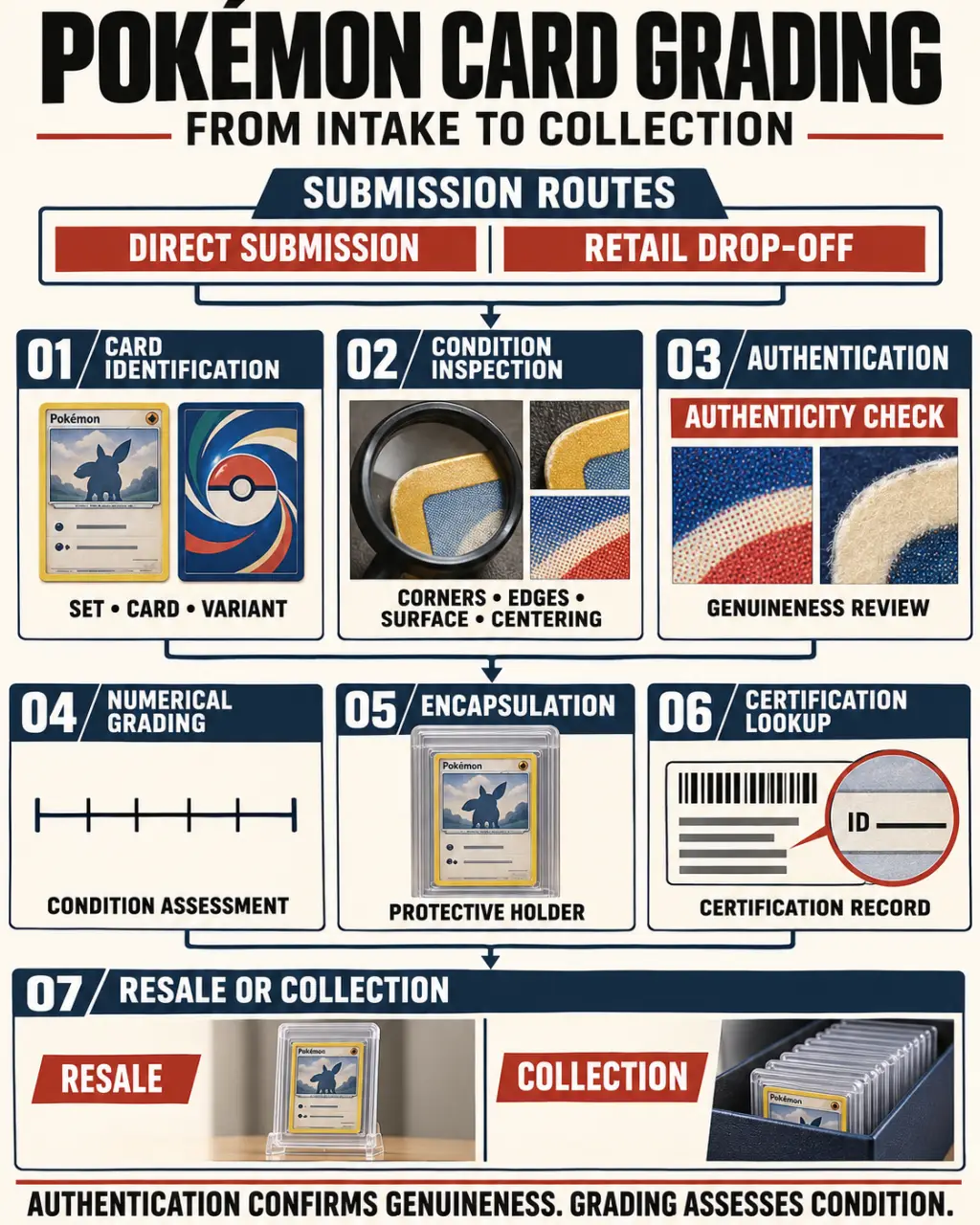
The providers below differ in reporting, submission access, and supporting tools. GameStop is a submission route to PSA, not a separate grading company.
| Provider or route | Main distinction | What to check before paying |
|---|---|---|
| PSA direct | 1–10 scale, certification, price-guide and registry resources | Service-tier value limits, shipping, and whether notes or imaging are included |
| CGC Cards | Gem Mint 10 and Pristine 10 designations; certification lookup with holder images | Current fees, eligible cards, turnaround, and guarantee terms |
| TAG | 1–10 grade and digital reporting; additional 1000-point TAG Score through DIG Plus | Card eligibility, report package, current pricing, and submission requirements |
| GameStop to PSA | Participating-store drop-off and pickup, with PSA performing grading | Store participation, value-based fees, preparation rules, and estimated completion |
TAG says its Photometric Stereoscopic Imaging supports defect identification and centering measurements. Its Card Vision feature offers up to 800% zoom, while DIG reports provide images and grading information. These are useful inspection features, but technology-led reporting does not make different companies’ grades interchangeable.
For resale, examine completed sales for your particular card in each company’s holder. For collecting, prioritize the holder, report detail, verification tools, and service experience you prefer.
Calculate the full bill and a realistic waiting period
There is no universal Pokémon card grading price. Fees depend on the provider, service tier, card value, and submission route. Add shipping, applicable insurance, membership costs if required, and possible value-based adjustments before comparing offers.
PSA Card Grading Explained: Criteria, Costs, and Process · Learn how PSA evaluates card condition, including corners, edges, centering, surface quality, and grading fees.
Understand declared value before choosing a tier
GameStop defines declared value as the estimated dollar value after authentication and grading. Its listed route costs $39.99 per card plus $9.99 shipping per order, with an additional fee if a card is worth more than $500. Its FAQ specifies $5 off shipping for Pro members. Confirm the applicable offer and terms before drop-off.
For example, three cards at those listed rates total $129.96 before tax, membership discounts, or additional charges. For resale, subtract grading, shipping, marketplace fees, and other selling expenses from the expected proceeds—not just the per-card grading charge.
High-value tiers are a different category. PSA lists Premium 1 at $999 per card for a maximum insured value of $25,000 or less, with an estimated turnaround of 5–7 business days. That is a specialized premium option, not a representative price for an ordinary Pokémon submission.
Compare door-to-door time, not just grading time
GameStop lists an estimated turnaround of 90–100 business days for its route. PSA’s stated turnaround estimates are not guaranteed and may change. Ask when the processing clock starts and whether the quoted period excludes shipping, intake, or retailer handling. A faster tier may shorten grading time without eliminating the rest of the journey.
Prepare and submit cards without adding avoidable risk
Read the chosen service’s current instructions before buying supplies. GameStop’s described route accepts standard cards measuring 2.5 in × 3.5 in and requires penny sleeves and card savers. Do not assume another provider accepts identical packaging or every Pokémon card format.
- Document each card. Photograph both sides and record identifying details and visible damage.
- Complete the submission accurately. Match card descriptions, service levels, declared values, and the physical submission order.
- Protect cards carefully. Insert them gently into the required sleeves and holders without forcing corners.
- Pack according to instructions. Prevent movement and use the provider’s required paperwork and protective materials.
- Keep evidence of handover. Retain receipts, tracking numbers, submission references, and shipping coverage details.
For retail submissions, clarify responsibility and coverage during transit, processing, and storage. For direct shipping, check carrier and insurance conditions rather than assuming declared value automatically provides equivalent compensation.
Track delivery separately from grading progress. CGC offers package-delivery confirmation, while GameStop provides submission tracking through My Orders. A delivered parcel may still need intake processing before individual cards appear in the grading workflow.
Check the returned slab, certification, and report
Encapsulation seals the assessed card inside a protective holder, commonly called a slab. PSA places the grade and certification number on its LightHouse label. CGC certification verification can display the card description, grade, and holder images; TAG offers certification lookup and digital report access.
On arrival, compare the card, label, and online record. Check the set, number, language, and variant, then inspect the holder for damage or signs of interference. A matching certification number is useful, but should be considered alongside the physical card and holder—not treated as proof on its own.
Read any available defect notes and images before judging the result. Population reports count recorded graded examples; they do not measure all surviving copies or guarantee scarcity. Likewise, CGC’s authenticity and grade guarantee has terms worth reading rather than assuming unlimited coverage.
Grading can support authentication, protection, and selling, but it does not guarantee a higher value or profit. Choose a service whose total cost and features fit your purpose, and submit only when you can accept a lower-than-expected outcome.