Pokémon Crystal is the enhanced third and final core-series game of Generation II. Developed by Game Freak and published by Nintendo, it follows the same broad adventure as Pokémon Gold and Silver, but adds enough new content to stand on its own. Kris, animated battle sprites, a Suicune-focused storyline, and the Battle Tower give the Game Boy Color title a distinct identity for returning players and collectors.
Why Pokémon Crystal stands apart from Gold and Silver
Crystal preserves the essential Generation II experience. You begin in New Bark Town, choose Chikorita, Cyndaquil, or Totodile, collect eight Johto Gym Badges, confront Team Rocket, and challenge the Elite Four. Afterward, the adventure expands into Kanto, where eight more badges lead to the game’s defining final battle against Red at Mt. Silver.
Official Nintendo 3DS eShop Closure and Purchase Availability · Official Nintendo support information confirming the 3DS eShop closure and explaining which digital purchases remain available.
The main differences concern presentation, character choice, and story focus. Gold and Silver are paired versions built around different mascot Legendary Pokémon. Crystal reshapes selected events, gives Suicune a dedicated narrative thread, and adds replayable content for players who already knew Johto.
| Feature | Pokémon Crystal | Pokémon Gold and Silver |
|---|---|---|
| Player character | Choose a male trainer or Kris, the female protagonist | Male protagonist only |
| Battle presentation | Animated Pokémon sprites during battles | Static battle sprites |
| Suicune | Expanded storyline involving Eusine and a dedicated encounter | One of the roaming Legendary beasts |
| Battle Tower | Available as a repeatable challenge area | Not included |
| Game hardware | Game Boy Color exclusive | Playable on the original Game Boy |
Kris and animated sprites were meaningful additions
Kris was the first selectable female protagonist in a core Pokémon game. The choice does not rewrite the entire plot, but it gives more players a way to see themselves in the journey. Animated sprites are similarly modest but memorable. A Pokémon’s brief movement at the start of battle makes the small Game Boy Color screen feel more alive without changing the familiar turn-based combat.
Suicune becomes a destination, not a coincidence
In Gold and Silver, Suicune, Entei, and Raikou roam Johto after their release from the Burned Tower. Finding them depends on chance, tracking, and preparation. Pokémon Crystal gives Suicune a more deliberate arc through Eusine, a Trainer devoted to pursuing it. The story builds toward the Clear Bell and Tin Tower, giving one of the three Legendary beasts a narrative payoff instead of leaving every encounter to the roaming system.
A Johto journey that keeps going into Kanto
The scale of Pokémon Crystal remains one of its clearest strengths. Johto offers a complete regional adventure with its own towns, caves, routes, Gym Leaders, and Pokémon League. Team Rocket’s takeover of the Goldenrod Radio Tower creates the central late-game conflict, while locations such as the Ruins of Alph reward slower exploration with Unown puzzles and hidden lore.
Defeating the Elite Four and Champion Lance is not the end. Travel to Kanto opens a second region with its own Gym Leaders, returning locations, and another layer of progression. After you defeat all eight Kanto Gym Leaders, Mt. Silver becomes accessible. Red waits there as the game’s ultimate optional challenge.
Why the 16-badge structure still feels special
Sixteen badges do not simply mean twice as many battles. The transition to Kanto changes the game’s rhythm. You revisit a familiar region from Generation I with a stronger team and a different perspective. Some locations have changed, and the climb to Mt. Silver turns the post-game into a genuine conclusion rather than a short victory lap.
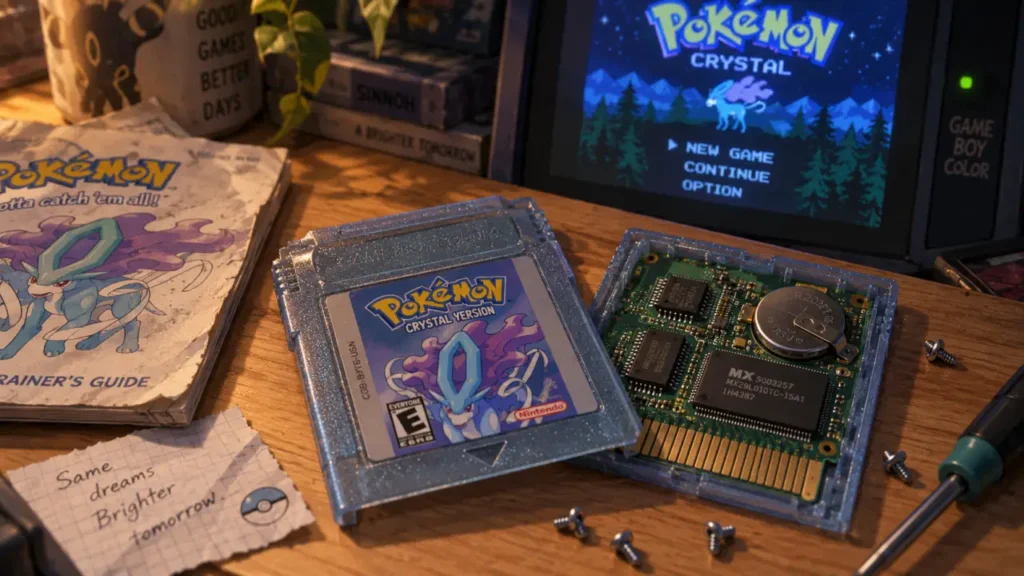
The physical design also gives collectors useful clues when they inspect a cartridge. Look for a label that sits evenly in the shell recess, has consistent print sharpness, and does not obscure the screw points. Adhesive residue, unusual trimming, a poorly aligned label, or a shell that looks different from the expected design can warrant closer inspection. These details help separate ordinary wear from possible warning signs before you power the game on.
Battle Tower, trading, and features built around replaying
Crystal adds the Battle Tower, a facility for Trainers who want structured battles after the main quest. Players enter with three Pokémon and face a run of seven trainers. The attraction is not another story chapter, but the pressure of building a reliable team. Type coverage, dependable moves, sensible held items, and a plan for unpredictable opponents all matter.
Trading remains part of completing Generation II
As with other classic Pokémon games, no single version contains every Pokémon needed for a complete Pokédex. Crystal supports trading and battling with Pokémon Gold, Silver, Red, Blue, and Yellow, subject to the usual generation and move compatibility limits. A link cable, another cartridge, or a trusted trading partner was therefore part of the original social experience.
Crystal can also connect with Pokémon Stadium 2 through the Transfer Pak, allowing teams to be used on Nintendo 64. In Japan, the game additionally supported the Mobile Adapter GB and Mobile System GB. These services offered trading, battles, news, quizzes, minigames, and battle replays, with a per-minute connection fee plus feature charges ranging from ¥10 to ¥100. The Mobile System GB was discontinued on December 18, 2002, so these functions are mainly of historical interest today.
Where Pokémon Crystal can be played now
The original release arrived in Japan on December 14, 2000, followed by North America on July 30, 2001, Australia on September 30, 2001, and Europe on November 2, 2001. Unlike Gold and Silver, Crystal was made for Game Boy Color and is incompatible with the original Game Boy.
An original cartridge can run on compatible Game Boy Color hardware and on a Game Boy Advance. Pokémon Crystal also reached Nintendo 3DS Virtual Console in 2018, but that edition could no longer be purchased after the Nintendo 3DS eShop closed on March 27, 2023. For someone seeking the original experience today, compatible physical hardware and a legitimate cartridge are the most direct route.
Buying or selling a cartridge: value depends on more than the game
Pokémon Crystal sold approximately 6.3 million copies worldwide, compared with approximately 23.7 million for Gold and Silver. It remains a sought-after Generation II collectible, but its market value is not a single fixed number. A loose cartridge, a tested copy with a working save, a copy with the manual and box, and a complete-in-box copy are different products to collectors.
- Authenticity: Inspect the shell, label quality, screw type, internal board, and boot behavior. Counterfeits can look convincing in listing photos.
- Save battery: The internal battery affects whether save data is retained. Ask whether the game saves correctly and whether the battery has been replaced.
- Completeness: The original box, manual, inserts, and tray can change collector interest and sale prices.
- Condition: Label tears, sun fading, cracked plastic, corrosion, writing, and damaged box corners all matter.
- Evidence: Compare recent completed sales for copies with the same region, contents, condition, and battery status.
Observed completed-sale examples range from $268.78 to $789.99, which shows why broad price claims can mislead. Complete-in-box examples include $440.99, $450.00, $650.00, $699.99, and $789.99. One copy with a manual and box sold for $268.78, while one copy with a new battery and box sold for $501.00. These are individual sales, not guaranteed valuations.
For players, Pokémon Crystal offers a focused version of Generation II with two regions, sixteen badges, and a more developed Suicune storyline. For collectors, the cartridge’s value depends just as much on authenticity, condition, completeness, and save reliability as on the Pokémon name itself.