Pricey Pokémon cards range from scarce promotional collectibles to ordinary-looking Trainer cards players need for their decks. Some graded cards have recorded five-figure sales; useful modern singles may be worth only a few dollars but still deserve more attention than the bulk pile. The crucial distinction is between a remarkable sale and a realistic price for your exact copy.
To judge value, match the card’s set, printing, language, condition, and grade before comparing prices. A familiar Pokémon or shiny surface alone tells you surprisingly little.
Expensive Pokémon cards: what recorded sales actually show
Historical sales reveal what a particular buyer paid for a particular card at a particular time. They are useful evidence of collector demand, but they are not standing offers for every copy bearing the same name.
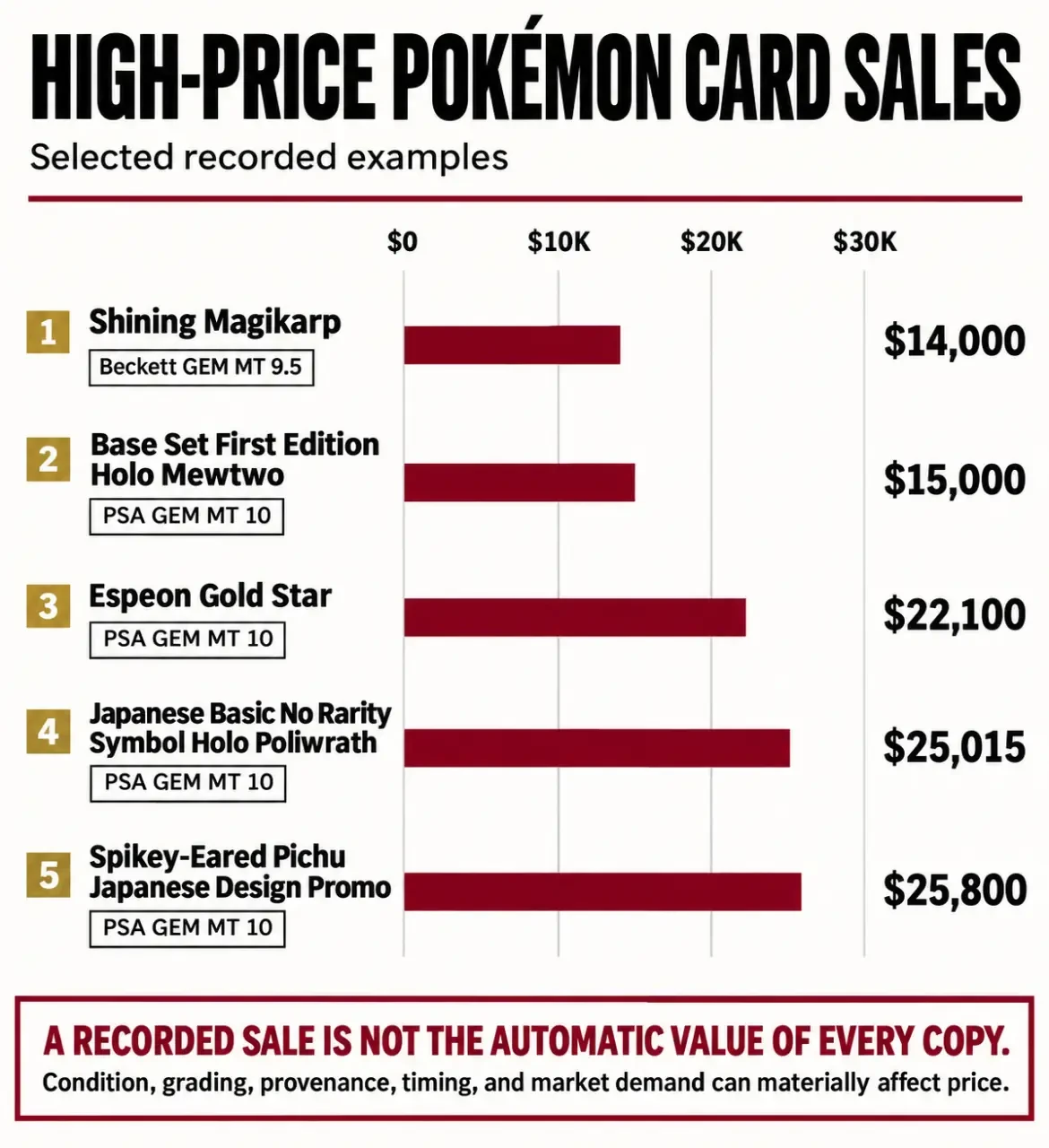
Wargamer reports the following examples. Each price belongs to the specified version and grade, not to an ungraded equivalent.
| Card | Reported sale | Date and venue | Grade |
|---|---|---|---|
| Shining Magikarp Pokémon Card Fan Club | $14,000 | May 24, 2023; venue not specified here | Beckett GEM MT 9.5 |
| Base Set First Edition Holo Mewtwo | $15,000 | April 16, 2023; Fanatics Collect | PSA GEM MT 10 |
| Espeon Gold Star | $22,100 | February 2021; eBay | PSA GEM MT 10 |
| Japanese Basic No Rarity Symbol Holo Poliwrath | $25,015 | 2020; Fanatics Collect | PSA GEM MT 10 |
| Spikey-Eared Pichu Japanese Design Promo | $25,800 | June 2023; Fanatics Collect | PSA GEM MT 10 |
These examples highlight different kinds of scarcity: a promotional release, an early printing characteristic, a collectible treatment, and exceptional condition. None establishes an automatic price floor for related cards.
For a current purchase or sale, look beyond the headline. Check whether the transaction was completed, whether the listing matches the stated grade, and whether newer comparable sales support the result. A single exceptional auction can be a poor benchmark for an otherwise thinly traded card.
Identify the exact printing before looking at prices
Searching only “Mewtwo card value” mixes unrelated products. Even cards with matching artwork can differ by edition, language, finish, or release. Start with the physical card rather than the highest number in search results.
Official Pokémon TCG Card Database · Search and explore Pokémon cards by type, Energy, format, expansion, and more.
- Record the name and collector number. Include the full number as printed, including any denominator or prefix.
- Confirm the set. Compare the set symbol and card number with a checklist.
- Check language and edition markings. First Edition and other printing distinctions must match the comparison.
- Identify the finish. Separate normal, Holo, Reverse Holo, and special-pattern versions.
- Record condition or the complete grading label. Keep raw and professionally graded copies in separate comparisons.
PriceCharting offers name-and-number searches, photo-based search, and set checklists. Image search is a useful starting point, but manually confirm small printing details before accepting a match.
Condition is more than whether the front looks clean
Inspect the back, edges, corners, and surface under good light. Whitening, scratches, creases, and dents matter even when the artwork looks attractive. Photograph visible defects rather than assuming a card qualifies as Near Mint because it has spent years in a binder.
A PSA or BGS grade adds another comparison requirement: match the grading organization and exact label. An ungraded card that appears excellent is not automatically equivalent to a PSA GEM MT 10. Before paying for grading, compare plausible outcomes and the total submission expense rather than assuming the highest grade.
Why ordinary-looking cards can escape the bulk pile
Collector demand and playing demand are different markets. Nostalgia, favorite Pokémon, artwork, and scarce releases can support collectible premiums. Competitive players may instead need multiple copies of a useful card, giving a Common or Uncommon meaningful value without making it a trophy collectible.
TCGplayer’s report of the 100 most expensive in-scope bulk cards illustrates this distinction. Its Market Prices are dated April 20, 2026, cover Rare, Uncommon, and Common cards from Temporal Forces forward, and apply to Near Mint copies. Normal and Reverse Holo printings are treated separately.
| Card and printing | TCGplayer Market Price |
|---|---|
| Night Stretcher Reverse Holo | $2.81 |
| Hilda, White Flare, Reverse Holo | $2.27 |
| Hilda, White Flare, normal | $2.11 |
| Team Rocket’s Petrel Reverse Holo | $1.59 |
| Lillie’s Determination Reverse Holo | $1.37 |
| Brock’s Scouting Reverse Holo | $1.26 |
| Poké Pad, Ascended Heroes, normal | $1.05 |
| Munkidori Reverse Holo | $0.95 |
| Poké Pad, Perfect Order, Reverse Holo | $0.85 |
| Gengar, Perfect Order, Reverse Holo | $0.85 |
This is not an all-time ranking of expensive Pokémon cards. The report excludes specified special-pattern Reverse Holo cards from Prismatic Evolutions, Black Bolt, White Flare, and Ascended Heroes. Its prices are a dated snapshot, not a promise of today’s proceeds.
Think of demand as an access ramp into the market: an inexpensive playable printing lets many buyers participate, while a premium finish appeals to a narrower collecting audience. When a reprint widens that ramp, players may gain a cheaper route to the same gameplay effect. Check whether buyers want the card’s function or that exact collectible version before assuming both prices will move together.
Build a usable price range, not a fantasy valuation
Once identification is settled, distinguish three numbers. An asking price is what a seller wants. A market estimate is a pricing service’s indicator. A completed-sale price records a transaction. They answer different questions and should not be treated as interchangeable.
Review several recent comparable sales where possible. Match printing, language, condition, and grade; note sale dates and venues. If the only matching transaction is old, describe the valuation as uncertain rather than substituting a recent sale of a different version.
For selling, work backward from likely proceeds. Marketplace charges, shipping, packaging, and any authentication or grading expenses can change whether listing a card individually makes sense. A modestly valuable single may be better grouped with related cards, depending on those costs.
For buying, request clear front-and-back photographs and close-ups of defects. For graded cards, check that the certification details correspond to the offered card. A price database is a valuation aid, not proof of authenticity.
Track changes without mistaking estimates for cash
A collection tracker is most useful after the collection is accurately cataloged. Pokémon Wizard describes a free portfolio, price alerts, and real-time collection-value updates. Those features can help you notice changes, but a portfolio total is not a guaranteed cash offer.
Keep a simple record of each significant card’s identity, printing, condition, acquisition cost, latest comparable price, and checking date. Revisit prices before a transaction and after relevant reprints or changes in competitive demand.
The most useful next step is small: identify your strongest candidates, verify their versions, and compare completed sales. Accurate matching beats an exciting headline price—whether you are protecting a childhood favorite, buying a collectible, or deciding which cards deserve individual listings.